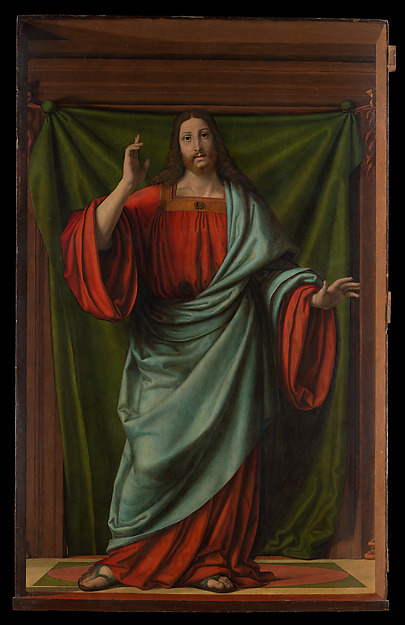
Painter of the Bible
Andrea Solario
Andrea Solario was a Lombard painter active in Milan, Venice, and France in the late Quattrocento and early Cinquecento — one of the principal Italian painters whose work bridged the Northern Italian tradition of soft sf…
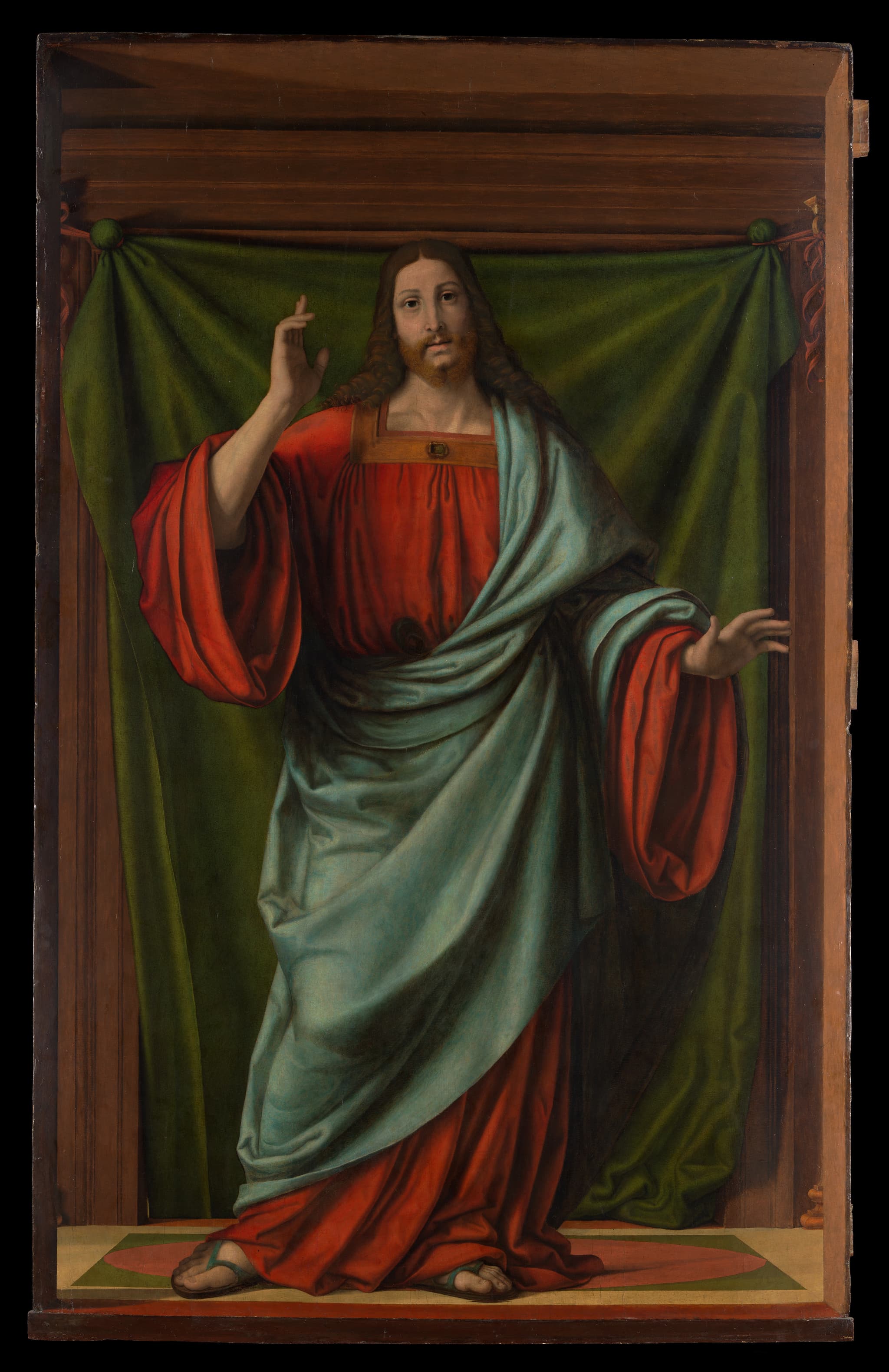 Christ Blessing
Their faith
Why Andrea Solario painted Christ
Andrea Solario, born into a family of stonecutters in Milan, was deeply influenced by the rich artistic traditions of his homeland, which were steeped in Christian faith. Though specific details of his personal beliefs are scarce, his body of work reveals a profound reverence for sacred subjects. Solario's altarpieces and devotional panels, crafted with meticulous technical refinement, reflect a commitment to portraying the divine with beauty and grace. His exposure to the works of Antonello da Messina and the influence of Leonardo's workshop suggest that he approached his art as a form of worship, channeling his devotion into every brushstroke. The intimate nature of his paintings, often designed for personal devotion, speaks to a spiritual practice that sought to draw viewers closer to God through visual contemplation.
Solario's faith is particularly evident in works such as "The Crucifixion" and "Madonna with the Green Cushion," where he captures the emotional depth and sacred significance of these scenes. In "The Crucifixion," the somber tones and poignant expressions invite viewers to reflect on Christ's sacrifice, while the tender portrayal of the Virgin and Child in "Madonna with the Green Cushion" conveys warmth and maternal love, embodying the essence of Christian compassion. His smaller panels, like the intimate depictions of Salome, resonate with a quiet authority that invites personal reflection and connection to the divine. Through his art, Solario's devotion continues to inspire and uplift, reminding us of the beauty and grace found in the sacred narratives of our faith.
Life & work
Andrea Solario was a Lombard painter active in Milan, Venice, and France in the late Quattrocento and early Cinquecento — one of the principal Italian painters whose work bridged the Northern Italian tradition of soft sfumato modeling and warm color with the new Florentine and Venetian High Renaissance vocabulary. Born in Milan around 1465 to a family of stonecutters and sculptors (his older brother Cristoforo Solario was an important Lombard sculptor), trained in Milan and almost certainly with significant exposure to the work of Antonello da Messina during a Venetian sojourn in the early 1490s, he was active across northern Italy and made a documented working trip to France in 1507–1509 in the service of Cardinal Georges d'Amboise at the Château of Gaillon. He died in Milan around 1524.
His Christian religious work is concentrated in altarpieces and small devotional panels of unusual technical refinement. The Crucifixion (Louvre, 1503), the Madonna with the Green Cushion (Louvre, c. 1507–1510), the Christ Carrying the Cross (Borghese), the Virgin and Child (Brera, c. 1510), the Salome with the Head of John the Baptist (Metropolitan Museum, c. 1507), the Saint Catherine of Alexandria (Brera), and a sequence of small Madonna-and-Child panels and Ecce Homo half-figures circulated through the Lombard, French, and Venetian markets and ended up scattered across the great European and American collections.
The Salome compositions in particular — small, intimate panels of a young woman holding a platter on which the head of John the Baptist sits, often against a soft hilly Lombard landscape — became one of the most-reproduced and most-copied Italian Renaissance treatments of the subject and were imitated by his pupils and by other Lombard painters for a generation.
His French sojourn left frescoes at the Château of Gaillon (the chapel decoration commissioned by Cardinal d'Amboise, since destroyed) and a small group of paintings now in French collections. His personal style — soft modeling, warm flesh, deep saturated drapery color, and a Northern Italian feeling for atmospheric landscape — combined the Lombard inheritance of Leonardo's Milanese workshop years (Solario was not a direct pupil but worked in close stylistic dialogue with Leonardo's Milanese followers) with the older Northern Italian tradition descending from Antonello da Messina and the Vivarini.
He never quite became a major name in his own century outside Lombardy, but the small panels — the Madonnas, the Salomes, the Ecce Homos — have a quiet jewel-like authority that has secured him a place in every serious survey of early Cinquecento Italian religious painting.
Notable works in detail
met-437699
Salome with the Head of Saint John the Baptist, painted by Andrea Solario in 1507 in oil on panel and now in the Metropolitan Museum of Art in New York, depicts the moment after the beheading of John the Baptist as recorded in Mark 6 — the young Salome receiving the head of the Baptist on a platter at the request of her mother Herodias, who had instigated the killing. Solario stages the scene as a small intimate vertical composition: Salome in three-quarter view holding the platter on which the head rests, an attendant servant standing behind her, the executioner visible in the deeper background having returned with his work done. The chromatic palette of pale flesh, deep crimson, and warm ochre against a darkened ground is characteristic of Solario's mature Lombard manner. The painting belongs to the Salome compositions in which Solario specialized — a particular Lombard-into-French Renaissance type that he produced in multiple workshop variants for private patrons.
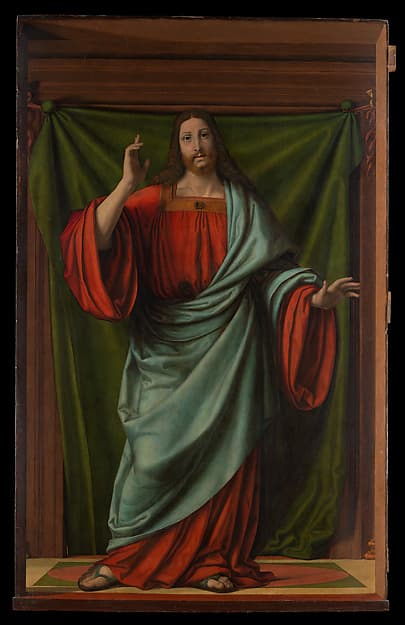
Christ Blessing, painted by Andrea Solario in 1519 in oil on panel and now in the Metropolitan Museum of Art in New York, depicts the half-length figure of Christ in three-quarter view raising his right hand in benediction and holding a transparent crystal globe surmounted by a small cross in his left — the iconographic Salvator Mundi composition (Christ Saviour of the World) that Lombard and Venetian painters of the early sixteenth century made into a particular specialty. Solario stages the figure against a dark neutral background with characteristic Lombard chromatic restraint — pale flesh, deep crimson robe, warm grey ground. The composition was a particular favorite of the Lombard workshop tradition descending from Leonardo's Milanese followers, and Solario produced multiple workshop variants of the Salvator Mundi type in his late career.
Bible scenes Andrea Solario painted
John