Painter of the Bible
Bernardo Strozzi
Bernardo Strozzi was the leading Genoese painter of the first half of the seventeenth century and one of the principal Italian Baroque masters whose mature career was spent largely in Venice, where he combined the Genoes…
_-_Google_Art_Project.jpg%3Fwidth%3D600&w=2048&q=75)
Their faith
Why Bernardo Strozzi painted Christ
Bernardo Strozzi, a prominent figure in the Italian Baroque movement, dedicated much of his life to the Capuchin Franciscan order after entering it in 1597. This strict branch of the Franciscans emphasized a life of humility, prayer, and service, which deeply influenced Strozzi's artistic vision. His years as a friar were marked by a devotion to scripture and the teachings of Christ, which he translated into his art. Even after leaving the order around 1630, the spiritual principles he embraced remained integral to his work, reflecting a profound commitment to his faith throughout his life.
Strozzi's faith is vividly expressed in his religious paintings, such as the poignant "Pietà" and the evocative "Saint Lawrence Distributing the Treasures of the Church." In these works, he employs a rich color palette and dramatic chiaroscuro, techniques that not only showcase his technical prowess but also convey deep emotional resonance. His portrayal of saints and biblical figures, often depicted with a sense of introspection and compassion, invites viewers to reflect on their own spiritual journeys. Through Strozzi's devotion and artistic mastery, he continues to inspire viewers today, reminding us of the beauty and depth of faith expressed through art.
Life & work
Bernardo Strozzi was the leading Genoese painter of the first half of the seventeenth century and one of the principal Italian Baroque masters whose mature career was spent largely in Venice, where he combined the Genoese-Flemish painterly tradition with the late Venetian color school of Veronese and Titian into a distinctive late-Baroque manner. Born in Genoa in 1581 (or 1582), trained in his native city in the workshops of the Sienese painter Cesare Corte and the Genoese Pietro Sorri, he entered the Capuchin Franciscan order in 1597 (the strict reformed branch of the Franciscans, from which he took the additional nickname Il Cappuccino — the little Capuchin), and remained a friar for some twenty years before being forced to leave the order around 1630. He moved to Venice in 1631 and worked there for the rest of his life, dying in Venice in 1644.
His Christian religious work is concentrated in altarpieces, devotional half-length figures, and small-format private devotional paintings. The Pietà (Strada Nuova, Genoa), the Saint Lawrence Distributing the Treasures of the Church (San Niccolò di Tolentino, Venice), the Saint Cecilia (Kansas City), the Madonna and Child compositions in workshop variants, the Penitent Magdalene (multiple versions in Venetian and English collections), and the late Saint John the Baptist altarpieces fill the principal late-Baroque Italian collections. His religious half-length saints, in particular — bearded Church Fathers, penitent Magdalenes, and meditative apostles painted with deep saturated chromatic palette and broad confident brushwork — became the standard mid-seventeenth-century Venetian devotional type and were collected in editions across Catholic Europe.
His personal style — combining the dense Caravaggesque chiaroscuro of his Genoese training with the warm chromatic palette and broad painterly brushwork of the Venetian late-Renaissance tradition — anticipated by a generation the loose painterly handling that would define the early Italian eighteenth century. He was particularly admired in his lifetime for his portrait painting; his portraits of Venetian patricians and ecclesiastical patrons gave him a wide international clientele in the 1630s and early 1640s.
He left a productive Venetian workshop that continued issuing his characteristic compositions for several decades after his death.
Notable works in detail
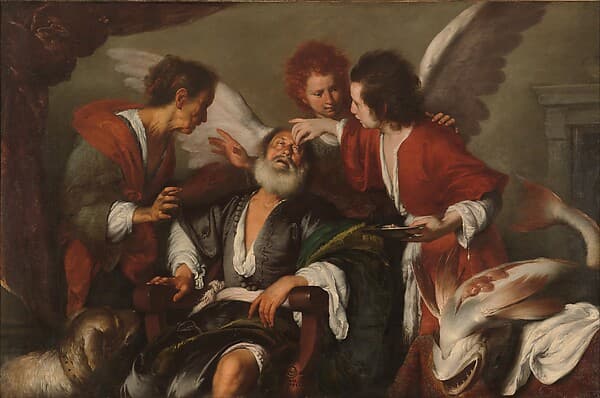
Tobias Curing His Father's Blindness
Tobias Curing His Father's Blindness, painted by Bernardo Strozzi around 1630 in oil on canvas and now in the Metropolitan Museum of Art in New York, depicts the climactic moment of the deuterocanonical Book of Tobit in which the young Tobias, instructed by the angel Raphael, applies the gall of a fish to the eyes of his blind father Tobit and restores his sight. Strozzi stages the scene as a tender intimate encounter: Tobias kneels in profile on the left applying the medicament to his father's eye, the seated Tobit in three-quarter view at the right, the angel Raphael standing behind in formal attendance with the small caught fish. The chromatic palette of warm flesh, deep crimson, and silvery cool white against the dark interior is the unmistakable mature Strozzi signature. The painting is among the principal Strozzi religious works in any American collection.
met-335981
Saint Peter, drawn by Bernardo Strozzi around 1620 in pen and brown ink with wash on paper and now in the Metropolitan Museum of Art in New York, depicts the apostle in the conventional iconographic posture of the elder Church Father, a single bearded figure in three-quarter view with the keys of the kingdom (his iconographic attribute) at his side. The drawing demonstrates Strozzi's characteristic combination of broad confident pen technique with a particularly Genoese-Caravaggesque dramatic figural intensity, and is among the principal Strozzi preparatory drawings in any American collection. Saint-portrait drawings of this kind were the standard preparatory currency of seventeenth-century Italian altarpiece practice and were used as working patterns for finished painted altarpiece commissions.
Bible scenes Bernardo Strozzi painted
Tobit
