
Tobit 6
People in this chapter
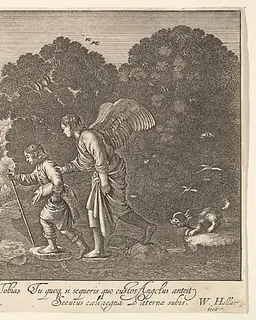
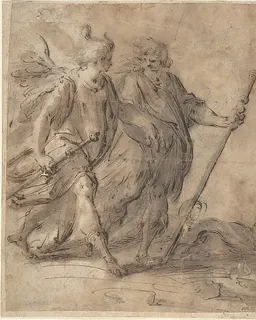
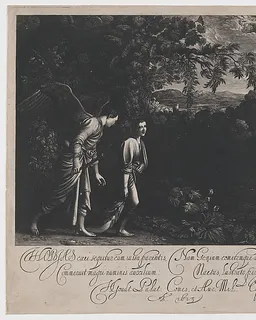
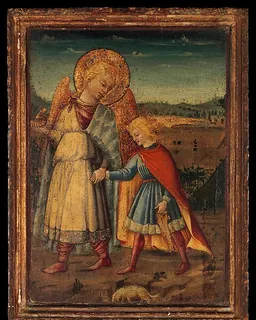
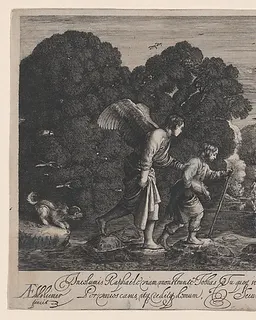
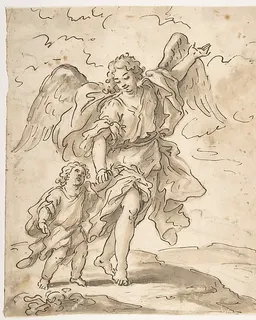
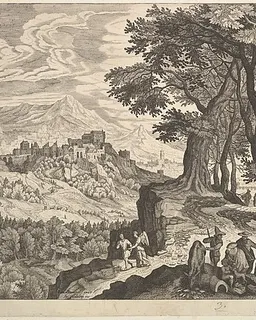
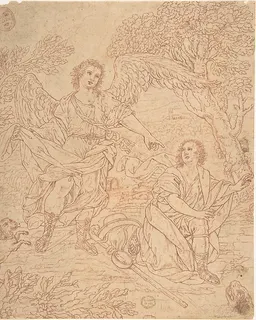
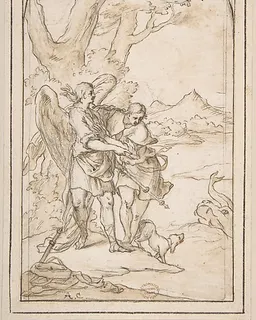
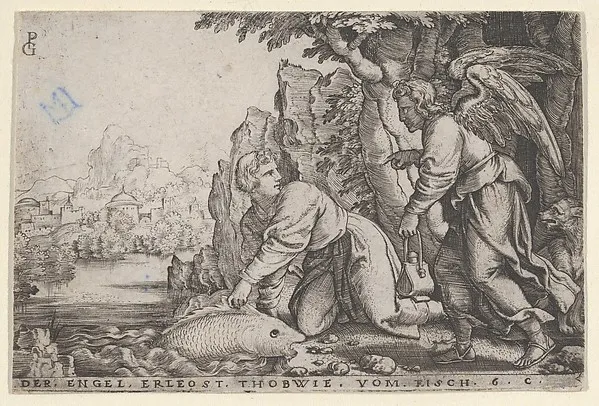
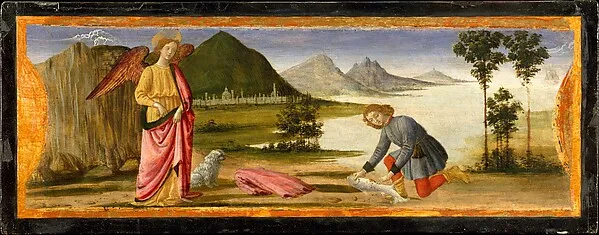
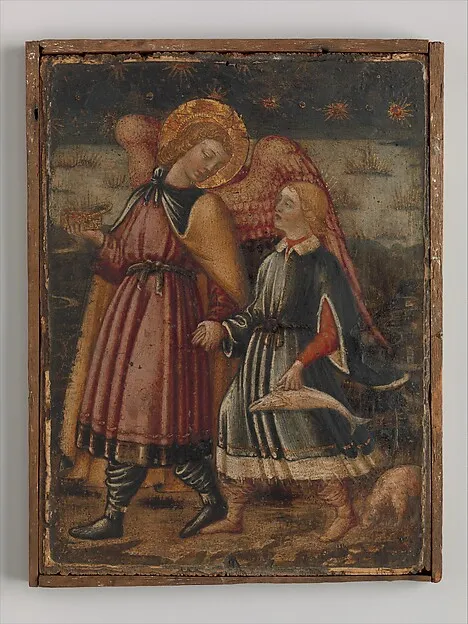
The road is where this chapter lives. Young Tobias has left his blind father behind in Nineveh and set out for a distant country to recover a debt, and walking beside him is a traveling companion who calls himself Azarias but is in truth the angel Raphael, sent in answer to a family's prayers. A dog follows along. It is an ordinary scene, two travelers and an animal by a river at nightfall, until a monstrous fish surges out of the water to devour the young man.
His cry of fear is the hinge. The angel does not remove the danger before it arrives; he meets Tobias inside it, telling him to seize the very thing that came to seize him. The fish that meant to be his end becomes his provision, its heart and gall and liver set aside as remedies for sorrows the family does not yet know how to heal.
Tap any highlighted phrase to jump to the commentary that unpacks it.
Tobit 6:1-5The Fish That Came to Devour Becomes Provision
1And Tobias went forward, and the dog followed him, and he lodged the first night by the river of Tigris. 2And he went out to wash his feet, and behold a monstrous fish came up to devour him.
The scene is drawn with tender, homely detail. A young man sets out on a road longer than any he has walked, and a dog comes with him, a small ordinary companionship that the storyteller does not think too plain to mention. God's providence in this book moves through the everyday: a debt to collect, a journey to make, a meal by a river, an animal at one's heels. The reader already knows what Tobias does not, that the man beside him is an angel and the whole journey is an answer to prayer.
Heaven is at work in the plainest things, and it usually does not announce itself.
The peace of the evening breaks open. A great fish rears up out of the Tigris as Tobias stoops to wash, and for a moment the threat is simply terrifying, a thing from the deep coming to swallow a young man alone at the water's edge. The book does not pretend the dangers of the road are imaginary. It lets the menace be real before it shows the deliverance. This is how faith is often tested: the fear comes first, sudden and large, and only afterward does the meaning of it appear.
What looks like the end of the journey is about to become its turning point.
3And Tobias being afraid of him, cried out with a loud voice, saying: Sir, he cometh upon me. 4And the angel said to him: Take him by the gill, and draw him to thee. And when he had done so, he drew him out upon the land, and he began to pant before his feet. 5Then the angel said to him: Take out the entrails of the fish, and lay up his heart, and his gall, and his liver for thee: for these are necessary for useful medicines.
Tobias does the most honest thing a frightened person can do: he cries out. There is no shame in the loud, plain cry of fear, "Sir, he cometh upon me." It is the same instinct that runs all through Scripture, the cry of someone in trouble who turns toward the one who can help. Notice that the angel does not rebuke the fear. The book never asks Tobias to feel no dread. It asks only that, in his dread, he listen and obey. The cry is the beginning of deliverance, not its enemy.
The angel's command turns the whole encounter around. Instead of fleeing the fish, Tobias is told to take hold of it, to seize the gill of the thing that came to seize him and draw it up onto the land. The creature that meant to devour now lies panting helpless before his feet. There is a deep pattern here that the faithful keep discovering: the danger faced in obedience becomes the very means of God's provision.
Tobias could not have foreseen it. He only had to do, inside his fear, what the angel told him to do, and the menace was mastered.
Now the strange gift is revealed. The fish is not merely a danger overcome; its heart, gall, and liver are to be kept, for "these are necessary for useful medicines." What attacked Tobias on the road carries within it the remedies for the two great sorrows of the story, the demon that torments Sara and the blindness that has darkened his father's eyes. God's provision was hidden inside the very thing that frightened him most.
The book invites the reader to wonder how often the trials we would have fled, had we been given the choice, were carrying the cure we needed all along.
Tobit 6:6-9The Remedies Hidden in the Catch
6And when he had done so, he roasted the flesh thereof, and they took it with them in the way: the rest they salted as much as might serve them, till they came to Rages the city of the Medes. 7Then Tobias asked the angel, and said to him: I beseech thee, brother Azarias, tell me what remedies are these things good for, which thou hast bid me keep of the fish?
The danger past, ordinary life resumes. They roast some of the fish for the journey and salt the rest to last the road ahead, the homely work of travelers provisioning themselves for the miles to Rages. The book keeps holding together two things we often imagine as separate: the miraculous and the mundane. The same fish that nearly killed Tobias now feeds him. Heaven's provision does not float above daily life; it is salted and packed and carried in a bag down a dusty road. Grace meets us in the kitchen as truly as at the riverbank.
Tobias calls his companion "brother Azarias," the human name the angel has taken for the journey. There is a striking gentleness in this hidden presence. The angel does not overwhelm Tobias with glory or demand recognition; he walks beside him as a trusted elder kinsman, teaching, guiding, answering questions. Heaven's help is often quieter than we expect, present under an ordinary name, offering counsel we can actually receive because it comes to us at our own level. Tobias trusts the one beside him enough to ask, and asking is how the wisdom of the road is gained.
8And the angel, answering, said to him: If thou put a little piece of its heart upon coals, the smoke thereof driveth away all kind of devils, either from man or from woman, so that they come no more to them. 9And the gall is good for anointing the eyes, in which there is a white speck, and they shall be cured.
The angel names the first remedy, and with it the reader begins to see how the whole story will knit together. The smoke of the fish's heart, laid upon coals, drives away the tormenting spirit. The book does not present this as a charm that works by itself; the chapters around it wrap the act in prayer and the fear of God, so that the remedy belongs to a life turned toward heaven. What matters here is the assurance the angel gives: the power that has terrorized Sara through seven marriages is not invincible.
God has already prepared, in an ordinary fish on an ordinary road, the means by which the torment will end.
The second remedy is for the eyes. The gall of the fish will heal the white film that has blinded a man, and the reader, who remembers Tobias's father sitting in darkness back in Nineveh, understands at once whose eyes these will be. Both of the family's deepest wounds, the demon and the blindness, find their cure in the single catch at the river. God's answer to two prayers was already swimming in the Tigris before Tobias ever reached its bank.
The provision was prepared ahead of the need, waiting only for the obedient hand to draw it out.
Tobit 6:10-15A Bride Waiting, and a Shadow of Death
11And the angel answering, said: Here is one whose name is Raguel, a near kinsman of thy tribe, and he hath a daughter named Sara, but he hath no son nor any other daughter beside her. 12All his substance is due to thee, and thou must take her to wife. 13Ask her therefore of her father, and he will give her thee to wife.
The angel now reveals the true destination of the journey. Beyond the debt to collect lies a person to love. Sara is the only child of Raguel, a kinswoman of Tobias's own tribe, and by the law of family inheritance the marriage would keep the household and its substance within the family line. To us this can sound like cold arrangement, but in the world of the book it is the opposite: it is belonging.
Sara is not a stranger but kin, and the marriage gathers her and Tobias into one family's continuing story. The journey for money has quietly become a journey for covenant.
The angel speaks of the marriage as something fitting and right, "thou must take her to wife." There is a sense throughout this scene that Tobias and Sara are meant for one another, that this meeting is no accident of the road but part of what God is doing. The same heaven that sent the angel and prepared the fish has also been preparing a bride. The book treats marriage as a serious and sacred good, woven into God's providence for a family and a people, not a small private matter but a thread in the larger design of blessing.
14Then Tobias answered, and said: I hear that she hath been given to seven husbands, and they all died: moreover I have heard, that a devil killed them. 15Now I am afraid, lest the same thing should happen to me also: and whereas I am the only child of my parents, I should bring down their old age with sorrow to hell.
Now the shadow falls across the joy. Tobias has heard the terrible history: seven men have taken Sara as wife, and a demon has killed every one of them. The grief behind that single sentence is immense, seven weddings turned to seven funerals, and a young woman left under a sorrow not of her own making. Tobias's fear is a clear-eyed reckoning with real danger and real death, the honest response of a sane man to a genuine threat.
The book is candid that the path God blesses can run straight through the valley of the shadow. It does not pretend the demon is not there.
What weighs on Tobias most is not his own death but his parents' grief. As their only child, his dying would "bring down their old age with sorrow" to the grave. This is the heart of a son who has watched his father suffer and cannot bear to add to it. His fear is love-shaped, bound up with the family that sent him and waits for him. The book honors this tenderness even as it prepares to lead him through the danger.
To fear for those we love is itself a form of love, the very affection that makes a faithful life worth living, and God does not despise it.
Tobit 6:16-22Take Her in the Fear of the Lord
16Then the angel Raphael said to him: Hear me, and I will shew thee who they are, over whom the devil can prevail. 17For they who in such manner receive matrimony, as to shut out God from themselves, and from their mind, and to give themselves to their lust, as the horse and mule, which have not understanding, over them the devil hath power.
The angel meets Tobias's fear not with a charm but with understanding. He will show him "who they are, over whom the devil can prevail," and in doing so he lifts the terror from the realm of blind dread into the realm of meaning. The danger is real, but it is not random or unconquerable. There is a way of entering marriage that leaves a soul exposed, and a way that is guarded. The angel's answer to fear is wisdom: not a denial that the demon exists, but a true account of where its power reaches and where it does not.
The angel describes those the demon overpowers: people who "shut out God" from their minds and give themselves to lust "as the horse and mule, which have not understanding." The image is deliberately stark. To approach marriage as mere appetite, with God shut out of the chamber, is to live below one's own God-given understanding, to behave as a creature driven only by instinct. The book does not condemn desire itself; it condemns desire unmoored from reverence, love severed from God.
Where God is shut out, the soul stands undefended. Where He is welcomed in, the demon's power finds no foothold.
18But thou when thou shalt take her, go into the chamber, and for three days keep thyself continent from her, and give thyself to nothing else but to prayers with her. 19And on that night lay the liver of the fish on the fire, and the devil shall be driven away.
Here is the heart of the angel's counsel. Before the marriage is consummated, Tobias and Sara are to give the first three nights to prayer together, entering their union upon their knees before God. The remedy of the fish is real, but it is set within something larger: a marriage begun in shared prayer, where the first act of the two as one is to seek God together. The book pictures the safest possible threshold to married life, husband and wife side by side before the Lord, asking His blessing and His protection.
What guards the marriage is not chiefly the smoke from the fire; it is the God to whom they pray.
The angel promises that the tormenting spirit will be driven away. The dread that has shadowed seven marriages will be broken, and Sara, so long bound by grief and fear, will be set free. The reader feels the weight of the promise: this young woman, who through no fault of her own has buried seven bridegrooms, is about to be released into the life that was always meant for her. The same God who prepared the fish prepares the deliverance. What no human power could overcome, heaven undoes, and a long captivity to fear comes to its end.
20But the second night thou shalt be admitted into the society of the holy Patriarchs. 22And when the third night is past, thou shalt take the virgin with the fear of the Lord, moved rather for love of children than for lust, that in the seed of Abraham thou mayst obtain a blessing in children.
The angel frames the marriage as a joining to something far older than the two of them. To be "admitted into the society of the holy Patriarchs" is to take a place in the long line of the faithful, the family of Abraham, Isaac, and Jacob, whose covenant runs down the generations. Tobias and Sara are not beginning a private story; they are stepping into the great stream of God's promise to His people.
Marriage here is generational and covenantal, a link forged between the fathers who went before and the children yet to come. The two who pray in the chamber are joining hands with all who have kept the covenant.
The angel's counsel reaches its summit. Tobias is to take Sara "with the fear of the Lord, moved rather for love of children than for lust," so that in the seed of Abraham he may obtain the blessing of children. Every motive is named and ordered: reverence for God first, the hope of children and continuing the covenant line next, desire put in its rightful place beneath these. The book holds marriage as a high and holy good, a means of blessing reaching forward into generations yet unborn.
Here desire is gathered up into reverence and rightly ordered, far from the loveless appetite that left the seven undefended. This is a marriage entered as worship, and such a marriage the demon cannot touch.
Where this echoes in Scripture
The Fish That Came to Devour Becomes Provision
- Psalm 34:4I sought the LORD, and he heard me, and delivered me from all my fears.Tobias cries out in fear and is met by deliverance, the pattern this verse names.
- Romans 8:28And we know that all things work together for good to them that love God, to them who are the called according to his purpose.Even the attacking fish is woven into provision for those God is leading.
- Genesis 50:20Ye thought evil against me; but God meant it unto good, to save much people alive.What threatened to destroy becomes the means of rescue, as the fish does here.
The Remedies Hidden in the Catch
- Hebrews 1:14Are they not all ministering spirits, sent forth to minister for them who shall be heirs of salvation?Azarias is exactly this, a ministering spirit sent to serve those God is saving.
- Philippians 4:19But my God shall supply all your need according to his riches in glory by Christ Jesus.The cure was in the fish before the need arose; God supplies ahead of the lack.
- Isaiah 65:24And it shall come to pass, that before they call, I will answer; and while they are yet speaking, I will hear.The remedy waited in the river before the prayer was finished, answered in advance.
A Bride Waiting, and a Shadow of Death
- Psalm 23:4Yea, though I walk through the valley of the shadow of death, I will fear no evil: for thou art with me.Tobias must walk through real danger, not around it, with God as his companion.
- Mark 12:20-23There were seven brethren... and the seven had her, and left no seed.Jesus is asked about a woman married to seven; the haunting echo of Sara's story.
- Joshua 1:9Be strong and of a good courage; be not afraid, neither be thou dismayed: for the LORD thy God is with thee.The fear is real, but so is the presence that answers it.
Take Her in the Fear of the Lord
- Ephesians 5:25Husbands, love your wives, even as Christ also loved the church, and gave himself for it.The faithful bridegroom who goes through danger for his bride points to Christ and the Church.
- Proverbs 9:10The fear of the LORD is the beginning of wisdom.The angel's whole counsel rests here: take her in the fear of the Lord.
- Hebrews 2:14-15That through death he might destroy him that had the power of death... and deliver them who through fear of death were all their lifetime subject to bondage.The demon over Sara is overcome here; Christ overcomes the power of death itself.