Painter of the Bible
Carlo Crivelli
Carlo Crivelli was a Venetian-born painter who spent his entire mature career in the small towns of the Marche on the Adriatic coast of central Italy, producing altarpieces in a deliberately archaizing late-Gothic-into-R…

Their faith
Why Carlo Crivelli painted Christ
Carlo Crivelli, a Venetian-born painter, devoted his life to creating religious art that reflects his deep Christian faith. Trained in the workshop of his father, Jacopo Crivelli, Carlo's artistic journey was marked by a significant turning point when he was exiled from Venice in 1457 due to a conviction for adultery. This exile led him to the Marche region, where he embraced his calling to produce altarpieces that would serve the spiritual needs of local communities. His work is characterized by a vibrant color palette and intricate details, demonstrating a reverence for the divine and a commitment to his craft. Crivelli's altarpieces were not merely artistic endeavors; they were acts of devotion, as he infused each piece with the essence of scripture and the beauty of his faith.
Crivelli's faith is particularly evident in masterpieces such as "The Annunciation with Saint Emidius," painted in 1486 for the church of Santi Annunziata in Ascoli Piceno. This altarpiece, created to commemorate the granting of the city's charter, showcases his ability to blend religious themes with local significance. The figures in his works, elongated and adorned with jewel-like colors against gilded backgrounds, invite viewers into a transcendent experience of the sacred. Similarly, the "Madonna della Candeletta" reflects his devotion through its rich symbolism and intricate detailing. Crivelli's unique style, which combines traditional Gothic elements with a personal touch, continues to inspire and uplift those who encounter his art, reminding us of the profound beauty that faith can manifest in the world.
Life & work
Carlo Crivelli was a Venetian-born painter who spent his entire mature career in the small towns of the Marche on the Adriatic coast of central Italy, producing altarpieces in a deliberately archaizing late-Gothic-into-Renaissance manner of unmistakable jewel-bright intensity. Born in Venice around 1430 to a family of painters (his brother Vittore Crivelli also became an active painter in the Marche), trained in Venice in the workshop of his father Jacopo Crivelli, and exiled from Venice in 1457 after a conviction for adultery, he settled in the Marche by the 1460s and produced altarpieces for Ascoli Piceno, Camerino, Massa Fermana, and the smaller hill towns of the region for the next thirty years. He died in Ascoli Piceno around 1495, having signed himself in the late altarpieces with the proud title CAROLUS CRIVELLUS VENETUS — Carlo Crivelli the Venetian.
His Christian religious work is concentrated in large polyptych altarpieces, Madonnas, and devotional panels in his characteristic style — figures in elongated late-Gothic proportions modeled with intense jewel-bright color, against tooled-gold backgrounds, framed by elaborate carved-and-gilded architectural altarpiece structures, and decorated with the unmistakable Crivelli touches of swag-and-fruit garlands, embroidered silks, and minute observation of botanical specimens. The Annunciation with Saint Emidius (London, 1486 — the supreme Crivelli altarpiece, painted for the church of Santi Annunziata in Ascoli Piceno to commemorate the granting of the city's charter of self-government), the Demidoff Altarpiece (London), the Madonna della Candeletta (Brera, c. 1490), and the great polyptychs in the Brera, the Vatican Pinacoteca, the Frick, and the Metropolitan fill museums across Europe and America.
His personal style — at once deeply traditional and slightly perverse, with figures whose proportions and chromatic intensity push the late-Gothic Italian tradition further than any of his contemporaries — was rediscovered in the nineteenth century by the Pre-Raphaelites and again in the twentieth century by Surrealist painters, who treated his combination of jewel-bright color with the small unsettling botanical and architectural details as a kind of proto-Surrealism. The 2022 National Gallery London exhibition of his work consolidated his modern reputation.
Notable works in detail
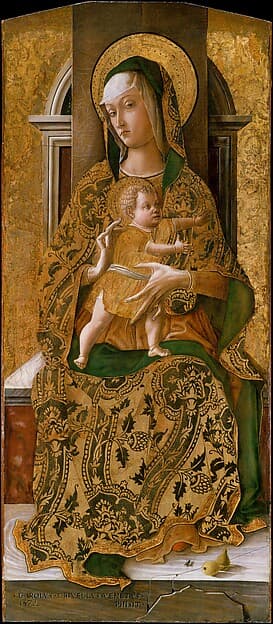
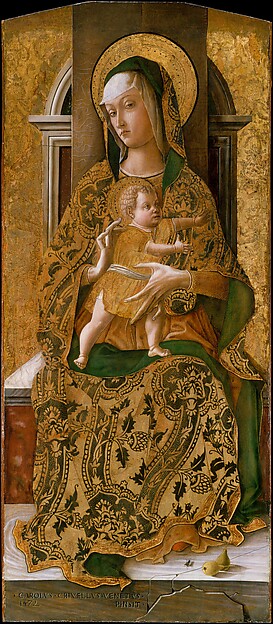
Madonna and Child Enthroned, painted by Carlo Crivelli around 1472 in tempera and gold on panel and now in the Metropolitan Museum of Art in New York, is a small altarpiece panel from his early Marche years and a defining example of his idiosyncratic late-Gothic-into-Renaissance manner. The Virgin sits enthroned on an elaborate carved-and-gilded marble throne with the standing Christ Child upright on her lap; the chromatic palette of saturated crimson, ultramarine, and tooled gold against the patterned gold-tooled background is the unmistakable Crivelli signature, and the small surface details — the embroidered silks of the Virgin's mantle, the swag of fruit garland behind the throne, the careful botanical observation of the small flowers at her feet — demonstrate Crivelli's characteristic combination of jewel-bright color with the small intricate detail that defined his mature painted manner.
met-436053
Pietà, painted by Carlo Crivelli around 1476 in tempera and gold on panel and now in the Metropolitan Museum of Art in New York, depicts the iconographic subject of the seated Virgin holding the dead body of Christ across her lap immediately after the Deposition. Crivelli stages the scene with characteristic late-Gothic compositional intensity: the Virgin in three-quarter view holding the body of Christ, John the Evangelist supporting the head from behind, the Magdalene kneeling at the feet, all set against a tooled-gold background. The chromatic palette of pale flesh, deep crimson, and tooled gold is the unmistakable Crivelli signature, and the elongated figural proportions and intense devotional faces demonstrate his characteristic combination of Italian Renaissance figural drawing with the older Italian late-Gothic decorative pictorial sensibility.
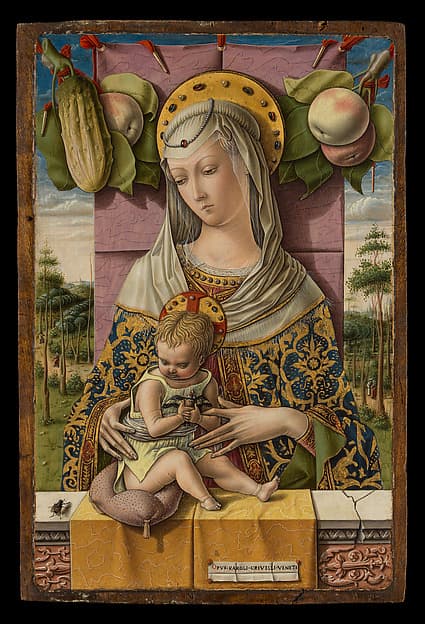
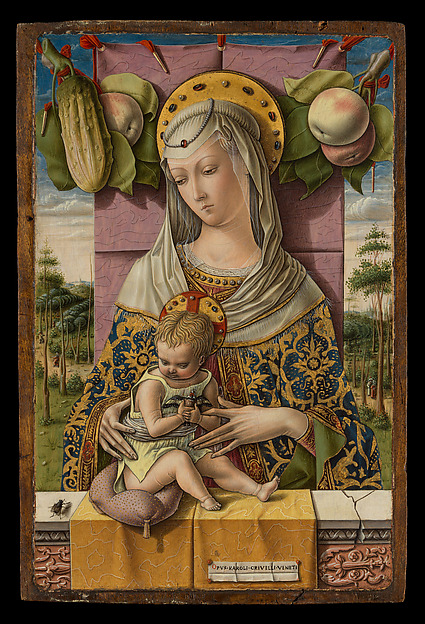
Madonna and Child, painted by Carlo Crivelli around 1475 in tempera and gold on panel and now in the Metropolitan Museum of Art in New York, is a small intimate Marian panel from the central productive years of his Marche career. The Virgin sits in three-quarter view holding the Christ Child upright on her lap; the chromatic palette and the careful tooled-gold background are characteristic of Crivelli's mature manner. The small surface details — the embroidered silks, the fruit garland, the botanical observation of the small plants and flowers around the figure — are the unmistakable Crivelli touches that gave his small devotional panels their distinctive jewel-bright intensity. The painting is among the principal Crivelli small Madonnas in any American collection.
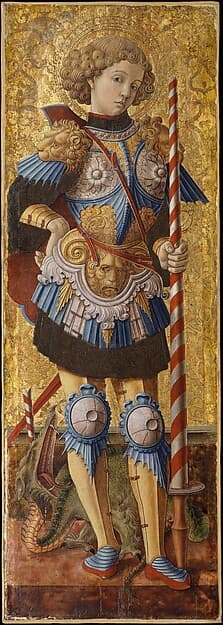
Saint George, painted by Carlo Crivelli around 1472 in tempera and gold on panel and now in the Metropolitan Museum of Art in New York, depicts the iconographic subject of the Christian knight from the medieval Golden Legend tradition. The painting shows George in three-quarter view standing in his armor, holding a small flag-bearing lance, with the small dragon of his legendary combat at his feet. The chromatic palette of polished steel, deep crimson, and tooled gold is characteristic of Crivelli's mature manner, and the intricate observation of the armor's small surface details — the rivets, the engraved patterns, the polished plates — demonstrates his characteristic late-Gothic compositional precision. The panel was originally part of one of Crivelli's large polyptych altarpieces for one of the Marche churches and was dispersed in the eighteenth or nineteenth century.
Bible scenes Carlo Crivelli painted
Revelation
Luke