Painter of the Bible
Domenico Ghirlandaio
Domenico Ghirlandaio — born Domenico di Tommaso di Currado di Doffo Bigordi in Florence in 1448 — was one of the leading Florentine painters of the late Quattrocento and the principal teacher of Michelangelo, who entered…

Their faith
Why Domenico Ghirlandaio painted Christ
Domenico Ghirlandaio, born in Florence in 1448, was deeply rooted in the Christian faith that permeated the culture of his time. His upbringing in a goldsmith family instilled in him a sense of artistry and reverence for beauty, which he channeled into his religious work. Ghirlandaio's commitment to his faith is evident in his fresco cycles for various Florentine churches, where he sought to bring biblical stories to life. His works often reflect a devotional habit of integrating contemporary figures into sacred narratives, making the divine accessible to the people of his time. His connections with influential patrons, like the Medici family, further demonstrate his role in the spiritual and artistic revival of the Renaissance, as he created works that were not only visually stunning but also spiritually enriching.
Ghirlandaio's faith profoundly shaped his artistic vision, particularly in works such as the "Adoration of the Shepherds" and the frescoes in the Tornabuoni Chapel. In the "Adoration of the Shepherds," Ghirlandaio presents the Christ Child in a Roman sarcophagus, symbolizing the intersection of the sacred and the contemporary, as he included recognizable Florentines among the shepherds. This approach invites viewers to witness the holy narrative within their own context. Similarly, the Tornabuoni Chapel frescoes depict the Lives of the Virgin and Saint John the Baptist, populated with portraits of the Florentine elite, blending devotion with community identity. Ghirlandaio's ability to weave together the sacred and the familiar allows his devotion to resonate with viewers even today, reminding us of the beauty and accessibility of Christ's message through art.
Life & work
Domenico Ghirlandaio — born Domenico di Tommaso di Currado di Doffo Bigordi in Florence in 1448 — was one of the leading Florentine painters of the late Quattrocento and the principal teacher of Michelangelo, who entered Ghirlandaio's workshop as a teenage apprentice in 1487. Born to a goldsmith family — the nickname "Ghirlandaio" derives from his father's specialty in producing the metalwork ghirlande (garlands) worn by Florentine women in their hair — and trained in painting and mosaic, he ran the leading Florentine fresco workshop of his generation, with his brothers Davide and Benedetto Ghirlandaio and his brother-in-law Sebastiano Mainardi as principal collaborators. He died in Florence in 1494.
His Christian religious work is concentrated in fresco cycles for Florentine churches and confraternities. The Sassetti Chapel in Santa Trinita (1483–1486), commissioned by the Medici banker Francesco Sassetti, includes the Stories of Saint Francis on the chapel walls and the famous Adoration of the Shepherds altarpiece (Uffizi, 1485) — a Christ Child laid on the ground in a Roman sarcophagus inscribed with a prophecy of his coming, attended by shepherds whose faces are recognizable contemporary Florentines. The Tornabuoni Chapel in Santa Maria Novella (1485–1490), commissioned by the wealthy Florentine banker Giovanni Tornabuoni, is the masterpiece — a four-wall cycle of the Lives of the Virgin and Saint John the Baptist, populated with portraits of the contemporary Florentine elite (Lorenzo de' Medici and his circle, the Tornabuoni family, the workshop assistants — including the young Michelangelo, who is reportedly visible as a small figure in one of the group scenes).
His Sistine Chapel contribution (1481–1482), painted alongside Botticelli, Perugino, and Cosimo Rosselli, includes the Vocation of the Apostles (still on the Sistine wall, depicting Christ calling Peter and Andrew at the Sea of Galilee) and the Resurrection (later destroyed and repainted in the seventeenth century). His altarpieces — the Adoration of the Magi (Uffizi, 1488), the Madonna and Saints (Munich), the Visitation (Louvre) — round out his religious painted corpus.
He was the leading Florentine portraitist of his generation; his sitter-portraits embedded in religious narrative made the Tornabuoni and Sassetti chapels both devotional cycles and group portraits of the Florentine ruling class. His Old Man and His Grandson (Louvre, c. 1490) — a tender informal portrait of an aging man with a large red nose and his fresh-faced grandson — is one of the most affecting Quattrocento portraits in any collection.
Notable works in detail
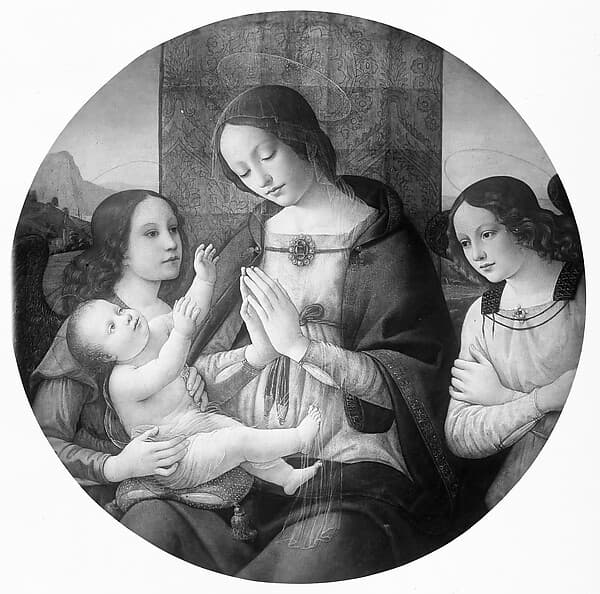
Madonna and Child with Angels, painted by Domenico Ghirlandaio (or by his immediate workshop) around 1469 in tempera and gold on panel and now in the Metropolitan Museum of Art in New York, is among the early small-format Madonnas from the Florentine workshop he ran with his brothers Davide and Benedetto. The Virgin sits in three-quarter view holding the Christ Child upright on her lap; two child angels lean in at her shoulders to crown her with a small wreath; a gold-tooled background gives the panel the jewel-bright surface of late-medieval Florentine devotional painting at the moment immediately before the new Renaissance landscape backgrounds began to displace gold-ground convention. The young Michelangelo entered Ghirlandaio's workshop as a teenage apprentice in 1487 — almost two decades after this small panel was produced — and absorbed Ghirlandaio's compositional discipline directly. The painting is one of the principal Ghirlandaio Madonnas in any American collection.