Painter of the Bible
Federico Barocci
Federico Barocci was the leading Italian Counter-Reformation painter of the late sixteenth century — the artist who, working from the small Marche town of Urbino almost his entire life, produced the most reproduced and m…

Their faith
Why Federico Barocci painted Christ
Federico Barocci was a devout Catholic artist whose work epitomized the spirit of the Counter-Reformation. Born into a family of artists in Urbino, he was deeply influenced by his father's sculptural background and the artistic traditions of his hometown. After a near-fatal poisoning incident in Rome, Barocci returned to Urbino, where he dedicated his life to creating religious art that inspired devotion and prayer. His connection to the faith was profound; he was known to be the favorite painter of Saint Filippo Neri, who recognized Barocci's ability to evoke a spiritual response through his art. The artist's meticulous approach to painting, which often involved years of preparation and reflection, speaks to his deep reverence for scripture and the divine. His altarpieces were not just artistic endeavors but acts of worship, crafted with the intention of drawing viewers closer to God.
Barocci's faith profoundly influenced his artistic output, particularly in his renowned altarpieces such as the 'Madonna del Popolo' and the 'Deposition.' These works reveal his unique ability to blend emotional immediacy with theological depth, using a soft pastel palette and luminous light to create a sense of divine presence. In 'Madonna del Popolo,' the tenderness of the Virgin Mary and the Child Jesus invites contemplation and prayer, embodying the very essence of maternal love and divine grace. Similarly, the 'Deposition' captures the poignant moment of Christ's removal from the cross, evoking deep empathy and reflection on sacrifice and redemption. Barocci's devotion continues to resonate with viewers today, as his paintings remain a testament to the beauty and power of faith expressed through art.
Life & work
Federico Barocci was the leading Italian Counter-Reformation painter of the late sixteenth century — the artist who, working from the small Marche town of Urbino almost his entire life, produced the most reproduced and most influential Italian altarpieces of his generation outside Rome. Born in Urbino around 1535 to a family of artists (his father Ambrogio Barocci was a sculptor; his uncle Francesco Menzocchi was a painter), trained in his father's workshop and in Rome under the painter Taddeo Zuccaro, he returned to Urbino in 1563 after a near-fatal poisoning incident in Rome and worked there for the rest of his life. He died in Urbino in 1612.
His Christian religious work is concentrated in large altarpieces produced for the principal Counter-Reformation Italian commissions — Roman, Bolognese, Florentine, and Marche-regional. The Madonna del Popolo (Uffizi, 1575–1579), the Deposition (Perugia Cathedral, 1567–1569), the Last Supper (Urbino Cathedral, c. 1592–1599), the Calling of Saint Andrew (Brussels), the Visitation (Santa Maria in Vallicella, Rome), the Aeneas Fleeing Troy (Borghese, 1598), the Madonna of Saint Simon (Urbino), and dozens of smaller devotional Madonnas of the Loreto type and the Holy Family with the Cat (Madonna del Gatto) anchor the painted corpus. His Madonnas with the Cat were particularly widely reproduced through the engraving market of his lifetime and after.
His personal style is unmistakable: soft pastel-colored sfumato modeling derived from Correggio, an emotional immediacy that combines tenderness with theatrical pictorial drama, an unusual chromatic palette of pinks, oranges, lavenders, and silvery whites, and a luminous handling of light that anticipated by a generation the Bolognese reform of the Carracci. He was Saint Filippo Neri's favorite painter (the saint named him in his correspondence as the artist whose works most reliably moved him to prayer), and the Counter-Reformation Catholic patrons treated him as the supreme model of devotionally effective religious painting.
He was famously slow — his altarpieces sometimes took six or seven years to complete — and worked from extraordinary preparatory drawing campaigns in red and black chalk. The drawings, scattered across the Uffizi, the Louvre, the Berlin Kupferstichkabinett, and the British Museum, are widely held to be among the supreme Italian Renaissance preparatory drawings.
Notable works in detail
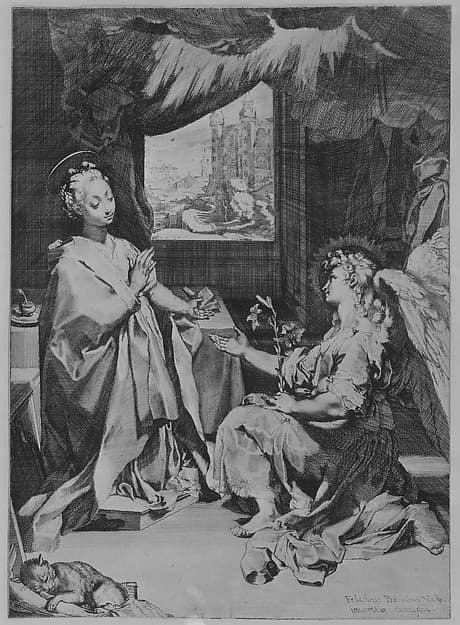
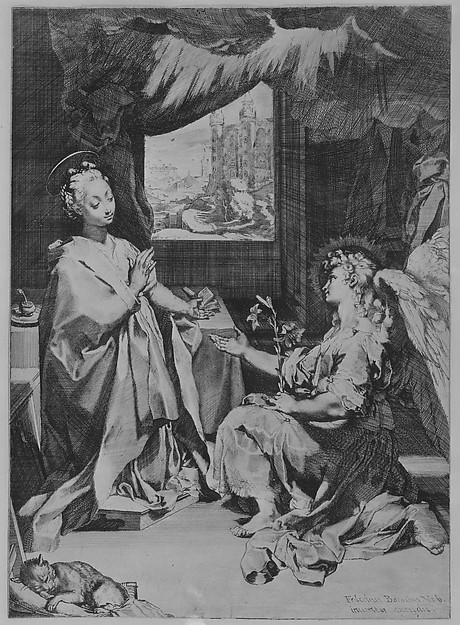
The Annunciation, etched by Federico Barocci around 1580 in his Urbino workshop and now in the Metropolitan Museum of Art in New York, depicts the moment from Luke 1 in which the angel Gabriel appears to the Virgin in her chamber to announce the conception of Christ. Barocci stages the scene with characteristic Counter-Reformation compositional discipline: the Virgin kneels at her prayer-desk on the right, the angel kneels on the left in an attitude of greeting, the Holy Spirit descends as a small dove on a beam of light from above. The etched line is patiently crosshatched in Barocci's distinctive late-mannerist manner — soft, slightly broken, with a particularly atmospheric tonal range. The print was widely reproduced through the European Catholic devotional engraving market for over a century after its first publication.
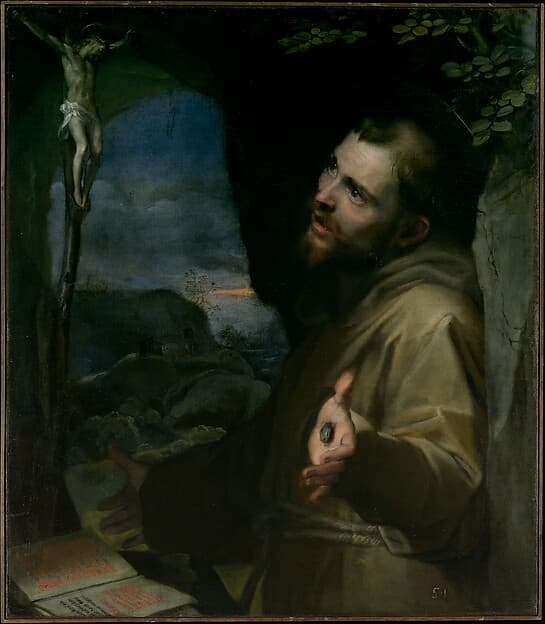
Saint Francis, drawn by Federico Barocci around 1600 in his Urbino workshop in red and black chalk on paper and now in the Metropolitan Museum of Art in New York, depicts the medieval Italian Franciscan saint in the conventional iconographic posture of his religious meditation. The drawing shows the seated Saint Francis in his habit, his hands folded in his lap, his face lifted in an attitude of inward contemplation. The combination of red and black chalk on paper — the standard Barocci preparatory drawing technique — gives the figure a soft sfumato modeling characteristic of his late drawing style, and the sheet demonstrates the careful preparatory drawing campaigns that Barocci pursued for every painted altarpiece across his slow, deliberate career.