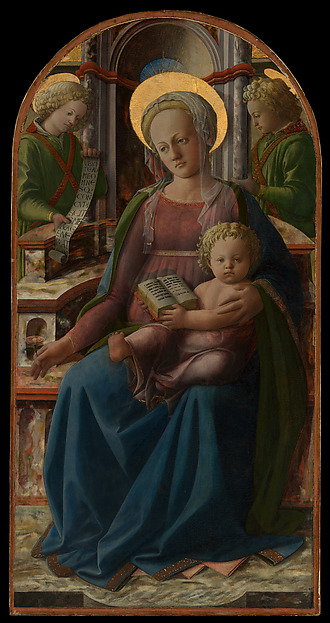
Painter of the Bible
Fra Filippo Lippi
Fra Filippo Lippi was a Florentine Carmelite friar and painter, one of the leading Florentine masters of the generation after Masaccio and the principal teacher of Sandro Botticelli.

Their faith
Why Fra Filippo Lippi painted Christ
Fra Filippo Lippi, a Carmelite friar and painter from Florence, dedicated his life to the service of God through his art. Orphaned at a young age, he found refuge in the Carmelite convent of Santa Maria del Carmine, where he embraced a life of devotion and religious discipline. Lippi's faith was deeply intertwined with his artistic practice, as he created numerous altarpieces and frescoes that reflected his spiritual convictions. Despite his eventual departure from monastic life to marry Lucrezia Buti, a young nun who inspired many of his works, Lippi's commitment to depicting sacred themes remained steadfast. His paintings often convey a sense of divine beauty and grace, inviting viewers to contemplate the mysteries of faith and the love of Christ.
Lippi's artistic vision is perhaps best exemplified in works such as the "Madonna and Child with Two Angels" and the "Coronation of the Virgin." In the former, the tender expressions of the Madonna and the joyful angels capture the essence of divine love, while the soft pastel colors and delicate details reflect Lippi's reverence for the sacred. The "Coronation of the Virgin" showcases his ability to blend narrative and theology, creating a powerful visual representation of Mary's exaltation in heaven. Through these masterpieces, Lippi not only expressed his personal devotion but also contributed to the broader Florentine artistic tradition, inspiring generations of artists, including his own apprentice, Sandro Botticelli. Today, Lippi's works continue to resonate with viewers, reminding us of the beauty and sanctity of faith as they invite us into a deeper relationship with Christ.
Life & work
Fra Filippo Lippi was a Florentine Carmelite friar and painter, one of the leading Florentine masters of the generation after Masaccio and the principal teacher of Sandro Botticelli. Born in Florence around 1406, orphaned young and placed in the Carmelite convent of Santa Maria del Carmine in 1421, he professed religious vows there and was ordained but lived his life in tension with monastic discipline — eventually leaving the order in the 1450s to marry Lucrezia Buti, a young nun who became the model for many of his Madonnas and the mother of his son Filippino Lippi (himself an important painter of the next generation). He died in Spoleto in 1469 while at work on the cathedral fresco cycle.
His Christian religious work is concentrated in altarpieces, predella panels, and fresco cycles for Florentine and Tuscan patrons. The Barbadori Altarpiece (Louvre, 1437), the Annunciation (Munich), the Coronation of the Virgin (Uffizi, 1441), the Madonna and Child with Two Angels (Uffizi, c. 1465 — the famous "Filippo Lippi Madonna," with Lucrezia Buti's face and the Christ Child held up by laughing winged boys), and the Madonna with Saint Anthony Abbot (Cleveland) anchor his painted reputation in museum collections. His Adoration of the Magi tondi for Cosimo de' Medici, his small predella scenes of the Apostles and the Virgin, and his deathbed Madonna and Child compositions circulated widely through the Florentine art market.
His most ambitious surviving project is the fresco cycle in the apse of Prato Cathedral (1452–1465), with scenes from the lives of Saint Stephen and Saint John the Baptist on opposing walls — the Banquet of Herod with the dancing Salome remains one of the canonical images of fifteenth-century Florentine fresco. The Spoleto Cathedral cycle (1467–1469), with the Coronation of the Virgin in the apse and a sequence of life-of-the-Virgin scenes around it, was completed after his death by his workshop including the young Filippino Lippi.
His personal style — sweet-faced Madonnas, soft pastel color, transparent veils, the half-Renaissance rebuilding of pictorial space alongside a still-medieval love of decorative pattern — defined the look of mid-fifteenth-century Florentine devotional painting and was the immediate stylistic ancestor of Botticelli, who entered his workshop as a teenage apprentice and absorbed Lippi's manner directly.