Painter of the Bible
Giovanni Antonio da Pordenone (Giovanni Antonio de Sacchis)
Giovanni Antonio de' Sacchis, called Pordenone from his birthplace, was the leading Friulian painter of the early sixteenth century and one of the principal northern-Italian rivals to the dominance of Titian in Venice.

Their faith
Why Giovanni Antonio da Pordenone (Giovanni Antonio de Sacchis) painted Christ
Giovanni Antonio da Pordenone, a prominent Friulian painter of the early sixteenth century, dedicated his life to the service of God through his art. As a member of the Catholic faith, Pordenone's spiritual devotion was evident in the way he approached his work, often drawing inspiration from scripture and the teachings of the Church. His training in local workshops and the influence of great masters like Giorgione and Titian shaped his artistic vision, but it was his deep reverence for sacred subjects that truly defined his legacy. Pordenone's commitment to his faith was reflected in the grandeur of his religious commissions, which he approached with the intention of uplifting the viewer's spirit and drawing them closer to God.
Pordenone's faith profoundly influenced his most significant works, such as the dramatic "Crucifixion" fresco in the Cathedral of Cremona. This masterpiece showcases not only his technical prowess but also his ability to convey deep spiritual truths through art. The packed crowd of figures and the intense emotional expression capture the gravity of Christ's sacrifice, inviting viewers to reflect on their own faith. Similarly, his altarpieces, like the "Madonna and Saints" in San Lorenzo, reveal his dedication to depicting divine narratives that resonate with the viewer's heart. Pordenone's art continues to inspire and uplift, reminding us of the power of faith expressed through beauty and creativity, and his devotion lives on in the hearts of those who encounter his work.
Life & work
Giovanni Antonio de' Sacchis, called Pordenone from his birthplace, was the leading Friulian painter of the early sixteenth century and one of the principal northern-Italian rivals to the dominance of Titian in Venice. Born in Pordenone in Friuli (now northeastern Italy) around 1483 or 1484, trained in the local Friulian workshop tradition and then increasingly under the influence of Giorgione and the early Titian during repeated working trips to Venice, he was active across Friuli, the Veneto, Lombardy, and Emilia for his entire career. He died in Ferrara in 1539, possibly from poisoning — his Venetian rivals (the early biographers, especially Vasari, hint at jealousy from the Titian camp), though the documentary evidence is inconclusive.
His central religious commissions are the great fresco cycles of the Cathedral of Cremona (1520–1521 — the dramatic Crucifixion on the entrance wall is among the great Italian Renaissance treatments of the subject), the choir of the Cathedral of Spilimbergo (1524–1526), the dome and lunettes of the Madonna di Campagna in Piacenza (1530–1535), and the great Conversion of Saul fresco for the cloister of San Salvatore in Venice. The Cremona Crucifixion in particular — with its packed crowd of figures, dramatic foreshortening, and compositional invention rivaling anything Titian was producing in the same decade — is widely held to be his masterpiece and the principal monument of his mature style.
His altarpieces include the Madonna and Saints in San Lorenzo in Verona, the Stories of Saint Catherine in Treviso Cathedral, the Annunciation (Treviso, c. 1525), and the Polyptych of the Annunciation in Pordenone Cathedral. He worked extensively in fresco — large-scale, decorative, public — and the bulk of his surviving work is in situ in the churches of the Friulian and Lombard provinces.
His personal style combined the local Friulian and Northern Italian inheritance with a vigorous response to Michelangelo's Sistine Chapel ceiling (which he saw on a Roman trip around 1517) and to Giulio Romano's Mantua frescoes. The result was a Northern Italian dramatic-figural manner that anticipated, by a decade or more, the late-Mannerist intensity that would define the Bassanos, the Tintoretto generation, and the early seventeenth-century Bolognese reform painters. He was Titian's principal living rival in northern Italy in the 1530s, and his death in Ferrara cut short what was likely to have been an extended late period of major commissions.
Notable works in detail
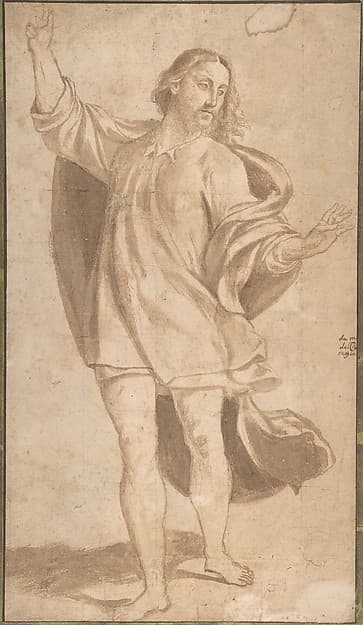
Standing Figure of Christ with Arms Upraised
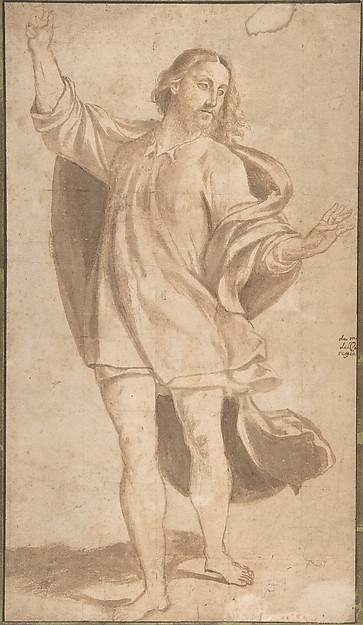
Standing Figure of Christ with Arms Upraised, drawn by Giovanni Antonio da Pordenone around 1525 in red chalk on paper and now in the Metropolitan Museum of Art in New York, is a small preparatory drawing for one of his great Crucifixion compositions — most likely the dramatic Crucifixion fresco he painted on the entrance wall of Cremona Cathedral between 1520 and 1521. The drawing shows the figure of Christ with arms lifted in the upright posture immediately before the Crucifixion, the body modeled in the dense muscular Pordenone manner that responded directly to Michelangelo's Sistine Chapel ceiling figures (which Pordenone had seen on his Roman trip around 1517). The sheet is among the principal Pordenone drawings in any American collection.
met-340528
Saint Christopher Bearing the Christ Child, drawn by Giovanni Antonio da Pordenone around 1525 in red chalk on paper and now in the Metropolitan Museum of Art in New York, depicts the iconographic subject from the medieval Golden Legend tradition in which the giant Christopher carries the small Christ Child across a flooded river — the act for which the saint is best known and from which his name (Christo-phoros, Christ-bearer) derives. The drawing shows the standing Saint Christopher in three-quarter view holding the small Christ Child up on his shoulder; the muscular figural anatomy and the energetic chalk technique demonstrate Pordenone's Michelangelo-influenced Northern Italian manner of the early 1520s.
Bible scenes Giovanni Antonio da Pordenone (Giovanni Antonio de Sacchis) painted
John