Painter of the Bible
Giovanni Bellini
Giovanni Bellini was the towering Venetian religious painter of the fifteenth and early sixteenth centuries and the principal architect of the Venetian school of color and atmospheric light.

Their faith
Why Giovanni Bellini painted Christ
Giovanni Bellini, a central figure in the Venetian school of painting, dedicated his life to creating profound religious art that reflects his deep Christian faith. Born into a family of artists, Bellini was trained in his father Jacopo's workshop and greatly influenced by his brother-in-law Andrea Mantegna. His commitment to his craft was not merely professional; it was an act of devotion. Bellini's paintings often served as altarpieces and devotional Madonnas, emphasizing the sacredness of the subjects he portrayed. His works reveal a reverent approach to scripture and a desire to convey the divine through beauty. The tenderness and color in his paintings invite viewers to experience the spiritual depth of the Christian narrative, showcasing his belief in the transformative power of faith.
Bellini's faith is particularly evident in masterpieces such as the San Giobbe Altarpiece and the San Zaccaria Altarpiece, both of which exemplify the Venetian sacra conversazione style. In these works, the Madonna and Child are depicted with a serene grace, surrounded by saints in harmonious compositions that reflect both the architectural beauty of the churches they adorn and the spiritual truths they embody. His landscapes, infused with a soft light and atmospheric depth, serve to elevate the sacred scenes, drawing viewers into a contemplative experience of the divine. Giovanni Bellini's art continues to resonate with audiences today, reminding us of the beauty of faith and the enduring power of Christ's love as expressed through the devotion of a master artist.
Life & work
Giovanni Bellini was the towering Venetian religious painter of the fifteenth and early sixteenth centuries and the principal architect of the Venetian school of color and atmospheric light. Born in Venice around 1430, trained in his father Jacopo Bellini's workshop alongside his older brother Gentile, and shaped through his early career by the example of his brother-in-law Andrea Mantegna (whose marriage to Giovanni's sister Nicolosia in 1453 brought the two artists into close stylistic dialogue), he ran the leading Venetian workshop for almost half a century. He was the master of Giorgione and Titian and the principal stylistic ancestor of every major Venetian painter of the next century. He died in Venice in 1516, well into his eighties.
His Christian religious work is enormous and is concentrated in altarpieces and devotional Madonnas of unrivalled tenderness and color. The San Giobbe Altarpiece (Accademia, Venice, c. 1487), the San Zaccaria Altarpiece (San Zaccaria, Venice, 1505) — both still in the city — set the standard for the new Venetian sacra conversazione: the Madonna and Child enthroned in a painted apse that visually completes the architecture of the church, attended by saints in patient symmetrical groups. The Madonna of the Meadow (London, c. 1505), the Madonna of the Trees (Accademia, c. 1487), the Madonna with the Greek Inscription (Brera), the Sacred Allegory (Uffizi), the Pietà (Brera), the Resurrection (Berlin), and dozens of other Madonnas and saints in museums across Europe and America anchor the painted reputation.
His landscape painting — the soft Veneto countryside under silvery evening light, with distant hills and slow rivers winding behind the principal religious scene — was the technical and conceptual foundation of the entire Venetian colorist tradition. His use of oil paint, learned from his father's late workshop and refined through long observation of Antonello da Messina (who visited Venice in 1475–1476 and brought the new Northern oil technique with him), gave his paintings an atmospheric depth and color saturation that egg-tempera could not produce.
His late style — the Feast of the Gods (Washington, 1514, painted for Alfonso d'Este of Ferrara and later partly repainted by Titian), the Drunkenness of Noah (Besançon, c. 1515), and the late altarpieces — shows the eighty-year-old master continuing to learn from his own pupils Giorgione and Titian, absorbing their newer manner without losing his own distinctive stillness and tenderness. He was buried in the church of Santi Giovanni e Paolo in Venice, beside his brother Gentile.
Notable works in detail
met-435640
Madonna Adoring the Sleeping Child, painted by Giovanni Bellini around 1460 in tempera on panel and now in the Metropolitan Museum of Art in New York, is one of the earliest surviving small-format Madonnas from his Venetian workshop and a defining statement of the tender, quietly observant manner that would define his religious painting for the next half-century. The Virgin sits in profile on the right with her hands folded in prayer above the sleeping infant Christ on her lap; the chromatic palette of deep ultramarine, soft rose, and pale gold against a darkened landscape opening to a low Veneto horizon is unmistakably early-Bellini. The painting belongs to the Madonnas-with-the-Sleeping-Child compositional type Bellini would refine in dozens of later versions; the type carried forward the late-medieval Italian devotional convention of meditating on the future Passion through the figure of the sleeping infant.
met-435641
Madonna and Child, painted by Giovanni Bellini around 1487 in tempera and oil on panel and now in the Metropolitan Museum of Art in New York, is one of the small mature Bellini Madonnas of his middle Venetian period. The Virgin sits in three-quarter view holding the standing Christ Child against her shoulder; her gaze is downcast in soft contemplation, the Child looks out at the viewer with the unspoken solemnity that the Bellini workshop made into the standard expression for the Christ Child in mid-Quattrocento Venetian painting. The cool silvery chromatic palette and the small open landscape glimpsed beyond a low parapet at the bottom of the panel are the unmistakable signatures of the mature Bellini Madonna type that his pupils Giorgione and Titian would adapt into the next generation of Venetian religious painting.
met-435642
Madonna and Child with Saints, painted by Giovanni Bellini around 1500 in oil on panel and now in the Metropolitan Museum of Art in New York, is a small sacra conversazione — the Italian Renaissance compositional type in which the Madonna sits enthroned with the Christ Child surrounded by attendant saints in a unified pictorial space. Bellini's small Met version shows the Virgin and Child at the center under a dark architectural niche with two saints flanking them in three-quarter view; the chromatic palette of deep ultramarine, emerald, and warm flesh against the dark ground is characteristic of the late mature Bellini manner. The compositional type — saints arranged around the enthroned Madonna in calm devotional dialogue — was Bellini's signature contribution to Italian Renaissance altarpiece painting and the immediate ancestor of the great sacra conversazione altarpieces of his pupils Giorgione, Titian, and the next generation of Venetian masters.
met-435643
The Circumcision, painted by Giovanni Bellini and his workshop around 1511 in oil on panel and now in the Metropolitan Museum of Art in New York, depicts the moment from Luke 2 in which the infant Christ, eight days after his birth, is brought to the Temple for circumcision according to Jewish law. Bellini composes the scene in a tight half-length grouping around a stone altar at the center: the priest holds the small instrument; the Virgin stands behind on the right, her hands folded in attendance; Joseph waits in the background. The painting is a workshop variant of a composition Bellini and his shop produced in multiple versions across the early sixteenth century; this Met version is among the principal surviving examples and one of the major late Bellini paintings in any American collection.
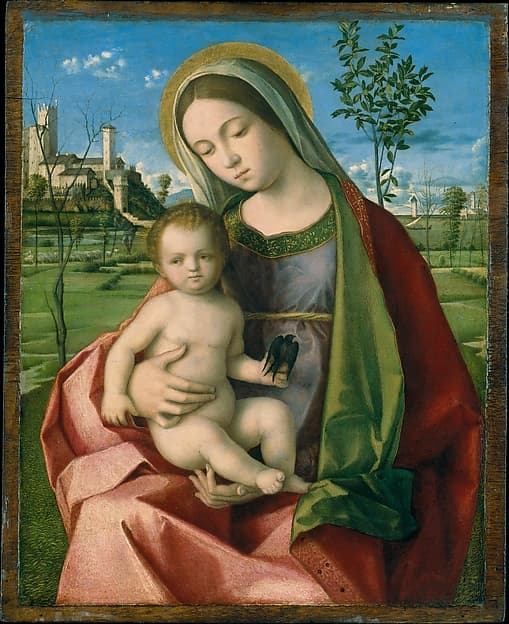
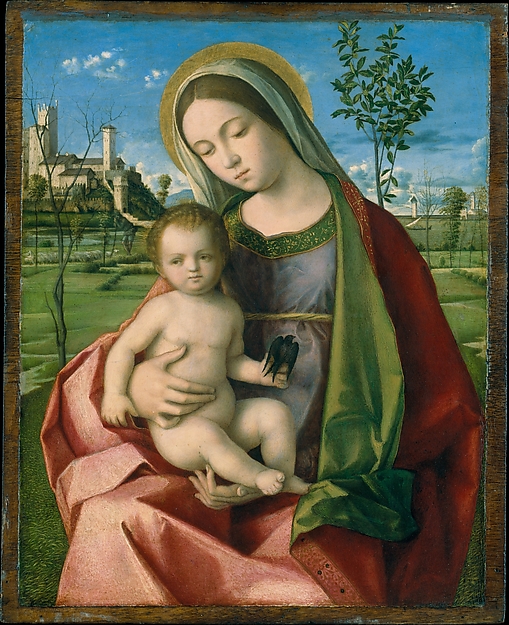
Madonna and Child, painted by Giovanni Bellini around 1505 in oil on panel and now in the Metropolitan Museum of Art in New York, is one of the late half-length Madonna compositions from Bellini's last decade of work in Venice. The Virgin sits on a low stone bench in three-quarter view with the Christ Child seated upright on her lap; the chromatic palette of cool blue, warm rose, and silvery flesh against an open Veneto landscape glimpsed beyond a low parapet is the unmistakable late-Bellini signature. The painting demonstrates the compositional and chromatic discipline the eighty-year-old master continued to refine through his last years — the same discipline his Venetian successors Giorgione and Titian would carry forward into the new century. The panel entered the Metropolitan in 1908.
Bible scenes Giovanni Bellini painted
Luke