Painter of the Bible
Jan van Eyck
Jan van Eyck is the founding figure of Northern Renaissance painting and one of the very few painters in any tradition whose technical innovations changed what oil paint could do for everyone after him.
%2520-%2520National%2520Gallery%252C%2520London.jpg%3Fwidth%3D600&w=2048&q=75)
Their faith
Why Jan van Eyck painted Christ
Jan van Eyck, a pivotal figure in the Northern Renaissance, is celebrated not only for his groundbreaking techniques in oil painting but also for the deep spiritual devotion that infused his work. While specific details about his personal faith are sparse, his artistic output reveals a profound reverence for Christian themes and scripture. He served as a court painter for Philip the Good, Duke of Burgundy, and his role often intertwined with the church, suggesting a life steeped in the spiritual milieu of his time. His commitment to capturing the divine in his art is evident in the meticulous detail and symbolism present in his paintings, reflecting a heart attuned to the sacred.
Van Eyck's faith is most vividly expressed in masterpieces such as the Ghent Altarpiece and the Madonna of Chancellor Rolin. The Ghent Altarpiece, completed in 1432, presents the Adoration of the Mystic Lamb, a powerful image that encapsulates the essence of Christ's sacrifice and the heavenly celebration surrounding it. The intricate details and layered glazes invite viewers to meditate on the divine mystery of Christ's presence. Similarly, the Madonna of Chancellor Rolin showcases Van Eyck's ability to blend the earthly and the divine, portraying the Virgin Mary with a sense of grace and intimacy that draws the viewer into a deeper understanding of her role in salvation history. Through his art, Van Eyck's devotion continues to inspire and uplift, inviting all who encounter his work to reflect on the beauty of faith and the presence of Christ in their lives.
Life & work
Jan van Eyck is the founding figure of Northern Renaissance painting and one of the very few painters in any tradition whose technical innovations changed what oil paint could do for everyone after him. Born around 1390, possibly in Maaseik in the Prince-Bishopric of Liège, he served as court painter and trusted diplomatic agent to Philip the Good, Duke of Burgundy, from 1425 onward, was sent on a 1428 embassy to Lisbon to paint the portrait of Philip's prospective bride Isabella of Portugal, and settled in Bruges by 1430, where he spent the rest of his life.
The work that fixed his reputation in his own century and ours is the Ghent Altarpiece — twelve panels arranged in two registers, opened on feast days to reveal the Adoration of the Mystic Lamb on the lower interior. He completed it in 1432 in collaboration with his older brother Hubert, who had begun the commission and died before its completion. The lower central panel — saints, prophets, virgins, and martyrs gathered in a meadow around an altar where the Lamb stands bleeding into a chalice, the Holy Spirit hovering above as a dove — gives Revelation 5 its most enduring single image. The work has been stolen, hidden, recovered, and restored more times than almost any other panel painting in the West; the long-running technical study of its layered glaze structure has shaped our understanding of fifteenth-century oil painting.
His independent religious panels are smaller in scale and exact in finish. The Madonna of Chancellor Rolin (Louvre, c. 1435), the Virgin and Child with Canon van der Paele (Bruges, 1436), the Lucca Madonna (Frankfurt), the Annunciation now in the National Gallery of Art in Washington, and the small diptychs of the Crucifixion and Last Judgment in the Metropolitan Museum carry the same impossibly precise brushwork — every brocade, jewel, hair, and reflection painted with magnifying-glass attention.
He also painted the great civilian Arnolfini Portrait (1434, National Gallery, London), and a small body of court portraits including the so-called Man in a Red Turban (1433, possibly a self-portrait). He died in Bruges in 1441 and was buried in the Church of Saint Donatian.
Notable works in detail
met-436282
The Crucifixion and the Last Judgment, painted by Jan van Eyck around 1436 in oil on canvas transferred from wood and now in the Metropolitan Museum of Art in New York, is a small early-Eyckian diptych that survives as one of the principal Jan van Eyck works in any American collection. The left panel shows the Crucifixion at the moment immediately after Christ's death — the swooning Virgin in the arms of John, the Magdalene clinging to the foot of the cross, the centurion on horseback in the foreground recognizing the divinity of the dying Christ — set against a panoramic landscape of the city of Jerusalem fading into snow-capped mountains. The right panel shows the Last Judgment in three vertical registers: Christ enthroned in judgment at the top, the resurrected dead emerging from the earth and sea in the middle, and a multi-tiered hell of damned souls and devils in the bottom. The painting is the principal Jan van Eyck religious work in the Metropolitan and a defining example of the Early Netherlandish oil-on-panel technique that the Eyckian workshop perfected in the 1430s.
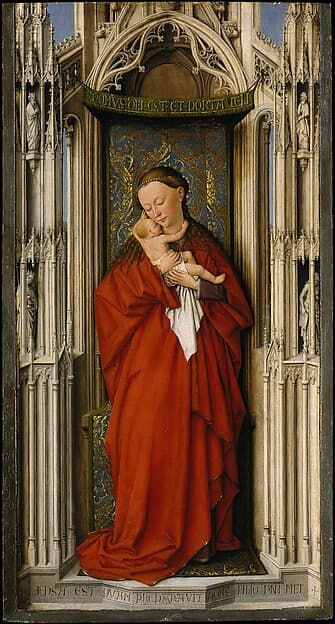
The Virgin and Child in a Niche, painted by Jan van Eyck around 1440 in oil on a small wooden panel and now in the Metropolitan Museum of Art in New York, is among the surviving small-format Eyckian devotional paintings of the late 1430s and early 1440s. The Virgin stands in a stone architectural niche with the Christ Child upright on her right arm; the niche is carved with small grotesque figures and topped by a small architectural canopy; the Virgin's blue mantle pools down onto a stone parapet at the bottom of the panel. The composition follows the Eyckian convention of placing the Madonna in a sculptural niche to underscore the stone-like permanence of the Marian devotional image — a visual conceit Jan van Eyck developed in several of the small surviving panels of the late 1430s and early 1440s. The painting is one of the principal small Jan van Eyck Madonnas in any American collection.
Bible scenes Jan van Eyck painted
Luke