Painter of the Bible
Ludovico Carracci
Ludovico Carracci was the eldest of the three Carracci — the cousin and senior partner to the brothers Annibale and Agostino — and the principal teacher and director of the Bolognese academy that the three founded together at the end of the sixteenth century.

Their faith
Why Ludovico Carracci painted Christ
Ludovico Carracci, born in Bologna in 1555, was a devout Christian whose artistic journey was deeply intertwined with his faith. As the eldest of the Carracci family, he dedicated his life to the service of God through art, founding the Accademia degli Incamminati alongside his cousins. This institution became a vital center for religious art in the region, emphasizing a style that was both emotionally resonant and accessible to the faithful. Carracci's commitment to his spiritual practice is reflected in the altarpieces and chapel commissions he created for Bolognese churches, where he sought to inspire devotion through clear and impactful imagery. His life of simplicity and dedication to his craft exemplified the principles of humility and service that are central to the Christian faith.
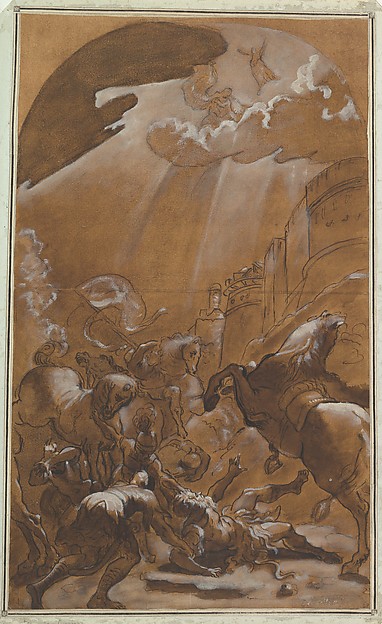
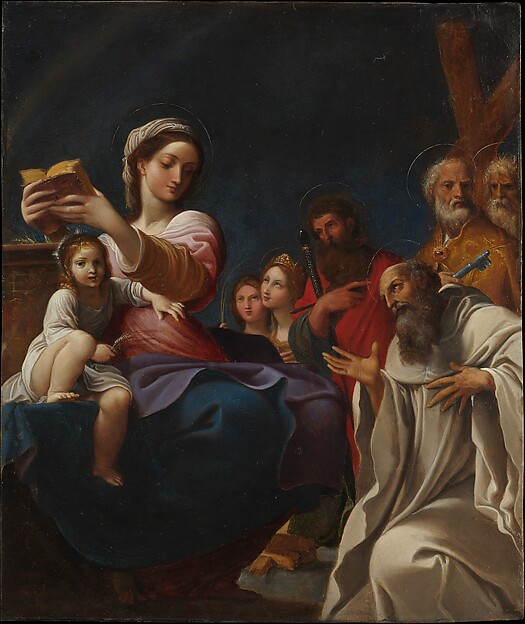
Carracci's faith significantly shaped his artistic output, as seen in masterpieces such as the "Madonna of the Bargellini" and the "Conversion of Saint Paul." These works not only showcase his technical skill but also reveal his deep spiritual vision. In the "Madonna of the Bargellini," the tender portrayal of the Virgin Mary invites viewers to contemplate her divine grace and maternal love, while the dramatic light in the "Conversion of Saint Paul" powerfully illustrates the transformative moment of divine intervention. Through these paintings, Carracci's devotion continues to resonate with viewers today, inviting them to experience the profound beauty of faith and the glory of Christ. His legacy lives on, reminding us of the sacred connection between art and spirituality, and the enduring impact of a life dedicated to God.
Life & work
Ludovico Carracci was the eldest of the three Carracci — the cousin and senior partner to the brothers Annibale and Agostino — and the principal teacher and director of the Bolognese academy that the three founded together at the end of the sixteenth century. Born in Bologna in 1555, trained in the workshop of Prospero Fontana and (for a year) in Venice in the orbit of Tintoretto, he stayed in Bologna for his entire career while his cousins moved to Rome and Parma. He died in Bologna in 1619.
His Christian religious work is concentrated in altarpieces and chapel commissions for Bolognese churches, painted in a deliberately devout, emotionally direct manner that drew on Correggio's soft modeling, Tintoretto's chiaroscuro, and the Counter-Reformation taste for clear, accessible religious imagery. The Madonna of the Bargellini (Pinacoteca Nazionale, Bologna, 1588), the Holy Family with Saint Francis (Cento, 1591), the Conversion of Saint Paul (Pinacoteca Nazionale, Bologna), the Vision of Saint Anthony (Vatican Pinacoteca), the great Annunciation (Pinacoteca Nazionale, Bologna, 1605), and the long sequence of Madonnas, Pietàs, and altarpieces fill the principal Bolognese churches. The frescoes of the lives of San Benedetto and Santa Cecilia in the cloister of San Michele in Bosco (1604–1605, in collaboration with his pupils) form a substantial cycle that survived restoration into the modern period.
His teaching at the Accademia degli Incamminati was the principal channel through which the Carracci reform reached the next generation of Bolognese painters. The list of his pupils — Guido Reni, Domenichino, Albani, Guercino, Lanfranco, and through them the entire seventeenth-century Bolognese school — makes him, more than either of his cousins, the founder of the Bolognese painting tradition that would dominate Italian religious painting through the middle of the seventeenth century.
He never married, lived simply, gave his name to the academy he ran, and was buried in the church of San Giovanni in Monte in Bologna. His personal style — soft, deeply shadowed, often with a single dramatic illuminated figure picked out against a dark ground — is sometimes described as the Bolognese answer to Caravaggio's Roman tenebrism, although Ludovico arrived at his own version of the device independently and earlier.