Painter of the Bible
Philippe de Champaigne
Philippe de Champaigne was a Brussels-born French Baroque painter and the principal Jansenist religious painter of seventeenth-century France.

Their faith
Why Philippe de Champaigne painted Christ
Philippe de Champaigne was a deeply devout painter whose faith was rooted in Jansenism, a Catholic reform movement that emphasized personal piety and the grace of God. Born into a Flemish family in Brussels, his artistic journey began in the workshop of Jacques Fouquière, but it was in Paris that he truly flourished. His connection to the church was profound, particularly after his daughter Catherine entered the Jansenist convent of Port-Royal in 1648. This personal experience deepened his spirituality and commitment to creating art that reflected his faith. His devotion was evident in his meticulous approach to scripture and his desire to convey the sacred through his work, leading him to become the principal religious painter of his time.
Champaigne's faith profoundly influenced his artistic expression, particularly in his later works that embraced the austere and introspective qualities of Jansenism. One of his most notable paintings, the Ex-Voto, exemplifies this shift; it was created as a heartfelt offering to the Port-Royal convent in gratitude for his daughter's miraculous recovery from illness. In this work, the restrained palette and the solemn figures of Catherine and Mother Superior Agnès Arnauld reflect a deep reverence for the divine and the importance of personal devotion. Similarly, his late Crucifixions and Pietàs reveal a spiritual depth and emotional restraint that set them apart from the more theatrical Baroque styles of his contemporaries. Through his art, Philippe de Champaigne invites viewers to experience a profound connection to Christ, encouraging them to reflect on their own faith journeys.
Life & work
Philippe de Champaigne was a Brussels-born French Baroque painter and the principal Jansenist religious painter of seventeenth-century France. Born in Brussels in 1602 to a Flemish family, trained in Brussels in the workshop of the landscape painter Jacques Fouquière before moving to Paris in 1621, and active in Paris for the rest of his life, he became the favorite painter of Cardinal Richelieu in the 1630s and served as principal painter to Anne of Austria's Regency in the 1640s. He died in Paris in 1674.
His Christian religious work falls in two distinct phases. The early Paris career produced large-format Baroque altarpieces in the warm Flemish colorist tradition descending from Rubens — the Vow of Louis XIII (Caen, 1638), the great series of religious paintings for the Carmelite church and the Val-de-Grâce in Paris, the portrait series of Cardinal Richelieu in his official roles. The later career, after his daughter Catherine became a nun at the Jansenist convent of Port-Royal in 1648, turned increasingly toward the austere, restrained, almost monochromatic religious manner that defined the Jansenist visual aesthetic. The famous Ex-Voto (Louvre, 1662 — the painting Philippe presented to the Port-Royal convent in thanksgiving for the miraculous recovery of his daughter Sister Catherine of Saint Suzanne from a paralyzing illness, with Catherine kneeling at the right and the Mother Superior Agnès Arnauld kneeling at the left in austere black-and-white Cistercian habits against a deeply restrained chromatic palette) is the canonical Jansenist religious painting and one of the most reproduced single religious images of the entire seventeenth-century French school.
The Jansenist religious sensibility — austere, devotionally inward, suspicious of the Italian Baroque ceiling-fresco theatricality and the Counter-Reformation cult of the saints — gave Philippe's late religious paintings a quietness and emotional restraint that distinguished them sharply from the contemporary Italian and Flemish Baroque. The portraits of the Port-Royal community, the Mother and the Daughter (Louvre versions of his daughter Catherine), and the late Crucifixions and Pietàs of the 1660s and early 1670s constitute the supreme statement of the seventeenth-century French Jansenist religious art.
He was a founding member of the French Royal Academy of Painting and Sculpture in 1648 and held the post of professor at the Academy until his death.
Notable works in detail
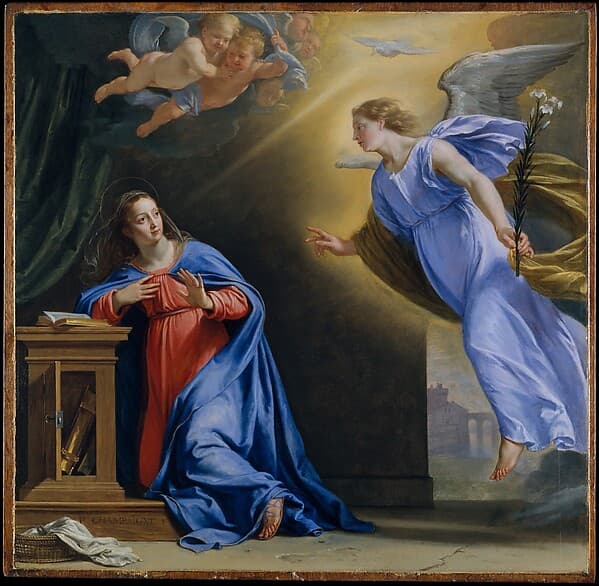
The Annunciation, painted by Philippe de Champaigne around 1639 in oil on canvas and now in the Metropolitan Museum of Art in New York, depicts the moment from Luke 1 in which the angel Gabriel appears to the Virgin in her chamber to announce the conception of Christ. Philippe de Champaigne stages the scene with characteristic Paris-Flemish compositional discipline: the Virgin kneels at her prayer-desk on the right, the angel descends from the upper left in an attitude of greeting with the lily of purity in one hand, the Holy Spirit appears as a small dove on a beam of golden light from above. The chromatic palette of saturated rose, ultramarine, and warm flesh against the carefully detailed Northern interior reflects the early Champaigne combination of Flemish technique with the new Italianate Roman compositional discipline that defined his mature Paris workshop manner.
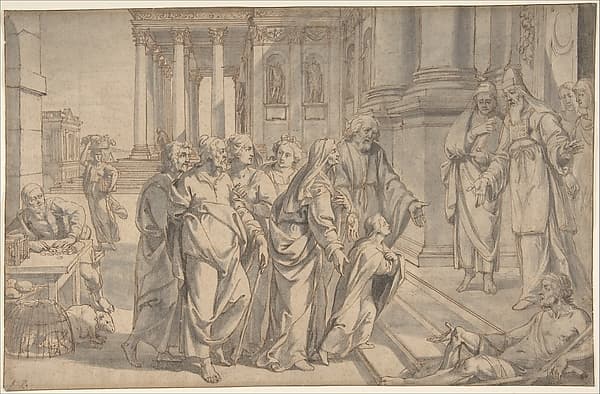
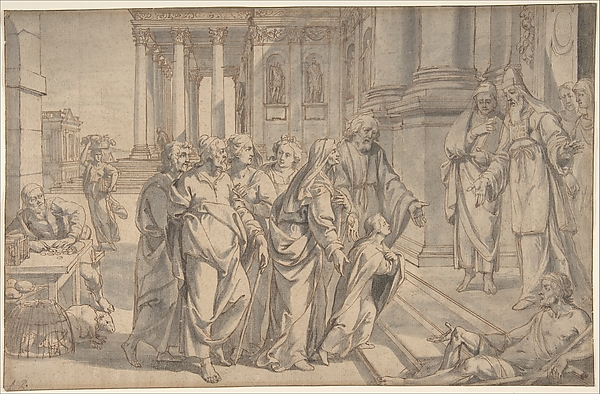
The Presentation of the Virgin
The Presentation of the Virgin, drawn by Philippe de Champaigne around 1610 (early in his Brussels career, before his Paris move in 1621) in pen and brown ink with wash on paper and now in the Metropolitan Museum of Art in New York, depicts the moment from the apocryphal Marian narrative in which the young Mary, at age three, is presented by her parents Anne and Joachim to the Temple in Jerusalem to be raised in the service of the Lord. The drawing shows the small Mary climbing the Temple steps toward the high priest who waits at the upper register, with Anne and Joachim standing in formal attendance behind. The drawing demonstrates the early Champaigne draughtsmanship before his Paris career began.
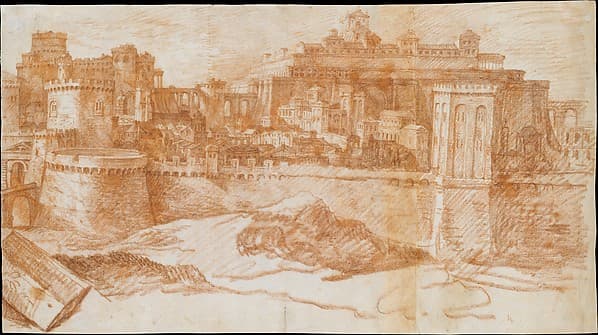
View of Jerusalem with the Temple of Solomon
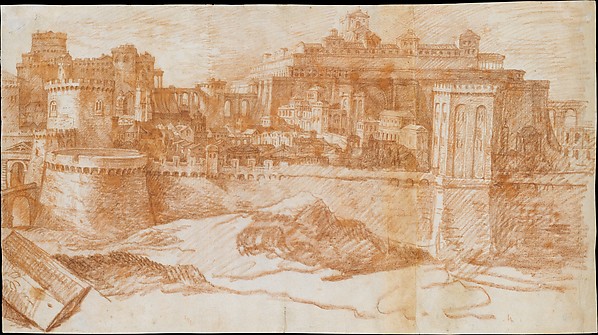
View of Jerusalem with the Temple of Solomon, drawn by Philippe de Champaigne around 1610 in pen and brown ink with wash on paper and now in the Metropolitan Museum of Art in New York, is a small preparatory drawing for an architectural-and-landscape composition of the Holy City. The drawing shows the panoramic view of Jerusalem from outside the city walls, with the great Temple of Solomon rising at the center of the composition and the surrounding city architecture and the Mount of Olives in the deeper background. The drawing reflects the seventeenth-century French interest in the careful topographical reconstruction of the Holy Land — a particular preoccupation of the Jansenist circle that would later shape Champaigne's mature Paris religious painting.