1 Kings 6
People in this chapter
For seven years the temple rose, and no one heard it. The stones were cut and shaped at the quarry, then carried up and fitted without a sound - no hammer, no axe, no iron tool in the holy place. Solomon was building the house David was promised but never allowed to raise.1 The work itself was an offering. You build this kind of thing slowly, or not at all.
Tap any highlighted phrase to jump to the commentary that unpacks it.
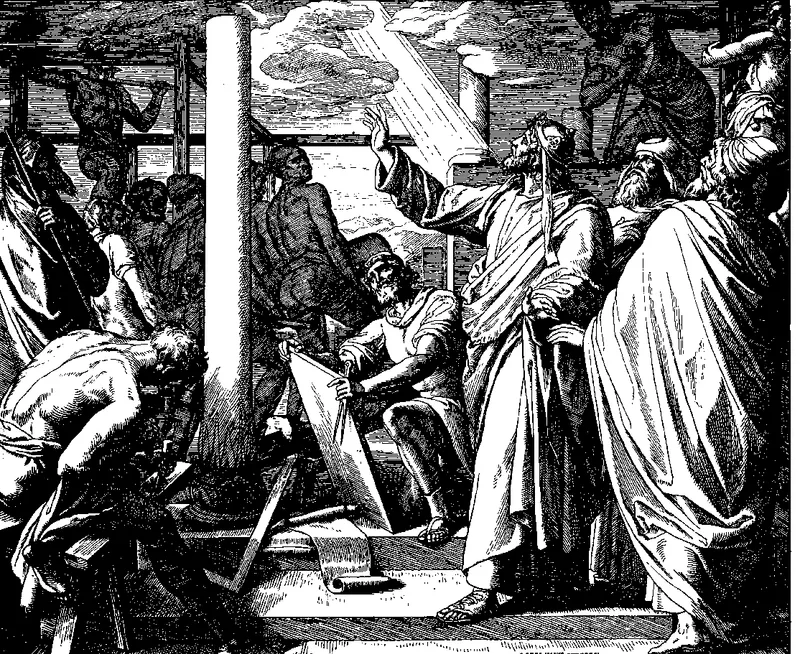
1 Kings 6:1-10The House Takes Shape
1And it came to pass in the four hundred and eightieth year after the children of Israel were come out of the land of Egypt, in the fourth year of Solomon’s reign over Israel, in the month Zif, which is the second month, that he began to build the house of the LORD. 2And the house which king Solomon built for the LORD, the length thereof was threescore cubits, and the breadth thereof twenty cubits, and the height thereof thirty cubits. 3And the porch before the temple of the house, twenty cubits was the length thereof, according to the breadth of the house; and ten cubits was the breadth thereof before the house. 4And for the house he made windows of narrow lights. 5And against the wall of the house he built chambers round about, against the walls of the house round about, both of the temple and of the oracle: and he made chambers round about:
The Lord's house is commanded; now the building begins - stone and cedar rise where wood once stood213.
6The nethermost chamber was five cubits broad, and the middle was six cubits broad, and the third was seven cubits broad: for without in the wall of the house he made narrowed rests round about, that the beams should not be fastened in the walls of the house. 7And the house, when it was in building, was built of stone made ready before it was brought thither: so that there was neither hammer nor axe nor any tool of iron heard in the house, while it was in building. 8The door for the middle chamber was in the right side of the house: and they went up with winding stairs into the middle chamber, and out of the middle into the third. 9So he built the house, and finished it; and covered the house with beams and boards of cedar. 10And then he built chambers against all the house, five cubits high: and they rested on the house with timber of cedar.
The 480th year after the exodus is a precise chronological marker - though scholars debate its historical calculation, the text places the temple's foundation in a moment of measured time, as though to say: this happens at a known moment, in a known reign, in a known month. Some scholars date this to approximately 967 BCE. The point is the covenant: in the fourth year of Solomon's reign, the promise made to David is beginning to be fulfilled.
"Windows of narrow lights" - the phrase suggests windows that allow light to enter but do not open to the outside. The temple admits light from heaven but is closed to the world. It is a place set apart, holy, where the divine light enters but human noise and traffic do not penetrate.
The chambers built against the temple walls served practical purposes - storage, preparation, the housing of priestly activities. But they also created a graduated entry into holiness. The outer chambers, broader and lower, gave way to the inner ones, narrower and more elevated, finally opening into the most holy place. The structure itself taught the hierarchy of sacred space.
This is perhaps the most remarkable detail in the passage: there was neither hammer nor axe nor any tool of iron heard in the house while it was being built. The stones were quarried, shaped, and fitted in the silence of the quarries before being brought to Jerusalem. Here at the site, they were assembled without noise, without discord. The work of holiness is work done in peace, in order, in reverence. It speaks to something deep in the biblical imagination: that true building, true creation, is a kind of silence, the silence of perfect purpose.
1 Kings 6:11-14The Covenant Condition
11And the word of the LORD came to Solomon, saying, 12Concerning this house which thou art in building, if thou wilt walk in my statutes, and execute my judgments, and keep all my commandments to walk in them; then will I perform my word with thee, which I spake unto David thy father: 13And I will dwell among the children of Israel, and will not forsake my people Israel. 14So Solomon built the house, and finished it.
The walls are rising, the gold is going up, and right in the middle of all that progress God interrupts with a condition: If thou wilt walk in my statutes. The building is not the guarantee. A finished temple does not hold God the way a cage holds a bird; His presence stays bound to the obedience of the king and the people. This is how covenant works throughout Scripture. The gift is given freely, and it asks for a life in return.
The word God spoke to David long before, that his son would build the house (2 Samuel 7), is now being kept in front of Solomon's eyes. To perform my word with thee is covenant language: God binding Himself to do what He said. But the keeping comes hedged with an if. The promise is sure, and the participation is real. The temple is the sign of it; the obedience of the king is how he steps inside the promise rather than merely watching it from the scaffolding.
Here is the line the whole chapter has been building toward, a promise: I will dwell among the children of Israel, and will not forsake my people Israel (v. 13). God could have blessed Israel from a safe distance, the way a king favors a province he never visits. Instead He says He will move in - will pitch His tent in the middle of them and stay. The word reaches back through the wilderness and the tabernacle, and it reaches forward to the day John would write that the Word dwelt among us.
If you have ever wondered whether God wants to be near you or merely tolerates you, this is His own answer: He builds Himself a house so He can live where His people live.
1-kings 6:15-19Cedar Walls, Hidden Stone
15And he built the walls of the house within with boards of cedar, both the floor of the house, and the walls of the ceiling: and he covered them on the inside with wood, and covered the floor of the house with planks of fir. 16And he built twenty cubits on the sides of the house, both the floor and the walls with boards of cedar: he even built them for it within, even for the oracle, even for the most holy place. 17And the house, that is, the temple before it, was forty cubits long. 18And the cedar of the house within was carved with knops and open flowers: all was cedar; there was no stone seen. 19And the oracle he prepared in the house within, to set there the ark of the covenant of the LORD.
The walls, floor, and ceiling are paneled with cedar - a wood of fragrance and durability. The cedar boards are carved with knops (decorative buds) and open flowers. The entire inner surface speaks: there is no stone seen, only wood, only beauty, only the scent of the sanctuary. And in the midst of this ornate chamber, Solomon prepares a space - the oracle, the most holy place - where the ark of the covenant will rest.
1-kings 6:20-22The Cube of Pure Gold
20And the oracle in the forepart was twenty cubits in length, and twenty cubits in breadth, and twenty cubits in the height thereof: and he overlaid it with pure gold; and so covered the altar which was of cedar. 21So Solomon overlaid the house within with pure gold: and he made a partition by the chains of gold before the oracle; and he overlaid it with gold. 22And the whole house he overlaid with gold, until he had finished all the house: also the whole altar that was by the oracle he overlaid with gold.
The oracle is a perfect cube: twenty cubits in length, breadth, and height. And it is covered - completely covered - with pure gold. The altar, the walls, the partition separating the oracle from the outer chamber, even the chains that hold the doors - all overlaid with gold. This is not decoration; this is theological statement. Gold is eternal, incorruptible, precious beyond measure. The sanctuary is the place where the earthly meets the eternal, and its covering proclaims: here, heaven touches earth.
1-kings 6:23-25Two Cherubim of Olive Wood
23And within the oracle he made two cherubims of olive tree, each ten cubits high. 24And five cubits was the one wing of the cherub, and five cubits the other wing of the cherub: from the uttermost part of the one wing unto the uttermost part of the other were ten cubits. 25And the other cherub was ten cubits: both the cherubims were of one measure and one size.
1-kings 6:26-30Wings That Met in the Middle
26The height of the one cherub was ten cubits, and so was it of the other cherub. 27And he set the cherubims within the inner house: and they stretched forth the wings of the cherubims, so that the wing of the one touched the one wall, and the wing of the other cherub touched the other wall; and their wings touched one another in the midst of the house. 28And he overlaid the cherubims with gold.
Two cherubim of olive wood stand within the oracle. Each is ten cubits high - as tall as the sanctuary itself. Their wingspans are precise: five cubits per wing, ten cubits from tip to tip. And they are positioned so that one wing of each touches the wall - the east wall, the west wall. Their inner wings meet in the very center of the room, above the ark of the covenant. The cherubim do not sit upon the ark; they form a throne above it, their wings creating a sacred space where heaven and earth meet.
And they, too, are overlaid with gold.
29And he carved all the walls of the house round about with carved figures of cherubims and palm trees and open flowers, within and without. 30And the floor of the house he overlaid with gold, within and without.
The carvings cover every wall - cherubim standing guard, palm trees speaking of paradise, open flowers blooming in perpetual spring. The entire sanctuary is carved and covered: walls, floor, cherubim, all speaking the same language: holiness, beauty, the presence of the divine made visible in matter. And the floor itself is gold - the very ground upon which one walks in the holy place is precious, is eternal, is set apart. There is no corner of this space that is ordinary. Everything has been consecrated.
The outer temple was forty cubits long (the other dimension being twenty), while the oracle - the inner sanctuary, the most holy place - was a perfect cube: twenty by twenty by twenty. The oracle takes up the back half of the temple. It is the holy of holies, the inner chamber, the place where God Himself will dwell above the ark of the covenant.
Gold. Gold everywhere. The altar overlaid with pure gold. The walls overlaid with gold. The floor overlaid with gold. The cherubim overlaid with gold. In the ancient world, gold was not merely valuable; it was sacred. It did not tarnish, did not corrupt. It represented eternity, incorruptibility, the divine. By covering the inner sanctuary with gold, Solomon was saying something wordless but profound: this place is eternal, this place is divine, this is where heaven touches earth.
The geometry of the cherubim is precise and meaningful. Each cherub has a wingspan of five cubits from tip to tip. Each stands ten cubits high. Their wings stretch across the sanctuary - one wing touches the east wall, the other wing touches the west wall. Their inner wings meet in the middle of the room. It is as though they are creating a protective space around the invisible presence of God. The point where their wings meet is the center of the holy of holies, the exact spot where the ark of the covenant rests.
The cherubim form a throne for the invisible God.
1 Kings 6:31-38Seven Years Complete
31And for the entering of the oracle he made doors of olive tree: the lintel and side posts were a fifth part of the wall. 32The two doors also were of olive tree; and he carved upon them carvings of cherubims and palm trees and open flowers, and overlaid them with gold, and spread gold upon the cherubims, and upon the palm trees. 33So also made he for the door of the temple posts of olive tree, a fourth part of the wall. 34And the two doors were of fir tree: the two leaves of the one door were folding, and the two leaves of the other door were folding.
Even the doors preach. Made of olive wood and folding in two leaves, they are carved with the same three things repeated everywhere in this house: cherubim, palm trees, open flowers - and then overlaid with gold. To pass through the doorway is to walk through a garden guarded by angels. Anyone who remembers Eden, with its cherubim set at the gate, would feel the echo. The way back into God's presence is being reopened, one carved threshold at a time.
35And he carved thereon cherubims and palm trees and open flowers: and covered them with gold fitted upon the carved work. 36And he built the inner court with three rows of hewed stone, and a row of cedar beams. 37In the fourth year was the foundation of the house of the LORD laid, in the month Zif: 38And in the eleventh year, in the month Bul, which is the eighth month, was the house finished throughout all the parts thereof, and according to all the fashion of it. So was he seven years in building it.
Even the measurements of the doors are governed by sacred geometry. The lintel and side posts are a fifth part of the wall - a proportion that echoes throughout the temple. Nothing is arbitrary. Every measurement speaks of order, of purpose, of a cosmos brought into being by divine intention.
And then it is simply done. The text closes the books like an accountant: foundation laid in the fourth year, the house finished in the eleventh, throughout all the parts thereof, and according to all the fashion of it. Nothing left unfinished, nothing improvised at the end. The same care that shaped each stone in silence carried all the way through to the last carved flower. What God begins in His house, He brings to completion.
Seven years. The number itself speaks. Seven is the number of completion in biblical numerology, the number of rest, of Sabbath. For seven years the hammer fell in the quarries, the craftsmen shaped stone and timber, the gold was beaten and applied. Seven years to build the throne of God in the midst of Israel. Not rushed, not hurried. Accomplished in the rhythm of creation itself.
Research trail
Sources & further study
These references support the historical, linguistic, manuscript, and contextual notes in this chapter. Scripture remains the primary text; external sources are provided so readers can inspect the research directly.
- Building the TempleDetailed description of the temple's construction, dimensions, and interior decoration.
- The First Temple: Scale ModelMuseum model and archaeological finds illuminating the architecture of Solomon's temple.
- The Temple: Israel's Holy HouseOverview of the temple's religious and political significance in Israel's monarchy.
Where this echoes in Scripture
Wings That Met in the Middle
- John 1:14And the Word was made flesh, and dwelt among us, (and we beheld his glory...).The promise of verse 13 carried further - God dwelling among His people, now in flesh.
- Colossians 2:9For in him dwelleth all the fulness of the Godhead bodily.The gold-lined dwelling of the most holy place answered in a Person.
- Hebrews 9:11-12Christ being come an high priest... by his own blood he entered in once into the holy place, having obtained eternal redemption for us.The sealed inner sanctuary (vv. 19-22) entered and opened by Christ.
- Exodus 25:21-22And thou shalt put the mercy seat above upon the ark... there I will meet with thee.The cherubim over the ark (vv. 23-28) as the appointed place of meeting.