Painter of the Bible
Maarten van Heemskerck
Maarten van Heemskerck was the leading Dutch Romanist of the sixteenth century — a Northern painter whose long Roman sojourn (1532–1536/37) immersed him in Michelangelo's late Sistine Chapel and the recovered antiquities…
.jpg%3Fwidth%3D600&w=2048&q=75)
Their faith
Why Maarten van Heemskerck painted Christ
Maarten van Heemskerck was a devoted Roman Catholic artist whose faith deeply influenced his work throughout his life. Born in the small town of Heemskerk, he trained under notable mentors before embarking on a transformative journey to Rome, where he immersed himself in the art and spirituality of the High Renaissance. His time in the eternal city, particularly his exposure to Michelangelo's masterpieces, ignited a passion for sacred themes that would resonate throughout his career. Heemskerck’s commitment to his faith is evident not only in the subjects he chose but also in the reverence with which he approached his craft, often creating works intended for altarpieces and religious settings that would inspire devotion among the faithful.
Heemskerck's faith is beautifully reflected in several of his notable works, including the Saint Lawrence Altarpiece and the Crucifixion altarpiece, both of which showcase his ability to convey profound spiritual narratives. The Saint Lawrence Altarpiece, commissioned by a Dutch patron, stands as a testament to his dedication to depicting Christian themes with grandeur and emotional depth. His engravings, such as the Triumph of Christ, further illustrate his commitment to spreading the gospel through art, reaching countless households across the Netherlands and beyond. Even in the face of adversity, such as the Iconoclastic Fury that threatened his work, Heemskerck's artistic legacy endures, reminding us of the power of faith to inspire beauty and devotion in the hearts of viewers today.
Life & work
Maarten van Heemskerck was the leading Dutch Romanist of the sixteenth century — a Northern painter whose long Roman sojourn (1532–1536/37) immersed him in Michelangelo's late Sistine Chapel and the recovered antiquities of the city, and whose subsequent four-decade career in Haarlem made him the principal channel through which Roman High Renaissance vocabulary entered Netherlandish religious art. Born in Heemskerk near Haarlem in 1498, trained in Haarlem first by Cornelis Willemsz and then in Jan van Scorel's circle, and active in Haarlem after his return until his death there in 1574, he produced both ambitious painted altarpieces and an enormous body of designs for engraving.
The Saint Lawrence Altarpiece (Linköping Cathedral, Sweden, 1538–1540) — commissioned by a Dutch patron, completed after his return from Rome, dispersed in the seventeenth century, and partly reassembled in Sweden — remains his largest documented Christian narrative project. The Crucifixion altarpiece in the Frans Hals Museum (Haarlem) and the Saint Luke Painting the Virgin (Haarlem, c. 1532, painted as a guild gift before his Italian trip and showing the painter's own self-portrait as Saint Luke) are among the principal anchors of his painted reputation.
His engraved output is vast and entirely religious in subject. The Triumph of Christ (1559) is a great twelve-plate Old- and New-Testament cycle. The Story of Eliezer and Rebecca, the Passion in eight prints, the great Acts of the Apostles series engraved by Philip Galle and others after Heemskerck's designs, the Old Testament patriarchs, the Triumphs of Patience, and dozens of other devotional series circulated through the Antwerp publishing houses of Hieronymus Cock and his successors. By volume, Heemskerck was the most-engraved Northern designer of his generation; the prints carried his Romanist vocabulary into every Protestant and Catholic household that could afford them.
He survived the Iconoclastic Fury of 1566 — when Calvinist mobs destroyed Catholic religious imagery across the Low Countries, including some of his own altarpieces — and the early years of the Dutch Revolt; his late Haarlem work shows the move toward the smaller, intimate, Old Testament-leaning religious painting that the new Protestant patrons preferred.
Notable works in detail
met-359446
Ecce Homo, designed by Maarten van Heemskerck around 1510 (probably in his early Haarlem years before the formative Italian sojourn of 1532–1537) and engraved by his workshop, depicts the moment from the Passion narratives in which Pontius Pilate presents the scourged and crowned-with-thorns Christ to the assembled crowd with the Latin words Ecce Homo (Behold the man). Heemskerck stages the scene on the small stone balcony of the Praetorium with Christ in the center, the Roman soldiers on either side of him holding the reed scepter and pointing to the wound, and Pilate standing slightly behind addressing the crowd that fills the lower foreground. The composition is among the early Heemskerck treatments of the Passion subject and demonstrates the careful Northern Renaissance figural drawing that would later be transformed by his Italian study trip into the Romanist manner that defined his mature output.
met-405360
Judith Slaying Holofernes, designed by Maarten van Heemskerck in 1530 (in his late pre-Roman Haarlem years) and engraved by his workshop as part of the great Story of Judith series, depicts the climactic moment of the deuterocanonical Book of Judith: the young Hebrew widow saws through the neck of the drunken Assyrian general in his command tent. Heemskerck stages the act with characteristic Northern Mannerist drama — Judith leaning back from the spurting blood with an expression of fastidious determination, the elderly servant Abra leaning in to hold open the linen sack into which the head will fall, the body of Holofernes sprawled across the bed in a complex foreshortened pose. The Story of Judith series, published in Antwerp by Hieronymus Cock at Aux Quatre Vents, was one of the most reproduced sixteenth-century Northern treatments of the Old Testament subject.
met-405357
Christ Driving the Money Changers from the Temple, designed by Maarten van Heemskerck in 1548 (in his mature post-Roman Haarlem years) and engraved by his workshop for publication in Antwerp by Hieronymus Cock at Aux Quatre Vents, illustrates the scene from John 2 (and parallel passages in the Synoptics) in which Christ overturns the tables of the money-changers and dove-sellers in the outer court of the Temple. Heemskerck stages the scene in an architectural setting that combines Northern Mannerist figural drawing with the Roman classical-architecture vocabulary he had absorbed during his 1532–1537 Italian sojourn — the columns and pediments of the Temple court are unmistakably Roman, the figures in their poses of flight and resistance are unmistakably Antwerp-Mannerist. The print circulated widely through the Cock distribution network and shaped the iconographic tradition of the subject for several generations.
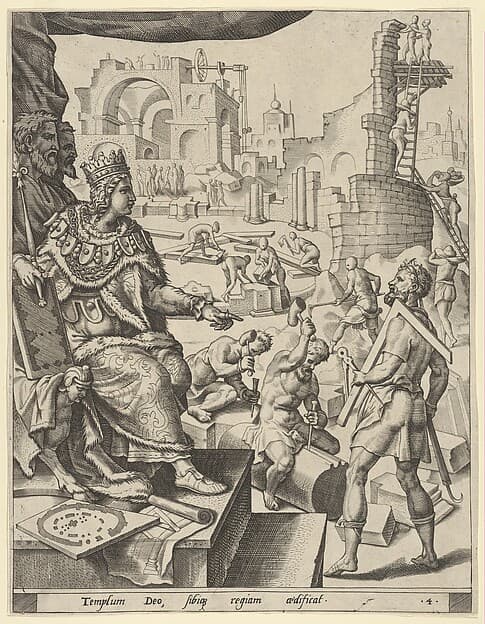
Solomon Building the Temple, from "The Story of Solomon"
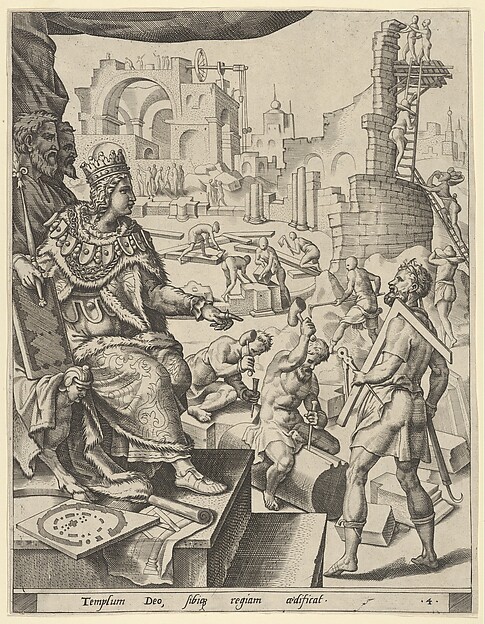
Solomon Building the Temple, designed by Maarten van Heemskerck in 1554 as one of the plates of the Story of Solomon series and engraved by his workshop for publication in Antwerp by Hieronymus Cock at Aux Quatre Vents, illustrates the great construction project from 1 Kings 6 in which Solomon erects the Temple in Jerusalem with cedar from Lebanon and stone from the quarries of Ophir. Heemskerck stages the scene as a vast architectural panorama — the temple under construction at the upper right with workers crawling over scaffolds, the hewn cedar logs being floated down from the north in the middle distance, Solomon directing the work from a small viewing platform on the left foreground, his courtiers and advisers gathered around him. The print is among the most ambitious of Heemskerck's late Old Testament narrative engravings and one of the principal sixteenth-century Northern visualizations of the Temple subject.