Judith 13
People in this chapter
Everything in the book of Judith has narrowed to this room. The city of Bethulia is days from surrender, its cisterns nearly dry, and Holofernes, the Assyrian general, is certain that beauty and wine have finally delivered this Hebrew widow into his hands. The servants withdraw. The doors close. Judith is alone with the most powerful enemy Israel faces, and he is helpless with drink. What she does in the next moments is brutal and decisive, and the text never lets us forget how it was done.
Before she touches the sword she prays. With the sword in her hand she prays again. The deed is hers, the danger is hers, and the strength she asks for is entirely God's.
Tap any highlighted phrase to jump to the commentary that unpacks it.
Judith 13:1-5The Doors Close and the Widow Is Left Alone
1And when it was grown late, his servants made haste to their lodgings, and Vagao shut the chamber doors, and went his way. 2And they were all overcharged with wine. 4But Holofernes lay on his bed, fast asleep, being exceedingly drunk.
The scene is set with a few quiet strokes. The servants hurry off to bed, the steward shuts the doors and leaves, and the whole camp is heavy with wine. Every detail that should make Judith more vulnerable, the locked room, the absent guards, the powerful man who has waited for this night, becomes in the story's logic the very thing that exposes him. Holofernes meant to use his power and his appetite to ruin her.
Those same appetites have left him defenseless. The narrative lets us see how a strength that serves only itself becomes, in the end, a kind of blindness.
Holofernes is described with a single devastating line: lying on his bed, fast asleep, exceedingly drunk. The man who has terrified nations cannot lift a hand to save himself. Scripture often pictures the downfall of the proud this way: a collapse from within, the proud man ruined by his own appetites. The enemy of God's people is at the height of his confidence and the depth of his helplessness in the same moment. What looks like Judith's opportunity the story will name as God's doing.
3And Judith was alone in the chamber. 5And Judith spoke to her maid to stand without before the chamber, and to watch:
Judith was alone. Four words that carry the weight of the chapter. No army stands behind her, no rescuer waits in the next room, no second chance is built into the plan. Her faithful maid keeps watch at the door, but the decisive moment belongs to one woman in an enemy's tent with no margin for error. The story has placed her exactly where deliverance so often comes in Scripture, at the narrow point where everything depends on God and a single trembling act of obedience.
Being alone is not the same as being abandoned, and the next verses will show the difference.
Judith 13:6-10Strengthen Me, O Lord God, at This Hour
6And Judith stood before the bed praying with tears, and the motion of her lips in silence, 7Saying: Strengthen me, O Lord God of Israel, and in this hour look on the works of my hands, that as thou hast promised, thou mayst raise up Jerusalem thy city: and that I may bring to pass that which I have purposed, having a belief that it might be done by thee.
At the decisive moment Judith does not reach for the sword. She stands before the bed and prays, with tears, her lips moving in silence so the sleeping man and the camp beyond hear nothing. The most violent act in the book is wrapped on both sides in prayer, and the story wants us to feel the weight of that. Here is a woman who knows that what she is about to do is beyond her, who weeps even as she steels herself, and who will not lift her hand until she has lifted her heart.
The silence of her prayer is its own kind of courage.
Her prayer is almost entirely about God and almost nothing about herself. "Strengthen me," she asks: let your strength move in me. She binds her own act to God's ancient promise, that He would raise up Jerusalem His city, asking Him to look on the works of her hands and make them serve His purpose. She does not pretend the deed is not hers; she calls it "the works of my hands" plainly. Yet she lays those hands open before God and asks Him to be the one who acts through them.
This is the heart of faithful courage, owning your part while resting the outcome entirely on God.
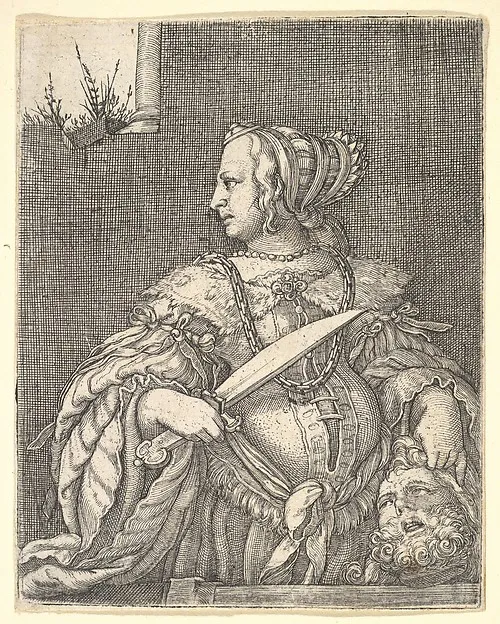
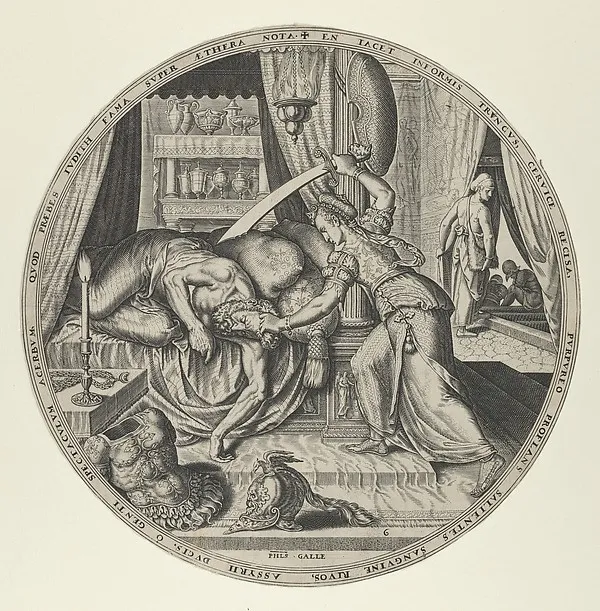
8And when she had said this, she went to the pillar that was at his bed’s head, and loosed his sword that hung tied upon it. 9And when she had drawn it out, she took him by the hair of his head, and said: Strengthen me, O Lord God, at this hour. 10And she struck twice upon his neck, and out off his head, and took off his canopy from the pillars, and rolled away his headless body.
She prays a second time, and this time the cry is even barer: "Strengthen me, O Lord God, at this hour." The repetition is dependence pressed to its limit. With his own sword drawn and his hair in her grip, at the exact instant when nerve could fail, she reaches again for God. Faith is a moment-by-moment leaning, a returning to God at "this hour" and then the next. The bravest people in Scripture are often the ones who pray most.
It is done with the enemy's own sword, in two strokes, and the story does not soften it. Then she takes the canopy from his bed as a token and rolls the body aside. Across Scripture, God repeatedly delivers His people through the smallest and least likely instrument, a shepherd's sling, a tent peg, a boy's loaves, so that the deliverance can only be credited to Him. A widow with a borrowed sword belongs in that company.
The very improbability of the deliverer is the point: when Israel tells this story, no one will be able to say they saved themselves.
Judith 13:11-16Open the Gates, for God Is With Us
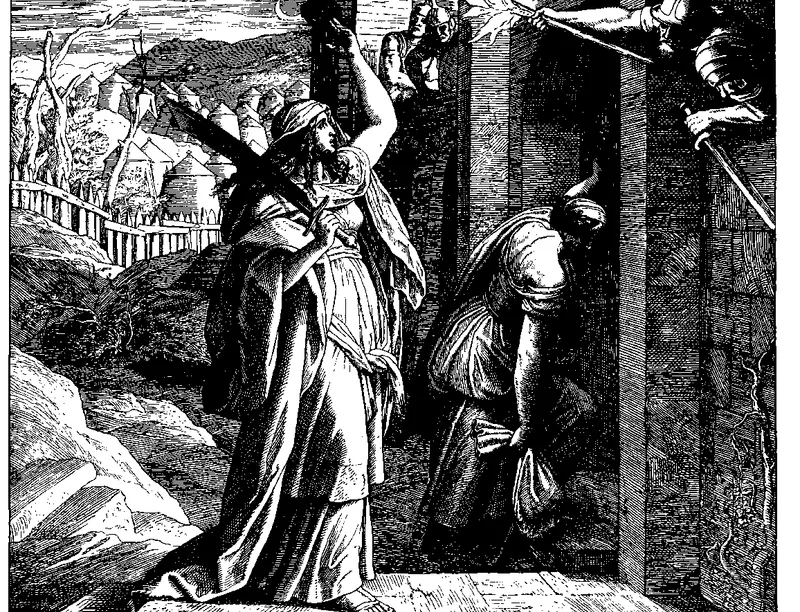
11And after a while she went out, and delivered the head of Holofernes to her maid, and bade her put it into her wallet. 12And they two went out according to their custom, as it were to prayer, and they passed the camp, and having compassed the valley, they came to the gate of the city.
The escape turns on a habit. Night after night Judith and her maid had gone out of the camp "as it were to prayer," until the guards stopped noticing. Now they walk out the same way, the head of the general hidden in the bag, and no one thinks to stop them. The patient, ordinary faithfulness of those earlier nights becomes the road home. There is a quiet lesson tucked into the detail: the small, unglamorous disciplines we keep when nothing seems to be happening are often what carry us through the hour when everything is at stake.
13And Judith from afar off cried to the watchmen upon the walls: Open the gates for God is with us, who hath shewn his power in Israel.
Her first words to her city are a confession of what God did. "Open the gates, for God is with us, who hath shewn his power in Israel." She had left a town despairing, its leaders ready to surrender if no rescue came in days. She returns announcing that the rescue has come and naming its true author. The cry "God is with us" is the oldest comfort of His people, the meaning folded into the name Immanuel, and it reaches its fullest depth when the New Testament gives that very name to a child born to save.
Here a widow shouts it up to the walls in the dark, and it turns out to be true.
15And all ran to meet her from the least to the greatest: for they now had no hopes that she would come. 16And lighting up lights they all gathered round about her: and she went up to a higher place, and commanded silence to be made. And when all had held their peace,
The detail is poignant: they had no hope she would come back. The city had written her off, given her up for lost or dead, and yet here she stands at the gate alive and victorious. The whole town pours out, from the least to the greatest, lighting torches against the night. Deliverance has a way of arriving exactly where hope has run out. The people who had stopped expecting anything are the first to come running, and what they find is far beyond what they dared to ask.
God's saving work often meets His people precisely at the end of their hope, when they can no longer claim credit for what is about to happen.
Judith 13:17-22By My Hand, and by the Hand of the Lord
17Judith said: Praise ye the Lord our God, who hath not forsaken them that hope in him. 18And by me his handmaid he hath fulfilled his mercy, which he promised to the house of Israel: and he hath killed the enemy of his people by my hand this night.
Standing above the crowd with every eye on her, Judith opens with "praise ye the Lord our God." The first thing she does with her victory is hand it back. And she names exactly the truth the night has proven: God "hath not forsaken them that hope in him." The city had teetered on the edge of believing themselves abandoned. Judith's deed becomes living evidence against that despair. The God of Israel does not forsake the hope set on Him, even when the rescue comes later and stranger than anyone expected.
Listen to how carefully she speaks: "by me his handmaid he hath fulfilled his mercy," and "he hath killed the enemy of his people by my hand." She holds two truths together without letting either swallow the other. The hand was hers; she does not pretend otherwise. The victory was God's; she will not claim it. She is the instrument, willing and real, and God is the one who acted through her. This is the posture of every faithful servant in Scripture, doing the work with everything they have while insisting that the increase belongs to God alone.
19Then she brought forth the head of Holofernes out of the wallet, and shewed it them, saying: Behold the head of Holofernes the general of the army of the Assyrians, and behold his canopy, wherein he lay in his drunkenness, where the Lord our God slew him by the hand of a woman. 20But as the same Lord liveth, his angel hath been my keeper both going hence, and abiding there, and returning from thence hither: and the Lord hath not suffered me his handmaid to be defiled, but hath brought me back to you without pollution of sin, rejoicing for his victory, for my escape, and for your deliverance.
Judith testifies that she did not go alone after all. An angel of the Lord, she says, was her keeper, going out, staying there, and coming back. The woman who seemed most exposed was in fact most guarded, and she names the protection as God's own. She is careful to say she returns undefiled, kept whole through the danger she walked into. The story it recalls runs all through Scripture: the people of God are watched over by His unseen messengers, and the saint who steps into the lion's den is not abandoned to it.
What looked like a woman utterly alone was a woman under guard the entire time.
21Give all of you glory to him, because he is good, because his mercy endureth for ever. 22And they all adored the Lord, and said to her: The Lord hath blessed thee by his power, because by thee he hath brought our enemies to nought.
Her closing words gather the whole night into a single call: "Give all of you glory to him, because he is good, because his mercy endureth for ever." It is the refrain of Israel's great songs of thanksgiving, the line the Psalms return to again and again. Judith refuses to let the moment become a monument to her own daring. She turns the gaze of the rescued city straight up to the God who rescued them.
And the people answer rightly: they adore the Lord first, and only then bless Judith, as His instrument. Worship is how God's people are meant to receive deliverance.
Judith 13:23-31Blessed Art Thou, and Blessed Be the Lord
23And Ozias the prince of the people of Israel, said to her: Blessed art thou, O daughter, by the Lord the most high God, above all women upon the earth. 24Blessed be the Lord who made heaven and earth, who hath directed thee to the cutting off the head of the prince of our enemies.
Ozias, the leader of the city, blesses Judith "above all women upon the earth," and in the same breath blesses "the Lord who made heaven and earth," who directed her hand. The two blessings belong together. Judith is genuinely honored, her courage is genuinely praised, and yet the praise of the woman flows straight into the praise of God who worked through her. Centuries later Elizabeth would greet Mary with words that ring like these, "Blessed art thou among women" (Luke 1:42).
Scripture knows how to honor the faithful without ever letting the honor stop short of God. The servant is blessed; the Lord is glorified; and the order is never reversed.
25Because he hath so magnified thy name this day, that thy praise shall not depart out of the mouth of men who shall be mindful of the power of the Lord for ever, for that thou hast not spared thy life, by reason of the distress and tribulation of thy people, but hast prevented our ruin in the presence of our God. 26And all the people said: So be it, so be it.
Ozias promises that Judith's name will not be forgotten, that people will remember her "for that thou hast not spared thy life" for the sake of her people. But notice what her remembered name is meant to point to: those who recall her will "be mindful of the power of the Lord for ever." Her lasting fame is tethered to God's glory. Her story endures because of the God it reveals, the One who saves through self-giving love and uses those willing to lay down their lives.
The whole assembly seals it with "so be it, so be it," and the city makes her praise its own.
27And Achior being called for came, and Judith said to him: The God of Israel, to whom thou gavest testimony, that he revengeth himself of his enemies, he hath cut off the head of all the unbelievers this night by my hand. 29Then Achior seeing the head of Holofernes, being seized with a great fear he fell on his face upon the earth, and his soul swooned away.
Achior, the foreigner who had earlier warned Holofernes that the God of Israel defends those who trust Him, is summoned to see the proof of his own words. The sight overwhelms him; he falls on his face and faints. When he recovers, the man who was an outsider to the covenant bows in awe before the God of Israel. The story reaches past the borders of one people. The deliverance at Bethulia becomes a testimony even to the stranger, a sign that the God of Israel is the living God whose power the nations must reckon with.
What God does for His own becomes a light to those outside, drawing them toward Him.
31Blessed art thou by thy God in every tabernacle of Jacob, for in every nation which shall hear thy name, the God of Israel shall be magnified on occasion of thee.
The chapter ends on a wide horizon. Achior declares that in every nation that hears Judith's name, "the God of Israel shall be magnified." Her story will not stay inside one city's walls; it will carry the fame of her God outward to the peoples. This is the quiet purpose under the whole account. A single faithful life, surrendered to God in the hour of danger, becomes a reason for the nations to honor Him.
The deliverance of Bethulia was always aimed beyond Bethulia, toward the magnifying of the God who saves, in every tabernacle of Jacob and in every nation that would one day hear.
Where this echoes in Scripture
The Doors Close and the Widow Is Left Alone
- Isaiah 41:10Fear thou not; for I am with thee: be not dismayed; for I am thy God: I will strengthen thee; yea, I will help thee.The promise Judith leans on in the locked room: the God who strengthens is present.
- Proverbs 16:18Pride goeth before destruction, and an haughty spirit before a fall.Holofernes at the peak of his confidence is at the edge of his fall.
- Psalm 23:4Though I walk through the valley of the shadow of death, I will fear no evil: for thou art with me.Alone in the enemy camp, she is not without a Keeper.
Strengthen Me, O Lord God, at This Hour
- Philippians 4:13I can do all things through Christ which strengtheneth me.Judith's "strengthen me" answered: the strength to act flows from God.
- 1 Samuel 17:47All this assembly shall know that the LORD saveth not with sword and spear: for the battle is the LORD's.Like David, Judith wins so that the victory can only be called God's.
- 2 Corinthians 12:9My grace is sufficient for thee: for my strength is made perfect in weakness.The power she asks for is the strength that meets human weakness at its limit.
Open the Gates, for God Is With Us
- Matthew 1:23They shall call his name Emmanuel, which being interpreted is, God with us.Judith's cry "God is with us" finds its deepest meaning in the name given to Christ.
- Psalm 46:1God is our refuge and strength, a very present help in trouble.The same confidence the watchmen hear shouted up to the wall.
- Luke 24:21But we trusted that it had been he which should have redeemed Israel.Like the city that lost hope, the disciples had given up just before the greatest deliverance.
By My Hand, and by the Hand of the Lord
- Luke 1:51-54He hath shewed strength with his arm; he hath scattered the proud... He hath holpen his servant Israel, in remembrance of his mercy.Mary's song echoes Judith's: the proud cast down, God's mercy remembered.
- Genesis 3:15It shall bruise thy head, and thou shalt bruise his heel.The promise that the enemy's head would be crushed, foreshadowed in this very deed.
- Psalm 136:1O give thanks unto the LORD; for he is good: for his mercy endureth for ever.The exact refrain Judith presses on the city: His goodness, His everlasting mercy.
Blessed Art Thou, and Blessed Be the Lord
- Luke 1:42Blessed art thou among women, and blessed is the fruit of thy womb.Elizabeth's greeting to Mary echoes the blessing Ozias speaks over Judith.
- Joshua 2:11The LORD your God, he is God in heaven above, and in earth beneath.Like Rahab the outsider, Achior the foreigner confesses the God of Israel.
- Matthew 5:16Let your light so shine before men, that they may see your good works, and glorify your Father which is in heaven.A faithful life magnifies God before the watching nations, as Achior's awe shows.