1 Samuel 17
People in this chapter
The Philistines and Israel stand ready for war. Two armies face each other across the valley of Elah - Philistines on one mountain, Israel on another, with a valley between them.
From the Philistine side comes Goliath of Gath, a man so tall he casts a shadow that swallows ordinary men. His armor weighs more than a man. His spear is like a weaver's beam. He is the Philistine champion, a warrior of war from his youth.
He cries out to Israel: "Give me a man, that we may fight together." No one answers. Israel is dismayed, greatly afraid.
Tap any highlighted phrase to jump to the commentary that unpacks it.
1 Samuel 17:1-11A Champion Comes
1Now the Philistines gathered together their armies to battle, and were gathered together at Shochoh, which belongeth to Judah, and pitched between Shochoh and Azekah, in Ephesdammim. 2And Saul and the men of Israel were gathered together, and pitched by the valley of Elah, and set the battle in array against the Philistines.
The valley of Elah is a real place - archaeologists have walked it, and it still bears the name. But it is not a place of grand strategy. Two armies face each other, and between them lies an open valley. The battle will be decided here, in this narrow space, and by one man123.
3And the Philistines stood on a mountain on the one side, and Israel stood on a mountain on the other side: and there was a valley between them.
The valley is empty. Waiting. And from the Philistine side, a man will step into that emptiness, and call out to Israel. The Philistines and Israel are far apart - yet the valley between them will decide everything.
4And there went out a champion out of the camp of the Philistines, named Goliath, of Gath, whose height was six cubits and a span.
A "champion" in this ancient world was a man chosen to fight on behalf of the army - a single combatant whose victory or defeat would settle the battle.
Six cubits and a span - roughly nine feet and nine inches. For context, an ancient cubit was about eighteen inches, and a span about nine inches. Goliath is outsized in a way that seems to belong to a different creation altogether. In the ancient world, giants were often associated with the world before the Flood, with chaos, with the enemies of God's order.
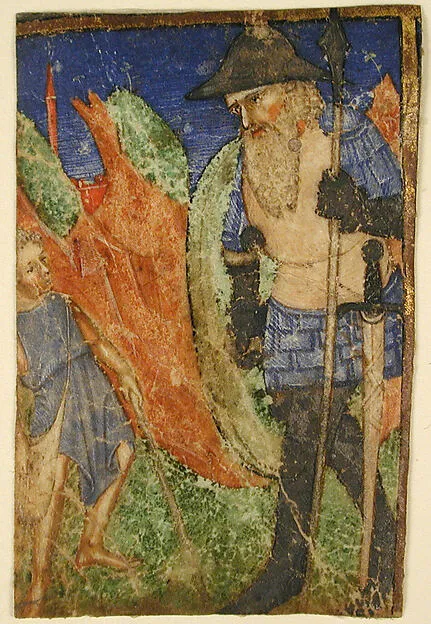
5And he had an helmet of brass upon his head, and he was armed with a coat of mail; and the weight of the coat was five thousand shekels of brass. 6And he had greaves of brass upon his legs, and a target of brass between his shoulders. 7And the staff of his spear was like a weaver’s beam; and his spear’s head weighed six hundred shekels of iron: and one bearing a shield went before him.
Every piece of Goliath's armor is metal - helmet, coat of mail, greaves, target. The weight of his coat alone was five thousand shekels of brass, roughly 150 pounds. And his spear - the spear head alone weighed six hundred shekels of iron, about fifteen pounds. He is a walking fortress. And even he has someone carrying his shield before him - he is so massive that he needs a man just to hold his protection.
8And he stood and cried unto the armies of Israel, and said unto them, Why are ye come out to set your battle in array? am not I a Philistine, and ye servants to Saul? choose you a man for you, and let him come down to me. 9If he be able to fight with me, and to kill me, then will we be your servants: but if I prevail against him, and kill him, then shall ye be our servants, and serve us. 10And the Philistine said, I defy the armies of Israel this day; give me a man, that we may fight together.
This is the heart of Goliath's challenge. He defies the armies of the living God. He stands in the valley and cries out: "I defy the God of Israel." His words are theological in their weight: your God is not strong enough to defend you. Your God cannot give you a man to stand against me. Give up.
11When Saul and all Israel heard those words of the Philistine, they were dismayed, and greatly afraid.
Israel does not answer. Saul, the king anointed by Samuel, does not step forward. And Israel is "dismayed, and greatly afraid." For forty days, Goliath will come out morning and evening, and repeat his defiance. For forty days, Israel will be silent. Saul is king, but Saul has no answer to Goliath.
1 Samuel 17:12-30A Boy Comes to the Camp
12Now David was the son of that Ephrathite of Bethlehemjudah, whose name was Jesse; and he had eight sons: and the man went among men for an old man in the days of Saul. 13And the three eldest sons of Jesse went and followed Saul to the battle: and the names of his three sons that went to the battle were Eliab the firstborn, and next unto him Abinadab, and the third Shammah. 14And David was the youngest: and the three eldest followed Saul.
David is an Ephrathite of Bethlehem - the same Bethlehem where Ruth and Boaz bore Obed, where the line of Jesus will be born. Jesse has eight sons, and David is the youngest. In the eyes of his household, he is the one left behind.
15But David went and returned from Saul to feed his father’s sheep at Bethlehem.
David is a shepherd, sent by his father back and forth - he plays the harp for Saul when Saul is troubled by the evil spirit (as the text mentioned in chapter 16), and then he goes back to Bethlehem to tend the sheep. He belongs to two worlds: the court of the king and the pasture of the flock.
16And the Philistine drew near morning and evening, and presented himself forty days.
17And Jesse said unto David his son, Take now for thy brethren an ephah of this parched corn, and these ten loaves, and run to the camp to thy brethren. 18And carry these ten cheeses unto the captain of their thousand, and look how thy brethren fare, and take their pledge.
Jesse sends David to the camp with food - parched corn, loaves of bread, cheeses. A father's simple errand. Bring food to your brothers. See how they are. Take a token (probably something of value) from them to prove you have done this. It is domestic, ordinary. No one knows that David is being sent straight into the moment that will reshape Israel.
19Now Saul, and they, and all the men of Israel, were in the valley of Elah, fighting with the Philistines. 20And David rose up early in the morning, and left the sheep with a keeper, and took, and went, as Jesse had commanded him; and he came to the trench, as the host was going forth to the fight, and shouted for the battle.
David rises early. The shepherd 's rhythm - he knows dawn. He leaves the sheep with a keeper, and runs to the camp. The armies are going forth to the fight, and David arrives at the moment of maximum tension, when the two nations are shouting for battle.
21For Israel and the Philistines had put the battle in array, army against army. 22And David left his carriage in the hand of the keeper of the carriage, and ran into the army, and came and saluted his brethren. 23And as he talked with them, behold, there came up the champion, the Philistine of Gath, Goliath by name, out of the armies of the Philistines, and spake according to the same words: and David heard them.
David has just arrived. He sets down his supplies, greets his brothers - and in that moment, Goliath comes out. The timing is not coincidence. David hears Goliath's defiance fresh, as a shepherd, unburdened by the forty days of fear that have weighed on Israel.
24And all the men of Israel, when they saw the man, fled from him, and were sore afraid. 25And the men of Israel said, Have ye seen this man that is come up? surely to defy Israel is he come up: and it shall be, that the man who killeth him, the king will enrich him with great riches, and will give him his daughter, and make his father’s house free in Israel.
Israel has been afraid so long that they have begun to speak of a reward for anyone who can kill Goliath - great riches, the king's daughter, freedom from taxation. But no one steps forward. Fear is not moved by promises. Fear is moved only by something stronger than fear.
26And David spake to the men that stood by him, saying, What shall be done to the man that killeth this Philistine, and taketh away the reproach from Israel? for who is this uncircumcised Philistine, that he should defy the armies of the living God?
David asks the men around him a question. He asks: what shall be done to the man that killeth this Philistine? He is testing the waters, asking as if the possibility had not occurred to anyone.
David speaks of the "reproach" on Israel - the shame, the disgrace. Goliath has defied Israel, and Israel has been silent. That silence is a wound. And David, though he has just arrived, feels it as keenly as if he had been there all forty days.
David repeats Goliath's own words: "Who is this uncircumcised Philistine, that he should defy the armies of the living God?" But where Goliath said it as a threat, David says it as a question. A question that suggests an answer: that such a defiance should not be tolerated.
27And the people answered him after this manner, saying, So shall it be done to the man that killeth him. 28And Eliab his eldest brother heard when he spake unto the men; and Eliab’s anger was kindled against David, and he said, Why camest thou down hither? and with whom hast thou left those few sheep in the wilderness? I know thy pride, and the naughtiness of thine heart; for thou art come down that thou mightest see the battle.
Eliab, David's eldest brother, is a soldier in the army. He has been afraid of Goliath for forty days. And now his youngest brother has arrived, asked a simple question, and the men have answered. Eliab's anger is kindled. He accuses David of pride, of wanting to see the battle. Eliab cannot see that his brother has just shown what none of the soldiers could show: a response to Goliath other than fear.
29And David said, What have I now done? Is there not a cause? 30And he turned from him toward another, and spake after the same manner: and the people answered him again after the former manner.
"Is there not a cause?" David responds: is there not a cause? Is there not a reason to speak? Is Goliath's defiance of the living God not a cause worth speaking about? And the people agree. They tell him again: the man who kills Goliath shall receive great rewards.
1 Samuel 17:31-40Saul's Armor and David's Faith
31And when the words were heard which David spake, they rehearsed them before Saul: and he sent for him. 32And David said to Saul, Let no man’s heart fail because of him; thy servant will go and fight with this Philistine.
David comes before the king and offers: "Let no man's heart fail because of him; thy servant will go and fight with this Philistine." He speaks as a servant with absolute certainty: "I will go and fight."
33And Saul said to David, Thou art not able to go against this Philistine to fight with him: for thou art but a youth, and he a man of war from his youth.
Saul looks at David and sees what the world sees: a youth still years from the battlefield. Saul is tall (taller than all the people from his shoulders upward, as the text said in chapter 10), and he knows the difference between a youth and a warrior. He tries to discourage David with reason.
34And David said unto Saul, Thy servant kept his father’s sheep, and there came a lion, and a bear, and took a lamb out of the flock: 35And I went out after him, and smote him, and delivered it out of his mouth: and when he arose against me, I caught him by his beard, and smote him, and slew him.
David answers Saul with a testimony. "Thy servant kept his father's sheep." He is a shepherd. And a shepherd's first duty is to protect the flock.
36Thy servant slew both the lion and the bear: and this uncircumcised Philistine shall be as one of them, seeing he hath defied the armies of the living God.
David compares Goliath to the beasts he has killed. The comparison is about the covenant. A lion and a bear are creatures of the wild. Goliath is uncircumcised - set apart from God's covenant. And David has killed creatures that seemed stronger than any man. The Philistine will be no different.
This is the turning point in David's testimony. He moves from what he has done to what God has done. "He hath defied the armies of the living God." The defiance is the issue. And God cannot accept such defiance forever.
37David said moreover, The LORD that delivered me out of the paw of the lion, and out of the paw of the bear, he will deliver me out of the hand of this Philistine. And Saul said unto David, Go, and the LORD be with thee.
David's faith rests on a simple pattern: the Lord has delivered him before; the Lord will deliver him again. His past experience of God's protection is the foundation of his present courage. His faith is grounded in memory.
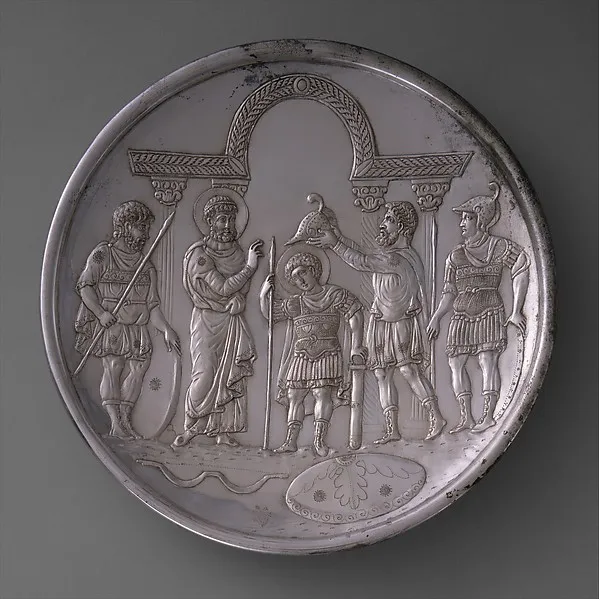
38And Saul armed David with his armour, and he put an helmet of brass upon his head; also he armed him with a coat of mail. 39And David girded his sword upon his armour, and he assayed to go; for he had not proved it. And David said unto Saul, I cannot go with these; for I have not proved them. And David put them off him. 40And he took his staff in his hand, and chose him five smooth stones out of the brook, and put them in a shepherd’s bag which he had, even in a scrip; and his sling was in his hand: and he drew near to the Philistine.
Saul gives David his own armor - the armor of a king, the armor that should protect. But David cannot move in it. He has not tested it, does not know its weight, does not fit in it. And in a moment of extraordinary faith, David takes it off. He refuses the apparatus of power and chooses what he knows: his staff, his sling, five smooth stones.
1 Samuel 17:40-51The Battle Belongs to the Lord
40And he took his staff in his hand, and chose him five smooth stones out of the brook, and put them in a shepherd’s bag which he had, even in a scrip; and his sling was in his hand: and he drew near to the Philistine.
Why five stones? David carries five weapons. Five chances. That is preparedness: faith is careful readiness.
A sling was a shepherd's tool. It was used to protect flocks, to drive away predators. It was a shepherd's weapon of care, a tool for defense. David approaches the greatest warrior in the world armed with a shepherd's tool.
41And the Philistine came on and drew near unto David; and the man that bare the shield went before him. 42And when the Philistine looked about, and saw David, he disdained him: for he was but a youth, and ruddy, and of a fair countenance.
Goliath looks at David and is contemptuous. He sees a boy, ruddy, fair of face. A shepherd. And in that moment of disdain, Goliath has already lost. He has looked at David and seen nothing of what David actually is.
43And the Philistine said unto David, Am I a dog, that thou comest to me with staves? And the Philistine cursed David by his gods. 44And the Philistine said to David, Come to me, and I will give thy flesh unto the fowls of the air, and to the beasts of the field.
Goliath is insulted. A dog? He is insulted at being challenged by a shepherd with a staff and a sling. But his insult contains a truth he does not intend: dogs are faithful. Dogs are loyal. The shepherd who comes with a staff is more like a dog than like a warrior. And a dog's loyalty to its master is what will serve David here.
45Then said David to the Philistine, Thou comest to me with a sword, and with a spear, and with a shield: but I come to thee in the name of the LORD of hosts, the God of the armies of Israel, whom thou hast defied.
David catalogs Goliath's weapons. Sword, spear, shield. All visible. All physical. All the apparatus of war that Saul offered to give him. And David refuses to compete on that ground.
Instead, David speaks his own armament: "I come to thee in the name of the Lord of hosts, the God of the armies of Israel." He comes in the name of the God of armies, as a representative, as an instrument, as a servant of the living God.
46This day will the LORD deliver thee into mine hand; and I will smite thee, and take thine head from thee; and I will give the carcases of the host of the Philistines this day unto the fowls of the air, and to the wild beasts of the earth; that all the earth may know that there is a God in Israel.
David speaks the outcome before it happens: "This day will the Lord deliver thee into mine hand." The purpose is that all the earth may know that there is a God in Israel. This is warfare for a theological purpose - to reveal God.
47And all this assembly shall know that the LORD saveth not with sword and spear: for the battle is the LORD’s, and he will give you into our hands.
This is the central thesis of the chapter. "The battle is the Lord's." Not David's, not Israel's - the Lord's. "The Lord saveth not with sword and spear" - salvation and victory come from God Himself. And the assembly of Israel will learn this lesson.
48And it came to pass, when the Philistine arose, and came, and drew nigh to meet David, that David hastened, and ran toward the army to meet the Philistine.
David "hasted and ran" toward Goliath, toward the thing that terrified all of Israel. And in that haste is the confidence of one who knows who the battle belongs to.
49And David put his hand in his bag, and took thence a stone, and slang it, and smote the Philistine in his forehead, that the stone sunk into his forehead; and he fell upon his face to the earth.
50So David prevailed over the Philistine with a sling and with a stone, and smote the Philistine, and slew him; but there was no sword in the hand of David. 51Therefore David ran, and stood upon the Philistine, and took his sword, and drew it out of the sheath thereof, and slew him, and cut off his head therewith. And when the Philistines saw their champion was dead, they fled.
The stone kills Goliath. David stands upon the body, takes the giant's own sword, and uses it to finish what the stone began. The Philistine armies see their champion dead, and they flee. Israel, which has been silent for forty days, now arises and shouts. The armies that were dismayed are now in pursuit. One stone. One shepherd. One act of faith. And all of Israel is transformed.
Research trail
Sources & further study
These references support the historical, linguistic, manuscript, and contextual notes in this chapter. Scripture remains the primary text; external sources are provided so readers can inspect the research directly.
Where this echoes in Scripture
A Champion Comes
- Psalm 20:7Some trust in chariots, and some in horses: but we will remember the name of the Lord our God.David’s armor refusal becomes Israel’s confession.
- 2 Corinthians 10:3-4The weapons of our warfare are not carnal, but mighty through God.Paul’s "weapons of our warfare" line is the brook-and-stone principle.
- Ephesians 6:10-17Be strong in the Lord… put on the whole armour of God.The armor David refuses, Paul retells as something Christ supplies from inside.
- Hebrews 11:32-34David… who through faith… waxed valiant in fight, turned to flight the armies of the aliens.The brook-and-stone victory canonized as faith.