Judith 12
People in this chapter
Faithfulness is easiest to measure when someone is watching. Judith 12 strips that away. A widow of Israel has gone, by her own daring plan, straight into the camp of the army besieging her city, and she is lodged in the tent of its commander. Every eye in that camp is an enemy's eye. And it is precisely there, where no friend can see her and no one of her own faith can hold her accountable, that she keeps the smallest details of her devotion.
She will not touch the general's food. She goes out every night to pray. The chapter asks a quiet, searching question: who are you when the only witness left is God?
Tap any highlighted phrase to jump to the commentary that unpacks it.
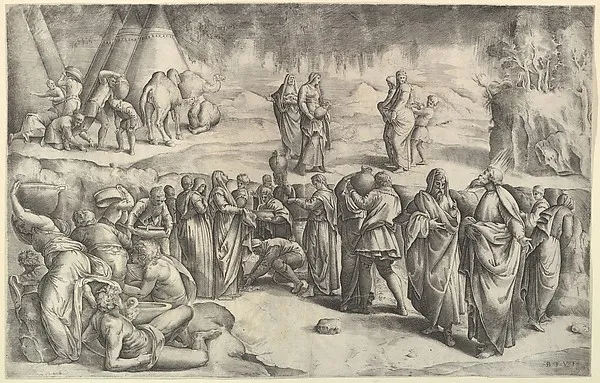
Judith 12:1-4She Will Not Defile Herself at the Enemy's Table
1Then he ordered that she should go in where his treasures were laid up, and bade her tarry there, and he appointed what should be given her from his own table. 2And Judith answered him and said: Now I cannot eat of these things which thou commandest to be given me, lest sin come upon me: but I will eat of the things which I have brought.
Holofernes offers Judith the best of everything: a place among his treasures, a portion from his own table, the fare of a conqueror. It is the kind of offer that bends most people. And she declines, quietly and completely, "lest sin come upon me." To share the general's food would be to blur the line between herself and the world that has set itself against God's people. So she keeps the line, down to what she eats.
The detail is small, almost domestic, and that is the point. She is showing in the most ordinary act of the day that she belongs to God before she belongs to anyone's table.
3And Holofernes said to her: If these things which thou hast brought with thee fail thee, what shall we do for thee? 4And Judith said: As thy soul liveth, my lord, thy handmaid shall not spend all these things till God do by my hand that which I have purposed. And his servants brought her into the tent which he had commanded.
The general worries, almost kindly, about what she will eat when her supplies run out. Her answer is a sentence with two faces. To his ears it sounds like flattery and reassurance. To the reader it is a vow charged with meaning he cannot hear: her provisions will not be gone "till God do by my hand that which I have purposed." She is telling him the truth and he does not know it. The whole drama of the chapter lives in that gap, between what Holofernes thinks he is hearing and what God is actually about to do.
Judith speaks of her purpose, but she lays it at God's feet; the deed will be His, worked through her hand.
Judith 12:5-9She Rises in the Night to Seek the Lord
5And when she was going in, she desired that she might have liberty to go out at night and before day to prayer, and to beseech the Lord. 6And he commanded his chamberlains, that she might go out and in, to adore her God as she pleased, for three days.
Judith asks for one freedom: to go out before dawn to pray. It is a striking request to make inside a hostile camp, and Holofernes grants it, never guessing that those nightly walks are the engine of everything that is coming. While the army sleeps, she rises in the dark to seek the Lord. Her boldness in the tent is the overflow of a life that meets God before the day begins. The chapter quietly insists that the courage we admire in the daylight is forged in the hours no one sees.
7And she went out in the nights into the valley of Bethulia, and washed herself in a fountain of water. 8And as she came up, she prayed to the Lord the God of Israel, that he would direct her way to the deliverance of his people. 9And going in, she remained pure in the tent, until she took her own meat in the evening.
Night after night she walks down into the valley below her own besieged city, washes in the spring, and rises from the water with a single petition: that God would direct her way "to the deliverance of his people." Her prayer reaches past her own danger to the rescue of everyone behind the walls of Bethulia. She has placed herself in the gravest peril, and her one request is that it be turned to her people's good.
This is the heart of intercession, to stand in the gap and ask that what you carry would become someone else's deliverance.
Verse 9 lingers on a quiet word: she "remained pure in the tent." In the most compromising place imaginable, surrounded by an enemy who means to possess her, she keeps herself unstained and waits. The whole shape of these days is discipline held under pressure: ordered food, ordered prayer, kept purity, all maintained while the outcome hangs in the balance. She does not know the hour God will act. She knows only to keep faith in the waiting, and to be ready when the moment comes.
Judith 12:10-14Summoned to the Feast
10And it came to pass on the fourth day, that Holofernes made a supper for his servants, and said to Vagao his eunuch: Go, and persuade that Hebrew woman, to consent of her own accord to dwell with me.
On the fourth day the general grows impatient. He throws a private feast and sends his servant Vagao to bring Judith, wanting her, the text says, "to consent of her own accord." Even the man who could simply command is here trying to be chosen. It is a flash of how power without God works: it can compel a body but it craves a consent it cannot truly win, and so it schemes and flatters to get what force alone cannot give. Holofernes thinks he is closing his trap. He is walking into one.
12Then Vagao went in to Judith, and said: Let not my good maid be afraid to go in to my lord, that she may be honoured before his face, that she may eat with him and drink wine and be merry. 13And Judith answered him: Who am I, that I should gainsay my lord? 14All that shall be good and best before his eyes, I will do. And whatsoever shall please him, that shall be best to me all the days of my life.
Judith's reply is a small masterpiece of double meaning. "Who am I, that I should gainsay my lord?" To Vagao it sounds like a servant's perfect submission. But the word "lord" hangs in the air with a second owner. The Lord she truly will not gainsay is the God of Israel. She agrees to come, to do what pleases him, calling it "best to me all the days of my life," and every phrase is true on a level no one in the tent can hear. She speaks as one fully surrendered, and she is, to God.
Judith 12:15-20Undone by His Own Cup
15And she arose and dressed herself out with her garments, and going in she stood before his face. 16And the heart of Holofernes was smitten, for he was burning with the desire of her.
Judith enters in her finest, stands before the general, and his heart is "smitten." The verb is the language of conquest, and the irony could not be sharper: the man who has smitten cities with his army is himself struck down by a glance, undone by his own desire before a single blow is struck. He believes he is the one in command of this moment. In truth he has already lost it. The strong man of the story is being conquered by the very appetite he was sure would let him conquer.
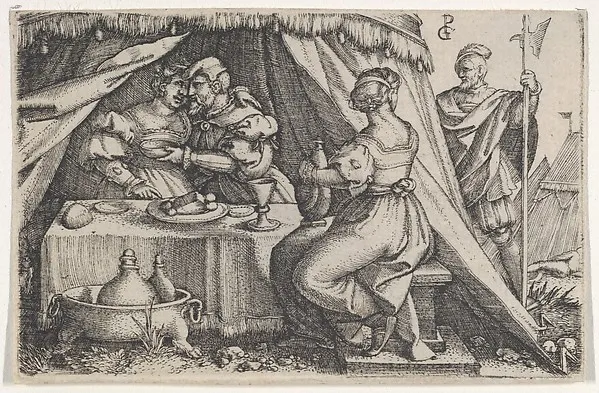
17And Holofernes said to her: Drink now, and sit down and be merry for thou hast found favour before me. 18And Judith said: I will drink my lord, because my life is magnified this day above all my days. 19And she took and ate and drank before him what her maid had prepared for her.
He presses wine on her; she answers with one more sentence that is true on two levels at once. "My life is magnified this day above all my days." He hears a woman flattered by his attention. She means that this is the day God has appointed her to do the great thing of her life, the deed that will be told for generations. Even here she keeps her own boundaries, eating and drinking only what her maid prepared, faithful in the details to the very end.
The trap is closing, and she is the one who set it, by keeping faith while he loses himself.
The chapter ends on the image that decides everything. The great general drinks "so much as he had never drunk in his life," sinking into the helplessness that will leave him at Judith's mercy. No army has done this to him. No siege has worn him down. He is defeated by his own cup, by the appetite he could not govern. The mighty have been brought low by their own unchecked desire, and the deliverance Judith prayed for in the valley is about to be placed in her hands.
The stage is set, and the last thing standing between her people and rescue is a sleeping man drowned in his own wine.
Where this echoes in Scripture
She Will Not Defile Herself at the Enemy's Table
- Daniel 1:8But Daniel purposed in his heart that he would not defile himself with the portion of the king's meat, nor with the wine which he drank.Another exile keeps faith by refusing the king's table.
- Psalm 141:4Incline not my heart to any evil thing, to practise wicked works with men that work iniquity: and let me not eat of their dainties.The prayer not to be seduced by the delicacies of the ungodly.
- 1 Corinthians 10:31Whether therefore ye eat, or drink, or whatsoever ye do, do all to the glory of God.Even eating becomes an act of belonging to God.
She Rises in the Night to Seek the Lord
- Mark 1:35And in the morning, rising up a great while before day, he went out, and departed into a solitary place, and there prayed.The Lord Himself rises before dawn to pray before the demanding day.
- Psalm 63:1O God, thou art my God; early will I seek thee: my soul thirsteth for thee.The same hunger to seek God early, before all else.
- Esther 4:16Go, gather together all the Jews... and so will I go in unto the king, which is not according to the law: and if I perish, I perish.Another woman risks herself in prayer for the deliverance of her people.
Summoned to the Feast
- Luke 1:38And Mary said, Behold the handmaid of the Lord; be it unto me according to thy word.A handmaid of the Lord through whom God works deliverance.
- Proverbs 21:1The king's heart is in the hand of the LORD, as the rivers of water: he turneth it whithersoever he will.The mighty man's plans are quietly bent toward God's purpose.
- Proverbs 16:18Pride goeth before destruction, and an haughty spirit before a fall.Holofernes' confident scheming runs straight toward his own ruin.
Undone by His Own Cup
- Luke 1:52He hath put down the mighty from their seats, and exalted them of low degree.Mary's song names the very pattern this chapter enacts.
- Proverbs 23:20-21Be not among winebibbers... for the drunkard and the glutton shall come to poverty.The ruin of the man ruled by his own cup.
- 1 Corinthians 1:27But God hath chosen the weak things of the world to confound the things which are mighty.God's way of saving: the weak overthrow the strong.