1 Kings 5
People in this chapter
David wanted to build God a house and was told no. Too much blood, too many wars. The promise went instead to his son. Now that son sits on the throne, and the sword is finally still. The LORD my God hath given me rest on every side. On that given rest Solomon begins. His first move is to reach north, to Hiram king of Tyre, his father's old friend, who commanded the cedar forests and the finest timber-cutters in the world.1
Tap any highlighted phrase to jump to the commentary that unpacks it.
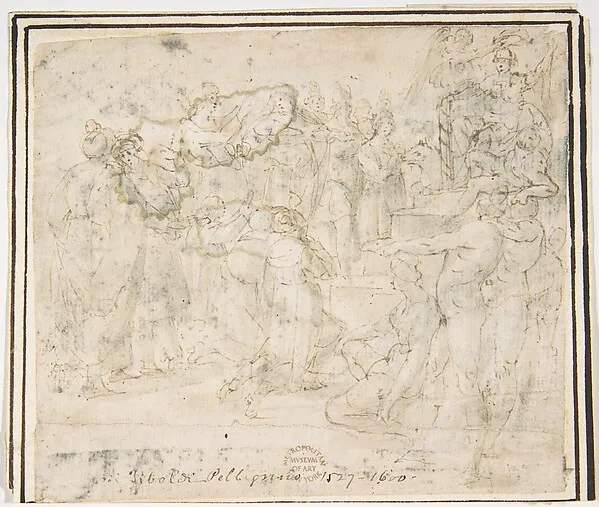
1 Kings 5:1-3Hiram, Ever a Lover of David
1And Hiram king of Tyre sent his servants unto Solomon; for he had heard that they had anointed him king in the room of his father: for Hiram was ever a lover of David. 2And Solomon sent to Hiram, saying, 3Thou knowest how that David my father could not build an house unto the name of the LORD his God for the wars which were about him on every side, until the LORD put them under the soles of his feet.
The chapter opens on a friendship that outlives the friend. Hiram king of Tyre had been, the text says, ever a lover of David - a settled friend, the kind of bond that takes years to form. This Hiram is the Tyrian king and friend of David who supplies the cedar for the temple. He should not be confused with a later man of the same name, Hiram the worker in brass, a widow's son of the tribe of Naphtali, who appears in chapter 7 to cast the temple's bronze.
David was a man of war and Israel; Hiram the king was a man of the sea, of trade and timber and craft. They were unlikely partners, and yet a real bond had formed between them. So when word reaches Tyre that David is dead and his son anointed in his place, Hiram does not wait to be courted - Hiram king of Tyre sent his servants unto Solomon. He moves first, to honor the son for the father's sake.
There is something instructive in that. A friendship David built becomes the open door through which Solomon walks to gather what he needs for the house of God. The goodwill of one generation is laid up like treasure for the next.
The reason David never built the temple is striking once Solomon names it: war. David's longing had been real; he had wanted it badly. But his hands were full of the sword, his reign spent holding the kingdom against enemies on every border. The ground had to be cleared before anything could be built on it - the fighting ran until the LORD put them under the soles of his feet. A generation of conflict came first, and only then could a generation of building follow.
David's wars were not wasted. They were the hard labor that made Solomon's peace possible. The father fought so the son could build.
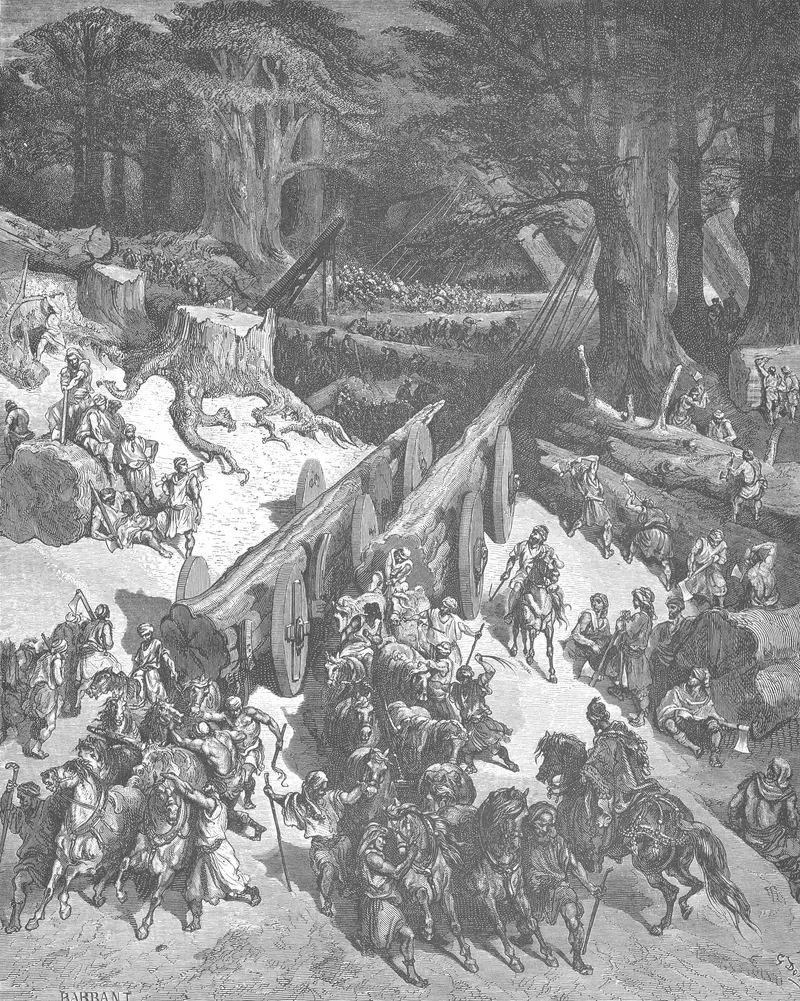
1 Kings 5:4-6A House for the Name, Now That God Has Given Rest
4But now the LORD my God hath given me rest on every side, so that there is neither adversary nor evil occurrent. 5And, behold, I purpose to build an house unto the name of the LORD my God, as the LORD spake unto David my father, saying, Thy son, whom I will set upon thy throne in thy room, he shall build an house unto my name. 6Now therefore command thou that they hew me cedar trees out of Lebanon; and my servants shall be with thy servants: and unto thee will I give hire for thy servants according to all that thou shalt appoint: for thou knowest that there is not among us any that can skill to hew timber like unto the Sidonians.
The hinge of the whole chapter is easy to read past. Notice who gives the rest. Solomon says it was given - the LORD my God hath given me rest on every side. Where David had wars on every side, Solomon has rest on every side, and the symmetry is deliberate: the same God who once put enemies under the soles of David's feet has now stilled them entirely. And it is exactly this rest that frees him to build.
The house of the LORD rises on a rest God Himself supplies. Before a single cedar is cut, you already know where the strength for the work will come from. The building begins where the striving ends.
Solomon's request is worth reading closely, because of how he makes it. He is the king of Israel, the LORD's anointed, building the house of God - and yet he asks: command thou that they hew me cedar trees out of Lebanon… for thou knowest that there is not among us any that can skill to hew timber like unto the Sidonians. He freely admits that Israel lacks the skill, that the men of Tyre and Sidon are the masters of this craft, and that he needs them.
The cedar of Lebanon was the most prized timber in the ancient world - fragrant, strong, slow to decay, the wood of palaces and temples2 - and Solomon will have nothing less for the house of the LORD. There is real humility in this. The wisest king of his age honors the gift God has placed in another people and asks for their help, offering fair wages in return. A great work for God grows stronger by needing others, drawing them in.
1 Kings 5:7-9Hiram Rejoices, and Offers the Cedar by Sea
7And it came to pass, when Hiram heard the words of Solomon, that he rejoiced greatly, and said, Blessed be the LORD this day, which hath given unto David a wise son over this great people. 8And Hiram sent to Solomon, saying, I have considered the things which thou sentest to me for: and I will do all thy desire concerning timber of cedar, and concerning timber of fir. 9My servants shall bring them down from Lebanon unto the sea: and I will convey them by sea in floats unto the place that thou shalt appoint me, and will cause them to be discharged there, and thou shalt receive them: and thou shalt accomplish my desire, in giving food for my household.
Hiram's response is the surprise of the passage. He is a foreign king, of another land and other gods, and the request reaching him is, on its face, simply good business - a lucrative contract for timber. So watch what he does with it. He does not haggle first; he worships. He blesses the LORD by name - the God of Israel, not his own - for giving David a wise son over this great people. No resentment, no calculation, just joy and a blessing spoken over the work before it begins.
A Gentile king looks at what God is doing in Israel and is glad. It is a small foretaste of something the Scriptures keep enlarging: the day the nations no longer merely tolerate the worship of the LORD but gladly join their voices to it, blessing His name and bringing their best to His house.
The logistics are remarkable in their own right. Lebanon's cedars grew in mountains far from Jerusalem, with no easy road between; so Hiram's plan is ingenious - My servants shall bring them down from Lebanon unto the sea: and I will convey them by sea in floats. The great logs would be lashed into rafts and floated down the Mediterranean coast to a point Solomon appointed, then carried inland.2 Notice the shape of the exchange underneath the engineering.
Hiram supplies what his land has - timber and the skill to move it; Solomon supplies what his land has - food for my household, the wheat and oil of Israel's fields. Each king gives out of his own abundance to meet the other's need. Two parties, each bringing what they have, woven together into a single work. The house of the LORD will be built by an exchange of gifts.
1 Kings 5:10-12Cedar for Wheat, and Peace Between the Two Kings
10So Hiram gave Solomon cedar trees and fir trees according to all his desire. 11And Solomon gave Hiram twenty thousand measures of wheat for food to his household, and twenty measures of pure oil: thus gave Solomon to Hiram year by year. 12And the LORD gave Solomon wisdom, as he promised him: and there was peace between Hiram and Solomon; and they two made a league together.
A quiet phrase tells us this was no one-time transaction: thus gave Solomon to Hiram year by year. Twenty thousand measures of wheat and twenty measures of pure oil, again and again, season after season. The building of the temple was not the work of a single dramatic moment but of sustained, repeated faithfulness - provision sent reliably, year upon year, until the work was done. There is a lesson hidden in the bookkeeping. We tend to imagine great works for God as bursts of inspired effort, but Scripture keeps showing us that they are mostly made of steady, unglamorous follow-through: the wheat sent again this year as it was sent last year, the promise kept and kept and kept.
Solomon's word to Hiram was good not for a month but for years. The house rose on the back of a faithfulness that did not flag once the excitement faded.
1 Kings 5:13-16The Levy, and the Labor Force
13And king Solomon raised a levy out of all Israel; and the levy was thirty thousand men. 14And he sent them to Lebanon, ten thousand a month by courses: a month they were in Lebanon, and two months at home: and Adoniram was over the levy. 15And Solomon had threescore and ten thousand that bare burdens, and fourscore thousand hewers in the mountains; 16Beside the chief of Solomon’s officers which were over the work, three thousand and three hundred, which ruled over the people that wrought in the work.
With the alliance sealed, the work itself begins, and the scale of it is staggering. Solomon raised a levy out of all Israel - thirty thousand men - and organized them with care: ten thousand a month by courses: a month they were in Lebanon, and two months at home. The rotation is humane and shrewd; no man spent more time away than at home, and the labor was shared across the whole nation. Beyond the levy there were seventy thousand bearing burdens, eighty thousand hewing in the mountains, and over three thousand officers supervising the work - well over a hundred and eighty thousand people, all coordinated toward one end.
The house of the LORD was the work of an entire people, organized, rotated, and overseen, every hand contributing to a building that no single hand could ever have raised. A great work for God draws a whole community into it.
1 Kings 5:17-18The Stones for the Foundation
17And the king commanded, and they brought great stones, costly stones, and hewed stones, to lay the foundation of the house. 18And Solomon’s builders and Hiram’s builders did hew them, and the stonesquarers: so they prepared timber and stones to build the house.
Look at what all this labor actually produced. Not the temple - the foundation of it. The cedar gathered, the timber floated, the months of hewing in the mountains, and the visible result by the chapter's end is the one part of the building no one will ever admire: stones laid down in the earth to carry everything that will rise above them. There is a deep dignity in that. The costliest, most carefully chosen stones went into the part of the house hidden from sight forever.
So much of the work that matters most is exactly this - unseen, unsung, laid quietly beneath what others will one day stand on and praise. A chapter that opened on a king's grand purpose closes on a foundation faithfully laid. That is where every house worth building begins.
Research trail
Sources & further study
These references support the historical, linguistic, manuscript, and contextual notes in this chapter. Scripture remains the primary text; external sources are provided so readers can inspect the research directly.
- 1 Kings 5 - Translators' NotesThe NET Bible's detailed footnotes on 1 Kings 5 - the relationship of Hiram and David, the idiom behind being given “rest on every side,” the measures of wheat and oil paid year by year (v. 11), and the organization of the levy and the labor force in verses 13-18.
- Art of the Ancient Near East · Heilbrunn TimelineThe Met's survey of the ancient Near Eastern world that frames this chapter - the prized cedar of Lebanon as the timber of palaces and temples, the seafaring Phoenician craft of Tyre and Sidon that floated it by sea (v. 9), and the squared and fitted ashlar masonry of the great foundation stones (v. 17).
- 1 Kings 5 · Hebrew + classical Jewish commentaryThe Hebrew text of 1 Kings 5 with Rashi, Radak, and other classical commentators side by side - useful for bayith (the “house” built unto the LORD), for shem (the “name” for which it is built, vv. 3-5), and for the language of the menuchah, the rest God gives on every side in verse 4.
- 1 Kings 5 ↔ 2 Samuel 7 · John 2 · 1 Peter 2 · Ephesians 2Traces the threads tying the promise that David's son shall build an house unto my name (v. 5) back to 2 Samuel 7:13 and forward to the Son of David who is Himself the temple (John 2:19-21), the people built up as lively stones (1 Pet. 2:5), and the nations builded together for an habitation of God (Eph. 2:22).
Where this echoes in Scripture
A House for the Name, Now That God Has Given Rest
- 2 Samuel 7:12-13I will set up thy seed after thee… He shall build an house for my name, and I will stablish the throne of his kingdom for ever.The promise Solomon quotes in verse 5 - its first half built in stone, its second reaching past every mortal king.
- John 2:19-21Destroy this temple, and in three days I will raise it up… he spake of the temple of his body.The cedar-and-stone house was a true house unto the Name, and in Christ that same Presence comes to dwell in a body, raised and indestructible.
- 1 Chronicles 22:8-9Thou hast shed blood abundantly… thou shalt not build an house unto my name… he shall be a man of rest.Why David could not build for the wars - and the son of rest who would.
- Hebrews 3:5-6Moses verily was faithful in all his house, as a servant… but Christ as a son over his own house; whose house are we.The house-builder greater than Solomon - the Son over the house that is His people.
Cedar for Wheat, and Peace Between the Two Kings
- Ephesians 2:14For he is our peace, who hath made both one, and hath broken down the middle wall of partition between us.The peace between Israelite and Gentile king - a small sign of the peace that makes Jew and Gentile one.
- Isaiah 60:5The abundance of the sea shall be converted unto thee, the forces of the Gentiles shall come unto thee.Hiram bringing the wealth of the sea to God's house - a foretaste of the nations' gifts gathered in.
- James 1:17Every good gift and every perfect gift is from above, and cometh down from the Father of lights.Solomon's wisdom given by the LORD (v. 12) - even the skill that builds for God is His gift.
- Psalm 72:10-11The kings of Tarshish and of the isles shall bring presents… yea, all kings shall fall down before him.A king of the coastlands honoring David's son - the Psalm's vision of foreign kings bringing tribute to the true King.
The Stones for the Foundation
- 1 Peter 2:5Ye also, as lively stones, are built up a spiritual house, an holy priesthood.The dressed stones of the foundation become a people - living stones built into a house for God.
- 1 Peter 2:6Behold, I lay in Sion a chief corner stone, elect, precious: and he that believeth on him shall not be confounded.The cornerstone of the true house - chosen and precious, as the foundation stones of verse 17.
- Ephesians 2:21-22In whom all the building fitly framed together groweth unto an holy temple in the Lord… builded together for an habitation of God.Israelite and Gentile builders raising one house (v. 18) - the pattern of the temple built from every nation.
- 1 Corinthians 3:11For other foundation can no man lay than that is laid, which is Jesus Christ.The foundation of the house (v. 17) answered in the one sure foundation of the house God builds now.