Painter of the Bible
Salvator Rosa
Salvator Rosa was a Neapolitan-born painter, etcher, poet, satirist, and actor whose flamboyant personal reputation and his subjects of wild mountainous landscapes and dramatic biblical and historical narratives made him…

Their faith
Why Salvator Rosa painted Christ
Salvator Rosa, born in 1615 in Naples, was deeply influenced by the Catholic faith that permeated his upbringing and the artistic environment of his time. His works reflect a profound engagement with scripture, often depicting biblical narratives that resonate with themes of solitude, contemplation, and divine revelation. Rosa's artistic journey was marked by a devotion to the spiritual life, as seen in his choice to portray figures like Saint John the Baptist and Saint Jerome, who embody the ascetic ideals of the Catholic monastic tradition. His ability to weave together his love for dramatic landscapes with these sacred subjects reveals a deep reverence for the divine, suggesting that his faith was not merely a backdrop but a driving force in his creative expression.
Rosa's paintings, such as "Saint John the Baptist Preaching" and "Saint Jerome in the Wilderness," showcase his unique ability to merge the grandeur of nature with the intimate struggles of faith. In these works, the biblical figures are often dwarfed by the overwhelming landscapes, symbolizing the vastness of God's creation and the humility of man before the divine. The dramatic skies and rugged terrains serve as a metaphor for the spiritual journey, filled with challenges and revelations. Through his art, Rosa invites viewers to contemplate their own faith journeys, encouraging a connection with the divine that transcends time and space. His devotion continues to inspire and uplift those who encounter his work, reminding us of the beauty and depth of a life lived in pursuit of God.
Life & work
Salvator Rosa was a Neapolitan-born painter, etcher, poet, satirist, and actor whose flamboyant personal reputation and his subjects of wild mountainous landscapes and dramatic biblical and historical narratives made him one of the most distinctive Italian Baroque artists of the seventeenth century and a particular favorite of the eighteenth and nineteenth-century European Romantic taste for wild scenery. Born in Arenella near Naples in 1615, trained in Naples in the orbit of his uncle Paolo Greco and the painter Aniello Falcone before moving to Rome in his early twenties, he was active in Rome and Florence (where he served the Medici grand-ducal court between 1640 and 1649) for the rest of his life. He died in Rome in 1673.
His Christian religious work falls in two distinct categories. First, the wild-landscape biblical narratives — Saint John the Baptist Preaching, Saint Anthony in the Wilderness, the Witch of Endor (1668, Louvre), the Tobias and the Angel — in which the small biblical figures are dwarfed by enormous craggy mountain landscapes, dark woodland glens, and stormy skies. Second, the philosopher-saint compositions — solitary hermits, ascetic monks, and the early Church Fathers in their desert retreats — in which he combined the Catholic monastic devotional tradition with his own taste for melancholic solitary contemplation. The Saint Jerome in the Wilderness compositions, in particular, were widely reproduced throughout the eighteenth century.
He was equally a major etcher. His suite of etched figures — soldiers, peasants, beggars, gypsies, and small religious-narrative compositions — circulated widely through European print collections in his lifetime and shaped the Romantic-era taste for the picturesque outsider figure as a subject for serious artistic attention. His landscape etchings of wild mountainous scenes were particularly influential on the eighteenth-century English picturesque movement.
He was also a published satirical poet, an actor in the Roman commedia dell'arte, and a chronic public controversialist whose feuds with the leading Roman painters of his generation (especially Pietro da Cortona and Carlo Maratti) provided material for two centuries of subsequent biographical writing about the seventeenth-century Roman art world.
Notable works in detail
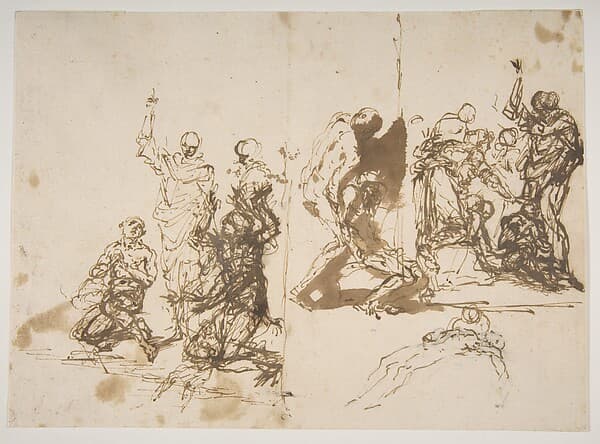
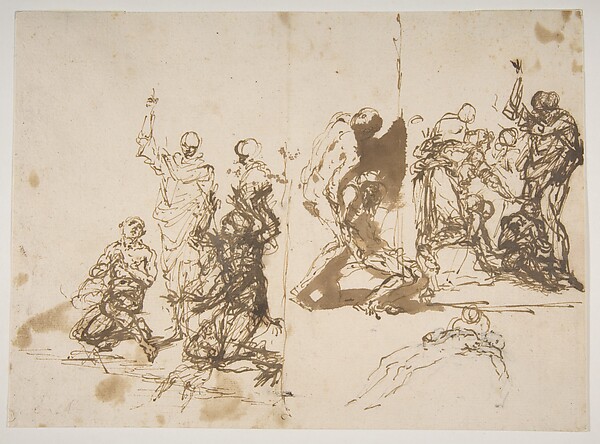
The Raising of Lazarus, drawn by Salvator Rosa in pen and brown ink with brown wash on paper and now in the Metropolitan Museum of Art in New York, illustrates the climactic miracle of John 11. Rosa stages the scene with characteristic dramatic compositional density: Christ at the lower left with his right arm extended in command, the bound figure of Lazarus emerging upright from the open tomb at the upper right, the sisters Martha and Mary kneeling between them at Christ's feet, and a small crowd of witnesses gathered behind. The drawing demonstrates Rosa's rapid confident pen-and-wash technique and his characteristic preference for the dramatic biblical narrative subject set in a wild rocky landscape.
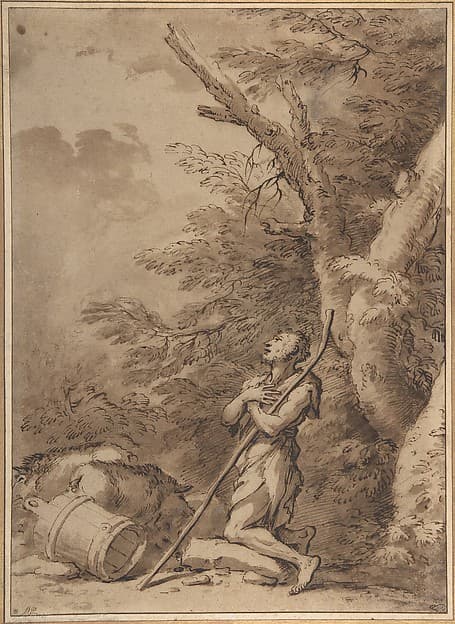
The Prodigal Son Kneeling Repentant among Swine
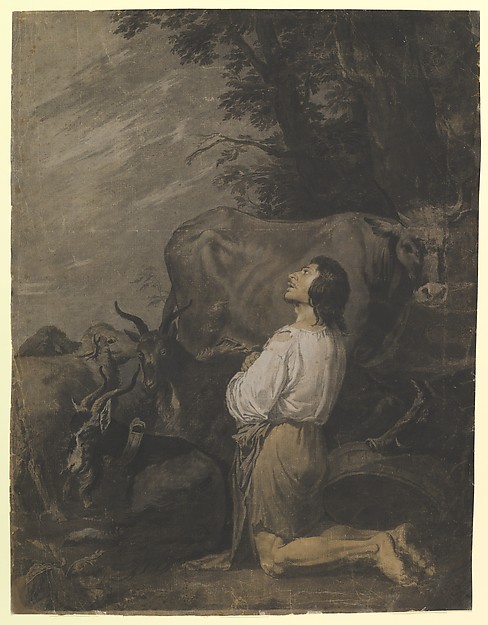
The Prodigal Son Kneeling Repentant among Swine, drawn by Salvator Rosa in pen and brown ink with wash on paper and now in the Metropolitan Museum of Art in New York, illustrates the moment from the Luke 15 parable in which the prodigal son, having squandered his inheritance and reduced to feeding swine, comes to himself and resolves to return to his father. Rosa stages the scene with characteristic Romantic-pastoral intensity: the kneeling son in the foreground, his hands folded in repentance, the swine scattered around him in the muddy field, a small wild landscape opening behind. The drawing demonstrates Rosa's characteristic interest in the solitary repentant figure as a subject for serious artistic attention — the same interest that defined his many painted treatments of hermit-saints.
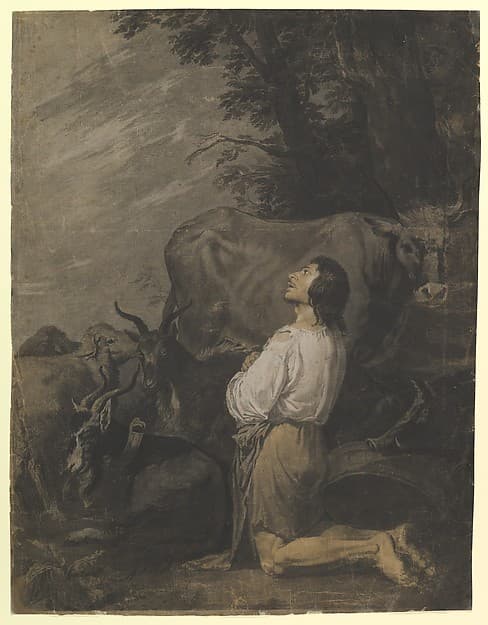
The Prodigal Son, drawn by Salvator Rosa in pen and brown ink with wash on paper and now in the Metropolitan Museum of Art in New York, is a second drawing of the Luke 15 parable subject — a more focused composition than the related kneeling-among-swine sheet. The drawing shows the prodigal son in a similar repentant posture in a small pastoral landscape with the small group of swine and a few rocks. Rosa returned to the Prodigal Son subject repeatedly across his career; the parable's combination of dramatic narrative reversal and meditative pastoral setting fit Rosa's lifelong artistic interests particularly well, and the multiple surviving drawings are among the principal documents of his preparatory working method.
met-340660
Saint Paul, Hermit, drawn by Salvator Rosa in pen and brown ink on paper and now in the Metropolitan Museum of Art in New York, depicts the early-Church desert father Paul of Thebes — traditionally regarded as the first Christian hermit — in his solitary retreat in the Egyptian desert. Rosa stages the scene with characteristic Romantic-melancholic intensity: the seated saint in profile in his cave-like retreat, his face lifted in inward contemplation, the small landscape of rocky desert opening behind. The drawing belongs to the long sequence of hermit-saint subjects that Rosa returned to throughout his career and that defined his particular contribution to seventeenth-century Italian devotional draughtsmanship.