Painter of the Bible
Sano di Pietro (Ansano di Pietro di Mencio)
Sano di Pietro (Ansano di Pietro di Mencio) was one of the most prolific Sienese painters of the fifteenth century, the supplier of altarpieces, devotional Madonnas, and predella panels to the Sienese churches and confraternities for almost half a century.
 Saint Francis
Their faith
Why Sano di Pietro (Ansano di Pietro di Mencio) painted Christ
Sano di Pietro was deeply rooted in the Christian faith, as evidenced by his prolific output of religious art throughout his career in Siena. Trained in the workshop of the esteemed painter Sassetta, Sano dedicated his life to creating altarpieces, devotional Madonnas, and narrative panels that served the spiritual needs of the Sienese community. His work was not merely a profession; it was a profound expression of his devotion to Christ and the teachings of the Church. The jewel-bright colors and gold backgrounds of his paintings reflect a reverence for the divine, while his calm and sweet-faced figures invite viewers into a contemplative engagement with the sacred. Sano's commitment to his faith was evident in the way he maintained the traditional Sienese style, emphasizing a spiritual vocabulary that aligned with the values of his religious community.
The impact of Sano di Pietro's faith is particularly visible in works like "Saint Bernardino Preaching in the Campo of Siena," which captures the essence of civic-religious culture during the fifteenth century. This painting not only commemorates a significant figure in the Franciscan tradition but also serves as a reminder of the harmonious relationship between faith and community life in Siena. His small Madonnas, characterized by the Virgin holding the Christ Child against a tooled gold background, became iconic representations of devotion, cherished by households and confraternities alike. Through these works, Sano di Pietro's artistic legacy continues to inspire and uplift viewers, inviting them to experience the beauty and depth of Christian faith that he so passionately conveyed through his art.
Life & work
Sano di Pietro (Ansano di Pietro di Mencio) was one of the most prolific Sienese painters of the fifteenth century, the supplier of altarpieces, devotional Madonnas, and predella panels to the Sienese churches and confraternities for almost half a century. Born in Siena in 1405, trained in the workshop of the Sienese painter Sassetta (Stefano di Giovanni), and active in Siena for almost his entire career, he ran the leading Sienese workshop of his generation and produced an enormous body of religious paintings for the Sienese ecclesiastical and lay markets. He died in Siena in 1481.
His Christian religious work is concentrated in altarpieces, polyptych panels, and small Madonnas in the unmistakable Sienese Quattrocento manner descending directly from Duccio, Simone Martini, and the Lorenzetti brothers. Saint Bernardino Preaching in the Campo of Siena (Pinacoteca Nazionale, Siena, c. 1448) — a small panel showing the great fifteenth-century Sienese Franciscan reformer preaching in the great public square of his native city — is among the most reproduced of Sano's small narrative panels and a defining document of mid-fifteenth-century Sienese civic-religious culture. The polyptych altarpieces in the Sienese Pinacoteca, in numerous Sienese parish churches still in their original locations, and in the Berlin and Met collections in dispersed fragments, fill the workshop's painted output.
His personal style is the unmistakable Sienese late-medieval-into-Renaissance signature: jewel-bright tempera color, tooled-gold backgrounds, slightly elongated figural proportions, calm sweet faces, and a certain deliberate refusal to follow the Florentine Quattrocento move toward weighted figures in legible perspectival space. The Sienese school under Sano's leadership maintained the older devotional pictorial vocabulary against the Florentine new manner; Sano's workshop was its principal carrier through the middle and late fifteenth century.
His workshop produced hundreds of small Madonnas and devotional panels for the Sienese household and confraternal devotional market; many survive in the Sienese Pinacoteca and in regional Tuscan collections, and the standard Sano di Pietro Madonna composition — the Virgin in three-quarter view holding the standing Christ Child against tooled gold — became one of the most-reproduced fifteenth-century Sienese devotional images.
Notable works in detail
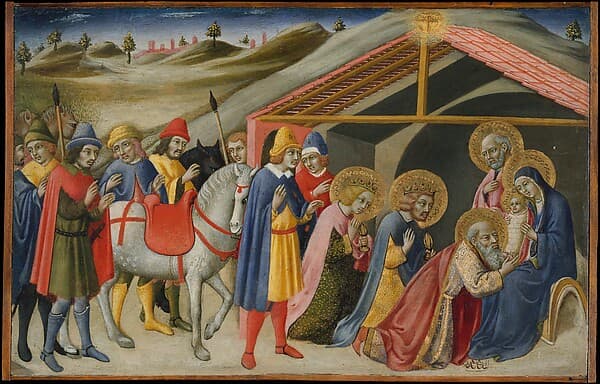
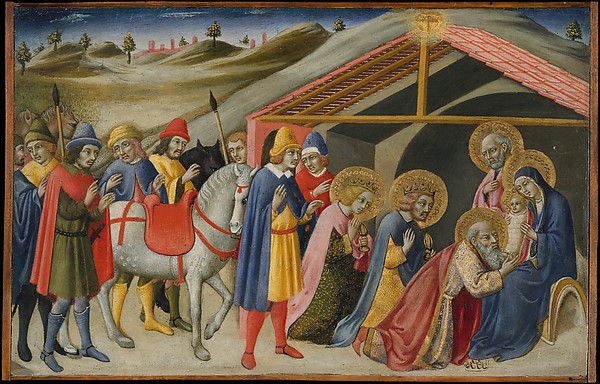
The Adoration of the Magi, painted by Sano di Pietro around 1465 in tempera and gold on panel and now in the Metropolitan Museum of Art in New York, depicts the visit of the three kings to the infant Christ as recorded in Matthew 2. Sano composes the scene with characteristic Sienese Quattrocento compositional sweetness: the seated Virgin and the Christ Child on the right, the eldest king kneeling in profile in the foreground offering his gift, the second and third kings standing behind in formal attendance. The chromatic palette of saturated crimson, ultramarine, and tooled gold against the patterned gold-tooled background is the unmistakable Sano di Pietro signature, and the calm sweet faces and slightly elongated figural proportions demonstrate the deliberately conservative Sienese alternative to the contemporary Florentine Renaissance pictorial reform.
met-437606
The Massacre of the Innocents, painted by Sano di Pietro around 1465 in tempera and gold on panel and now in the Metropolitan Museum of Art in New York, depicts the slaughter of the male children of Bethlehem ordered by King Herod after the visit of the Magi as recorded in Matthew 2. Sano stages the scene with characteristic Sienese narrative density: the soldiers in the foreground in the act of killing, the screaming mothers clutching their dead infants, the small bodies of the killed children scattered across the foreground, the seated Herod presiding over the action from a small architectural throne in the upper register. The composition was likely part of a small predella series — the small narrative panels arranged below the larger central altarpiece — and is one of the principal Sano di Pietro Massacre treatments.
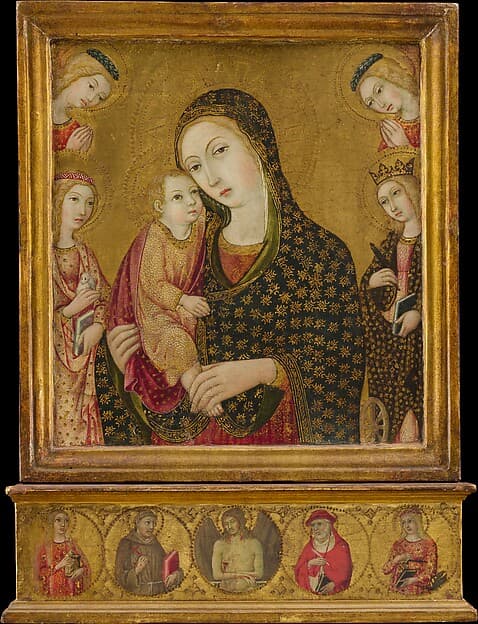
Madonna and Child with the Dead Christ, Saints Agnes and Catherine of Alexandria, and Two Angels
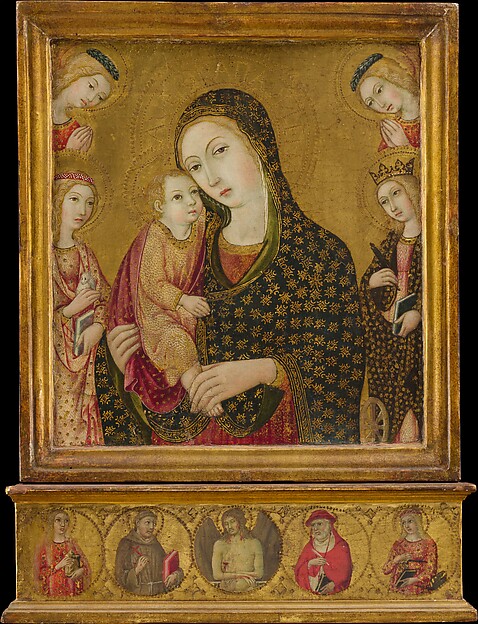
Madonna and Child with the Dead Christ, Saints Agnes and Catherine of Alexandria, and Two Angels, painted by Sano di Pietro around 1465 in tempera and gold on panel and now in the Metropolitan Museum of Art in New York, is a small intimate altarpiece panel that combines the iconographic subject of the Madonna and Child with the Marian Pietà type — the standing or seated Virgin holding the dead body of Christ across her lap. The composition shows the seated Virgin with both the living Christ Child on her lap and the dead body of the adult Christ supported across her knees; Saints Agnes and Catherine flank the Virgin in formal attendance, and two small attending angels complete the composition. The unusual compositional combination of the two subjects — the infancy and the Passion in the same panel — was a particular Sienese mid-fifteenth-century devotional preference.
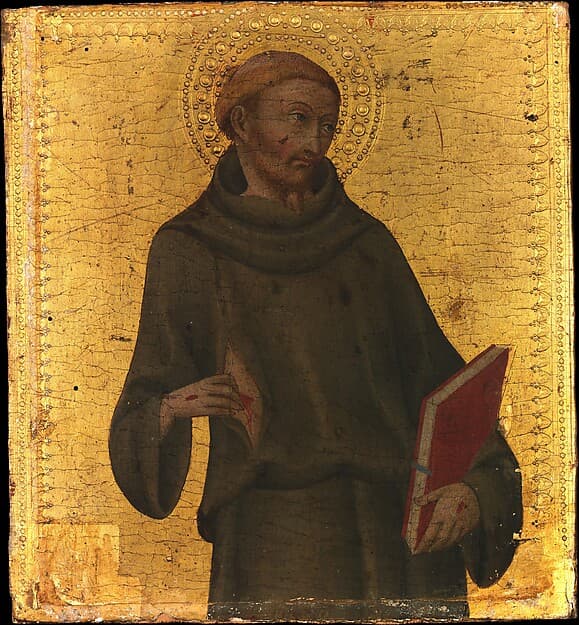
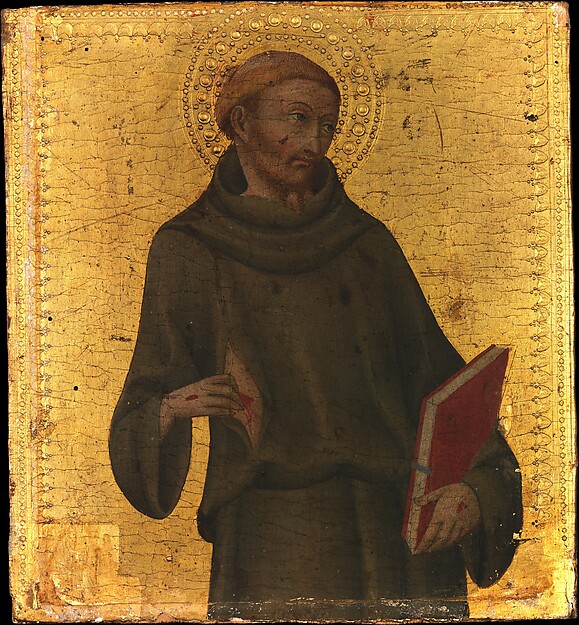
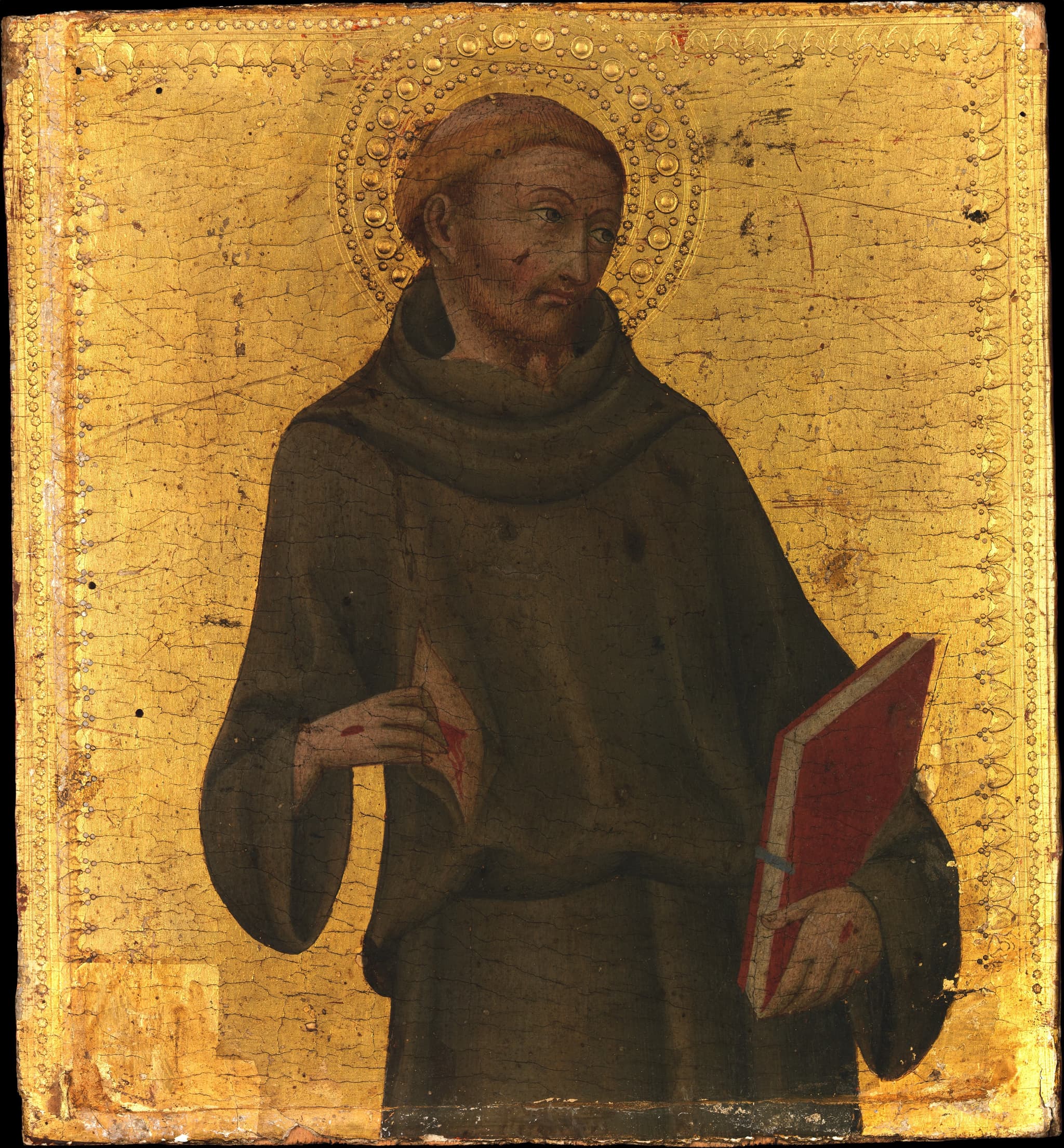
Saint Francis, painted by Sano di Pietro around 1440 in tempera and gold on panel and now in the Metropolitan Museum of Art in New York, depicts the medieval Italian Franciscan saint in the conventional iconographic posture of his religious meditation. The painting shows the seated Francis in his habit, his hands marked with the stigmata he received in his vision on Mount La Verna in 1224, his face lifted in inward contemplation. The chromatic palette of saturated brown, soft grey, and tooled gold against the patterned gold-tooled background is the unmistakable Sano di Pietro signature, and the calm sweet face is characteristic of his Sienese workshop's deliberately conservative late-medieval-into-Renaissance pictorial vocabulary.