Painter of the Bible
Sassetta (Stefano di Giovanni)
Sassetta — born Stefano di Giovanni di Consolo in or near Siena around 1392 — was the leading Sienese painter of the early fifteenth century and the principal stylistic bridge between the late Sienese Trecento tradition …
%2520-%2520WGA20849.jpg%3Fwidth%3D600&w=2048&q=75)
Their faith
Why Sassetta (Stefano di Giovanni) painted Christ
Sassetta, born Stefano di Giovanni di Consolo in the early 15th century, was deeply rooted in the Christian faith that permeated the culture of Siena. As the leading Sienese painter of his time, he dedicated his artistic talents to the service of the Church, creating numerous altarpieces and polyptych panels that reflected his devotion. His training in the late Trecento workshop tradition imbued him with a reverence for sacred subjects, and his works often conveyed a sense of spiritual tenderness and narrative depth. Sassetta's artistic practice was likely intertwined with a devotional life, as the creation of religious art was a form of worship and service to God, echoing the beliefs of his contemporaries in the Sienese artistic community.
Sassetta's faith profoundly influenced his artistic vision, most notably seen in works like the Borgo San Sepolcro Altarpiece and the Madonna of the Snow. The Borgo San Sepolcro Altarpiece, with its intricate narrative scenes and jewel-bright colors, showcases his ability to convey biblical stories with a sense of grace and beauty, inviting viewers into a deeper contemplation of the divine. Similarly, the Madonna of the Snow reflects his commitment to depicting sacred figures with a calm and sweet demeanor, embodying the love and compassion of Christ. Through his art, Sassetta continues to inspire viewers, reminding them of the beauty of faith and the importance of seeing the divine in everyday life.
Life & work
Sassetta — born Stefano di Giovanni di Consolo in or near Siena around 1392 — was the leading Sienese painter of the early fifteenth century and the principal stylistic bridge between the late Sienese Trecento tradition descending from Duccio, Simone Martini, and the Lorenzetti brothers and the new Quattrocento International Gothic and early Renaissance vocabulary that arrived in Siena through traveling Northern artists, the Florentine workshops of Lorenzo Monaco and Gentile da Fabriano, and the new Sienese-Florentine artistic exchange of the 1420s. Trained in Siena in the late Trecento workshop tradition, and active in Siena, Cortona, and the smaller Sienese hill towns for his entire career, he died in Siena in 1450 — possibly from a chill caught while frescoing the Porta Romana of Siena.
His Christian religious work is concentrated in altarpieces, polyptych panels, and small predella narratives in his characteristic combination of Sienese Trecento decorative refinement and the new Quattrocento interest in narrative incident and legible figural drawing. The Borgo San Sepolcro Altarpiece (1437–1444 — a vast double-sided polyptych originally painted for the church of San Francesco in Borgo San Sepolcro, now dispersed across the Louvre, the Berlin Gemäldegalerie, the National Gallery in London, the Boston Gardner Museum, and the Vatican Pinacoteca, with several individual predella panels still in private collections), the Madonna of the Snow (Florence, Contini Bonacossi collection), the Cortona Polyptych, and the small predella narratives of the lives of Saint Anthony Abbot and Saint Francis fill the painted corpus.
His personal style is the unmistakable late-Sienese late-medieval-into-Renaissance signature: jewel-bright color, tooled gold, slightly elongated figural proportions, calm sweet faces, and an unusual narrative tenderness in the small predella scenes that the Sienese Trecento tradition had largely passed to him through Simone Martini's example. His workshop trained the next generation of Sienese painters — Sano di Pietro above all — and shaped the Sienese mid-fifteenth-century pictorial vocabulary directly.
He was a contemporary of Masaccio and Filippo Lippi in Florence — exact contemporary in age and active across the same years — but represented the deliberately conservative Sienese alternative to the new Florentine pictorial revolution. The twentieth century rediscovered Sassetta as one of the supreme Sienese Quattrocento masters; the modern critical assessment treats him as a quietly major painter whose work was overshadowed in his own lifetime by the louder Florentine generation.
Notable works in detail
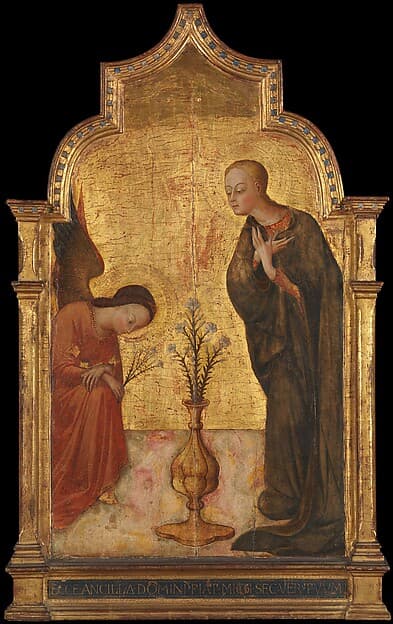
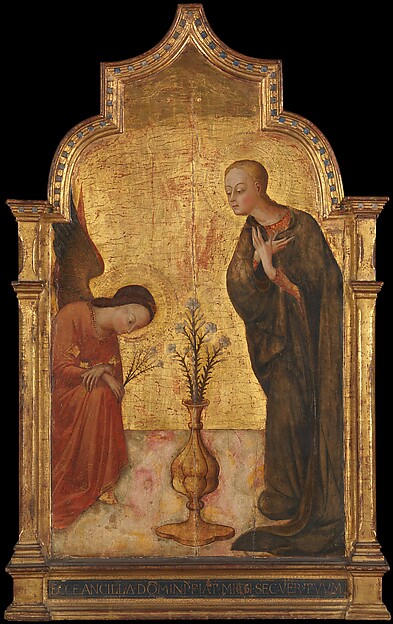
The Annunciation, painted by Sassetta around 1432 in tempera and gold on panel and now in the Metropolitan Museum of Art in New York, depicts the moment from Luke 1 in which the angel Gabriel appears to the Virgin Mary in her chamber to announce the conception of Christ. Sassetta stages the scene with characteristic late-Sienese compositional sweetness: the Virgin kneels at her prayer-desk on the right, the angel kneels on the left in an attitude of greeting with the lily of purity in one hand, the Holy Spirit descends as a small dove on a beam of golden light from the upper register. The chromatic palette of saturated rose, ultramarine, and tooled gold against the patterned gold-tooled background is the unmistakable Sassetta signature, and the elongated figural proportions and calm devotional faces demonstrate the bridge from the Sienese Trecento tradition to the new Quattrocento International Gothic.
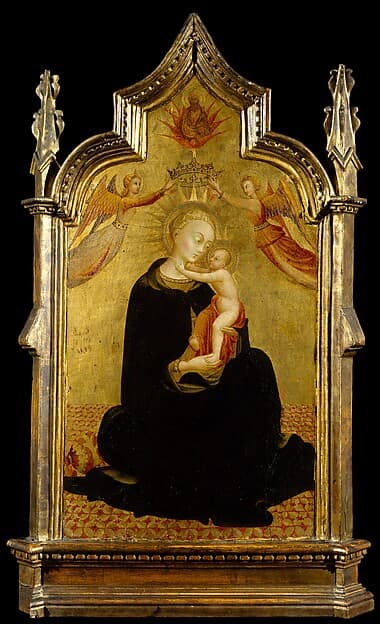
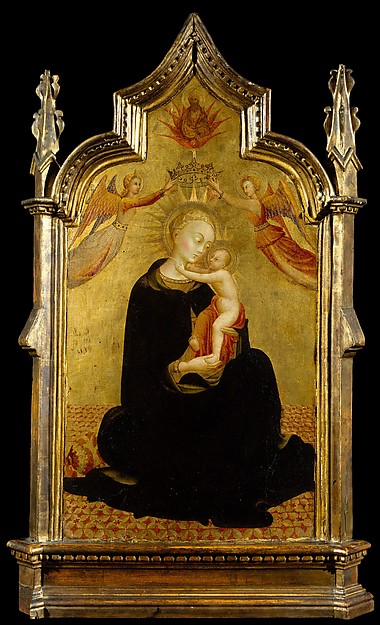
Madonna and Child with Angels, painted by Sassetta around 1445 in tempera and gold on panel and now in the Metropolitan Museum of Art in New York, is a small intimate Marian devotional panel from the late Sassetta workshop years. The Virgin sits in three-quarter view holding the Christ Child upright on her lap; two small attending angels lean in at her shoulders to crown her with a small wreath; the chromatic palette of saturated crimson, ultramarine, and tooled gold against the patterned gold-tooled background is the unmistakable late Sassetta signature. The panel belongs to the small Sienese fifteenth-century devotional Madonna type that the Sassetta workshop produced in dozens of variants for the Sienese household and confraternal devotional market.