Painter of the Bible
Sassoferrato (Giovanni Battista Salvi)
Giovanni Battista Salvi — universally called Sassoferrato from his birthplace in the Marche, the town of Sassoferrato — was an Italian Baroque painter who specialized in deeply traditionalist devotional images of the Vir…

Their faith
Why Sassoferrato (Giovanni Battista Salvi) painted Christ
Giovanni Battista Salvi, known as Sassoferrato, dedicated his artistic life to creating devotional images that reflect his deep Christian faith, particularly through his portrayals of the Virgin Mary. Born in 1609 in the town of Sassoferrato, his upbringing in a Christian household and training in his father's workshop instilled in him a reverence for sacred subjects. His artistic journey also included a brief period with the renowned painter Domenichino in Rome, where he further developed his spiritual vision. Sassoferrato's works are characterized by a serene and contemplative quality, embodying the essence of prayer and devotion. He often depicted the Virgin Mary in prayerful poses, capturing her humility and grace. His commitment to traditionalist themes, inspired by the works of Raphael and Perugino, reflects a desire to connect with the spiritual heritage of the Church, making his art a vehicle for devotion and worship.
Sassoferrato's paintings, particularly his iconic 'Madonna at Prayer' and the 'Madonna of the Rosary,' reveal the depth of his spiritual vision and his intention to inspire faith in viewers. The 'Madonna at Prayer' showcases a serene Mary, head bowed and hands crossed in a gesture of pure devotion, which became one of the most recognizable images in Catholic Europe. This painting, along with others, was not merely decorative but served as a focal point for prayer and meditation in homes and chapels. Through his art, Sassoferrato invites viewers to experience a moment of divine connection, encouraging them to reflect on their own faith. His legacy endures, as his devotion continues to resonate with those who encounter his work, reminding us of the beauty and power of prayer in our lives.
Life & work
Giovanni Battista Salvi — universally called Sassoferrato from his birthplace in the Marche, the town of Sassoferrato — was an Italian Baroque painter who specialized in deeply traditionalist devotional images of the Virgin Mary in a manner that consciously archaized back to Raphael and Perugino. Born in Sassoferrato in 1609, trained in his father's workshop and probably also briefly with Domenichino in Rome, he was active in Rome, the Marche, and Naples for his entire career. He died in Rome in 1685.
His Christian religious work is concentrated almost entirely in Madonnas and devotional panels of the Virgin in prayer — perhaps the most narrowly specialized output of any major Italian Baroque painter. Versions of the Madonna at Prayer, the Madonna with the Hands Crossed, the Madonna with the Veil, the Madonna of the Annunciation, and the various Madonna and Child compositions exist in the National Gallery in London, the Borghese in Rome, the Pinacoteca Capitolina, the Palatine Gallery in Florence, the Hermitage, the Louvre, and most of the major German and American collections — typically several versions in each. He produced these in painted, partly autograph and partly studio versions, in editions over decades. His characteristic Madonna — head bowed, eyes closed, blue mantle drawn over a white veil, hands crossed at the breast in a gesture of pure prayer — became, by repetition and reproduction in engraving, one of the most recognizable Italian Baroque devotional images.
His one major altarpiece, the Madonna of the Rosary in Santa Sabina in Rome (1643), is a deliberate exercise in fifteenth-century revival — composed in the manner of a Perugino or early Raphael altarpiece, with a careful symmetry and a pastel-colored sweetness that consciously turned away from the Caravaggesque chiaroscuro and the late-Baroque pictorial drama of his contemporaries.
His art is sometimes described as "the last fifteenth-century painter" — a deliberate seventeenth-century retreat into the calm, prayer-centered pictorial mode that the High Baroque had largely abandoned. The Madonnas were collected directly by aristocratic and ecclesiastical patrons across Europe in his lifetime, and through the eighteenth and nineteenth centuries his Madonna at Prayer became one of the most-reproduced devotional engravings in Catholic Europe — a fixture in chapels, prayer books, and homes from Naples to Quebec. The market for his Madonnas continued essentially unbroken into the early twentieth century.
Notable works in detail
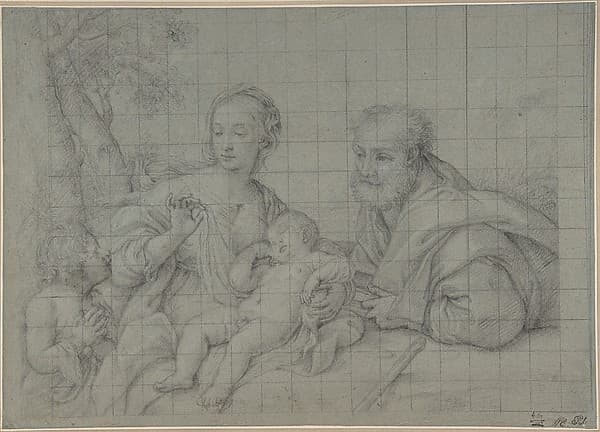
The Holy Family with the Infant Saint John the Baptist
The Holy Family with the Infant Saint John the Baptist, drawn by Sassoferrato around 1650 in his late Roman workshop in pen and ink with wash on paper and now in the Metropolitan Museum of Art in New York, is a preparatory drawing for one of his many small painted Holy Family devotional compositions. The drawing shows the seated Virgin holding the small Christ Child standing on her lap, with the small John the Baptist embracing the Christ Child from the side; Joseph stands behind the Virgin in formal attendance. The drawing demonstrates Sassoferrato's deliberately archaizing late-Quattrocento manner — figures composed in the style of Raphael and Perugino rather than in the contemporary mid-seventeenth-century Roman Baroque idiom — that defined his entire output and made him, by his own pictorial choice, the last fifteenth-century painter.
Bible scenes Sassoferrato (Giovanni Battista Salvi) painted
Luke