Painter of the Bible
Simone Martini
Simone Martini was the leading Sienese painter of the generation immediately after Duccio di Buoninsegna and the supreme stylist of the Sienese late-medieval-into-Renaissance tradition.

Their faith
Why Simone Martini painted Christ
Simone Martini, a prominent painter of the Sienese school, was deeply rooted in the Christian tradition that shaped his artistic vision. Born in Siena around 1284, he likely trained under Duccio di Buoninsegna, whose influence is evident in Martini's work. His faith was expressed through his commitment to creating sacred art that adorned churches and altars across Italy and Provence. Martini's devotional practices are reflected in his meticulous attention to detail and the reverence he showed for biblical narratives. His works often embody the spiritual aspirations of the medieval church, capturing the divine in a way that speaks to the hearts of believers. His connection to the Avignon papal court further highlights his role in the religious and cultural life of his time, as he painted for patrons who valued faith and beauty in art.
Martini's faith significantly shaped his artistic output, particularly in masterpieces like the Annunciation altarpiece and the Maestà fresco. In the Annunciation, the tender moment between Mary and Gabriel is rendered with exquisite detail, showcasing not just the elegance of the figures but also the profound spiritual significance of the event. The use of gold leaf and vibrant colors elevates the scene, inviting viewers to contemplate the mystery of the Incarnation. Similarly, the Maestà fresco, with its depiction of the Virgin Mary enthroned among angels and saints, serves as a visual testament to the glory of God and the reverence due to the Virgin. Through these works, Martini's devotion resonates with viewers, reminding us of the beauty and grace found in faith. His artistic legacy continues to inspire, inviting each observer into a deeper understanding of Christ and His message.
Life & work
Simone Martini was the leading Sienese painter of the generation immediately after Duccio di Buoninsegna and the supreme stylist of the Sienese late-medieval-into-Renaissance tradition. Born in Siena around 1284, almost certainly trained in Duccio's late workshop, and active in Siena, Naples, Pisa, Orvieto, Assisi, and finally Avignon (where he followed the Avignon papal court from 1336 onward), he produced altarpieces and fresco cycles across central and southern Italy and Provence for almost forty years. He died in Avignon in 1344, having become the favorite painter of the great Italian humanist poet Petrarch (who lived in Avignon during the same years).
His Christian religious work is concentrated in altarpieces and fresco cycles in his characteristic combination of Sienese decorative refinement and an unusually elegant figural elongation that anticipated the International Gothic style of the next generation. The Maestà fresco in the Palazzo Pubblico of Siena (1315 — Simone's first major commission, the Virgin enthroned in glory among angels and saints painted on the wall of the Council chamber facing the door), the Annunciation altarpiece (Uffizi, 1333 — painted in collaboration with his brother-in-law Lippo Memmi for the Cathedral of Siena, perhaps the supreme Sienese altarpiece of the entire fourteenth century), the Saint Martin Chapel frescoes in the lower church of the Basilica of San Francesco in Assisi (c. 1322–1326), the Robert of Anjou Crowned by Saint Louis altarpiece (Capodimonte, 1317), and the late Avignon work for Cardinal Stefaneschi anchor the painted reputation.
His personal style is unmistakable — figures of exceptional elegance and proportion, exquisite jewel-bright color, careful attention to embroidered textiles and intricate decorative pattern, and a particular tenderness in the Marian and devotional subjects that defined the Sienese pictorial tradition. The Uffizi Annunciation in particular — Mary recoiling slightly from Gabriel's greeting, the Latin words of the angel's salutation rendered in tooled gold across the empty space between the two figures, the slim attendant saints in the side panels — is one of the supreme statements of Sienese Trecento painting and one of the most reproduced images in the entire history of Italian medieval art.
He died in Avignon in 1344 having become a major figure of the early Italian humanist circle around Petrarch, who wrote two sonnets in his honor in the Canzoniere.
Notable works in detail
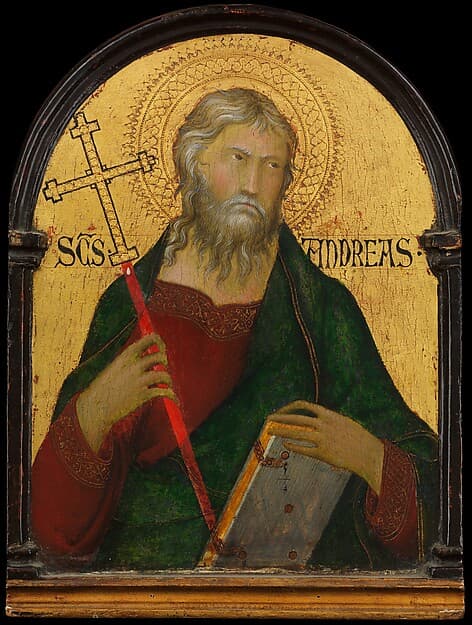
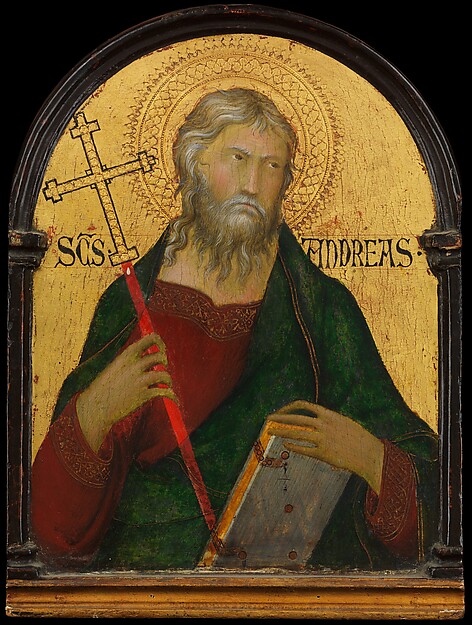
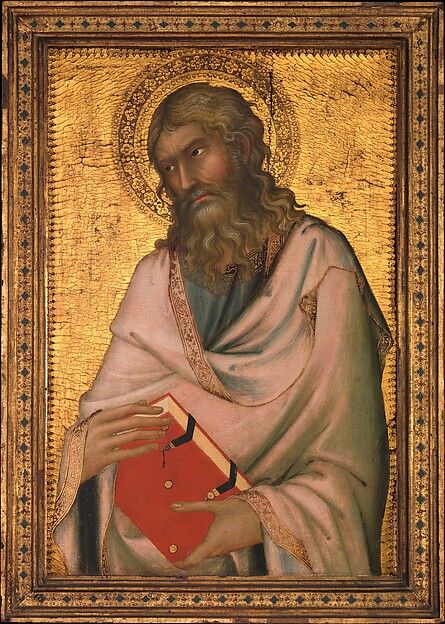
Saint Andrew, painted by Simone Martini around 1317 in tempera and gold on panel and now in the Metropolitan Museum of Art in New York, depicts the apostle Andrew in the conventional iconographic posture of his apostolic teaching, holding a small book and standing in three-quarter view against the unmistakable Sienese Trecento tooled-gold background. The chromatic palette of saturated rose, ultramarine, and tooled gold is the unmistakable early Simone Martini signature, and the elongated figural proportions and calm devotional face demonstrate the elegance that defined his entire Sienese workshop output. The panel was originally part of one of his larger Sienese polyptych altarpieces with the Virgin and Christ Child at the center and individual apostles in the side panels.
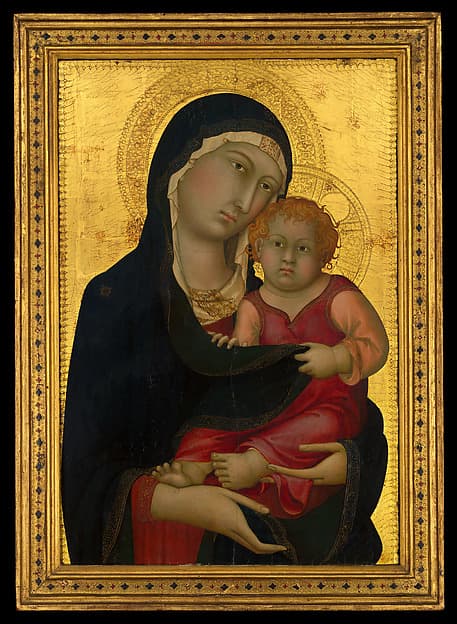
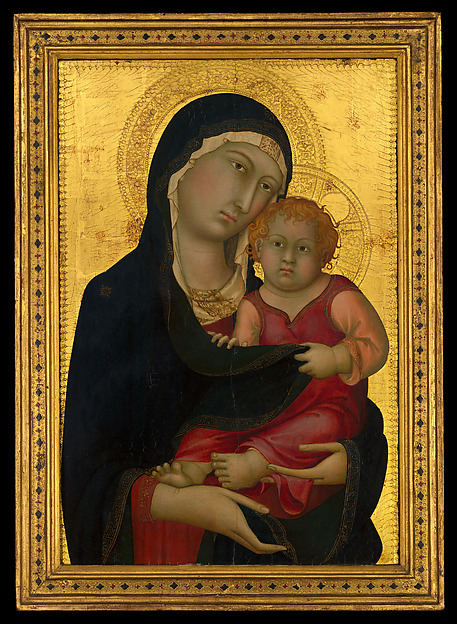
Madonna and Child, painted by Simone Martini around 1323 in tempera and gold on panel and now in the Metropolitan Museum of Art in New York, is a small intimate Marian devotional panel from his early-mature Sienese workshop years. The Virgin sits in three-quarter view holding the standing Christ Child upright on her lap; the chromatic palette of saturated crimson, ultramarine, and tooled gold against the patterned gold-tooled background is the unmistakable Simone Martini signature, and the elongated figural proportions and calm devotional faces demonstrate the Sienese late-medieval-into-Renaissance pictorial tradition at full mature statement. The panel is one of the principal small Simone Martini Madonnas in any American collection.