Painter of the Bible
Ventura Salimbeni
Ventura Salimbeni was a leading Sienese painter and printmaker of the late sixteenth and early seventeenth centuries — the principal Sienese exponent of the late-Mannerist style that the Tuscan school carried into the po…

Their faith
Why Ventura Salimbeni painted Christ
Ventura Salimbeni was deeply rooted in the Christian faith, which profoundly influenced his artistic journey. Born in Siena in 1568 to a family of painters, he was immersed in the rich traditions of Catholicism from an early age. His father, Arcangelo Salimbeni, nurtured his talent within the family workshop, where Ventura honed his skills alongside his half-brother, Francesco Vanni. This environment fostered a devotion to sacred subjects, as both brothers became leading figures in the late-Mannerist style, particularly during the Counter-Reformation. Salimbeni's work primarily served ecclesiastical purposes, creating altarpieces and devotional panels for Sienese churches and confraternities. His commitment to his faith was evident in his meticulous approach to scripture and the spiritual themes he explored through his art.
Salimbeni's faith found expression in several notable works, including the striking Crucifixion altarpiece located in San Giovanni Battista in Pisa and the intimate Madonna and Saints altarpieces for local parish churches. His late-Mannerist style, characterized by elongated figures and vibrant colors, reflects a deep reverence for the divine. The emotional intensity and devotion captured in his paintings invite viewers into a sacred space, encouraging contemplation and spiritual reflection. Through his art, Salimbeni's devotion continues to resonate with audiences today, reminding us of the beauty and power of faith as expressed through creativity.
Life & work
Ventura Salimbeni was a leading Sienese painter and printmaker of the late sixteenth and early seventeenth centuries — the principal Sienese exponent of the late-Mannerist style that the Tuscan school carried into the post-Tridentine Catholic Counter-Reformation period. Born in Siena in 1568 to the painter Arcangelo Salimbeni (whose workshop he trained in alongside his half-brother Francesco Vanni — who became, with Ventura, the leading Sienese late-Mannerist painter), and active in Siena, Rome, and the smaller central-Italian hill towns for his entire career, he died in Siena in 1613.
His Christian religious work is concentrated in altarpieces, fresco cycles, and small devotional panels for the Sienese churches and confraternities and (during his Roman sojourn under Pope Sixtus V in the late 1580s and 1590s) for the Roman ecclesiastical commissions of the late-Mannerist papal-court generation. The frescoes in the Vatican Library (1588–1589, painted alongside several of the leading late-Mannerist Roman painters under the direction of Cesare Nebbia for Pope Sixtus V's library decoration), the great Crucifixion altarpiece in San Giovanni Battista in Pisa, the Madonna and Saints altarpieces for the Sienese parish churches, and the small etchings of biblical and devotional subjects he produced for the Sienese print market fill the painted-and-printed corpus.
His personal style — late-Mannerist, with elongated figures in jewel-bright color, careful Tuscan compositional discipline, and a particular preference for the small intimate devotional subject over the large public altarpiece — defined the Sienese late-Mannerist tradition alongside his half-brother Francesco Vanni. The Sienese late-Mannerist school the two brothers led continued the older Sienese workshop tradition into the Counter-Reformation period.
He is sometimes confused in older scholarship with the more famous Roman early-Baroque painter Ventura Salimbeni's near-contemporary Cavaliere d'Arpino, but the two are distinct figures. He was buried in Siena in his parish church of Santo Spirito.
Notable works in detail
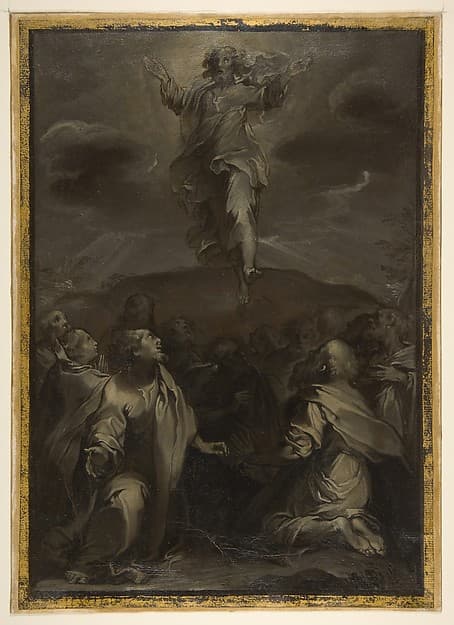
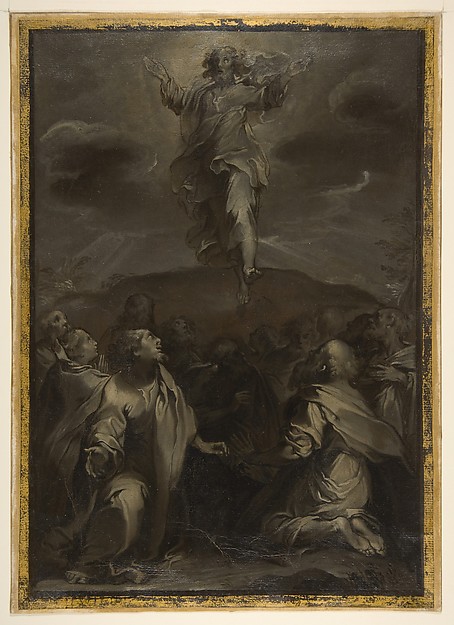
The Ascension of Christ, drawn by Ventura Salimbeni around 1595 in pen and brown ink with wash on paper and now in the Metropolitan Museum of Art in New York, depicts the moment from Acts 1 in which Christ ascends into heaven from the Mount of Olives in the presence of the assembled apostles. Salimbeni stages the scene as a vertical composition: Christ rises in the upper register surrounded by attending angels and a luminous burst of light, the apostles gather below in a tight formal grouping looking up in attitudes of astonishment and farewell. The drawing demonstrates the late-Mannerist Sienese draughtsmanship that Salimbeni and his half-brother Francesco Vanni made into the Sienese pictorial signature of the late Cinquecento.
met-459499
Study for the Figure of Christ in a Deposition, drawn by Ventura Salimbeni around 1600 in red chalk on paper and now in the Metropolitan Museum of Art in New York, is a small preparatory drawing for one of his painted Deposition compositions. The drawing shows the figure of Christ in three-quarter view, his arms outstretched, his body modeled in the soft sfumato red-chalk technique that the late-Cinquecento Florentine and Sienese workshop tradition had refined to a high pitch. Such drawings — focused single-figure studies — were the standard preparatory currency for late-Mannerist Italian altarpiece practice.
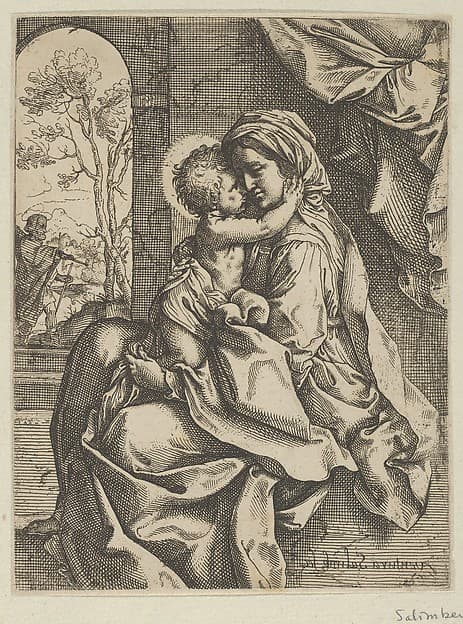
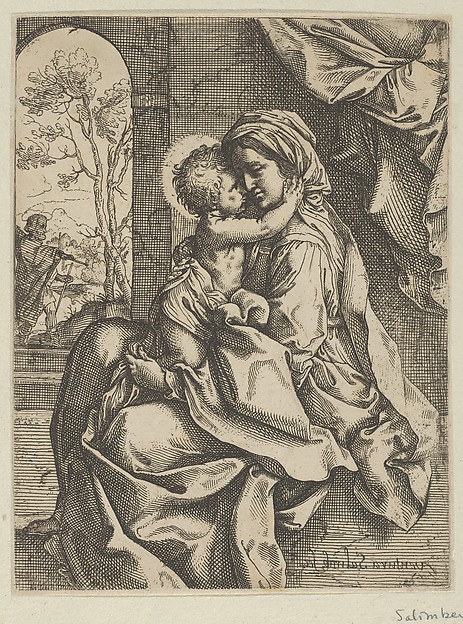
The Virgin Seated with the Christ Child on Her Lap, drawn by Ventura Salimbeni around 1605 in pen and ink with wash on paper and now in the Metropolitan Museum of Art in New York, depicts the iconographic subject of the seated Virgin holding the small Christ Child in tender embrace. Salimbeni stages the scene with characteristic late-Mannerist Sienese compositional sweetness: the Virgin in three-quarter view, the Christ Child seated on her lap reaching up to embrace her cheek, the small attending figures of John the Baptist and other Marian devotional figures completing the composition. The drawing demonstrates the late-Mannerist Sienese workshop signature at full mature statement.