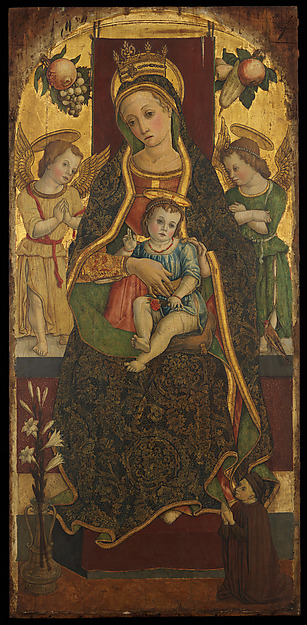
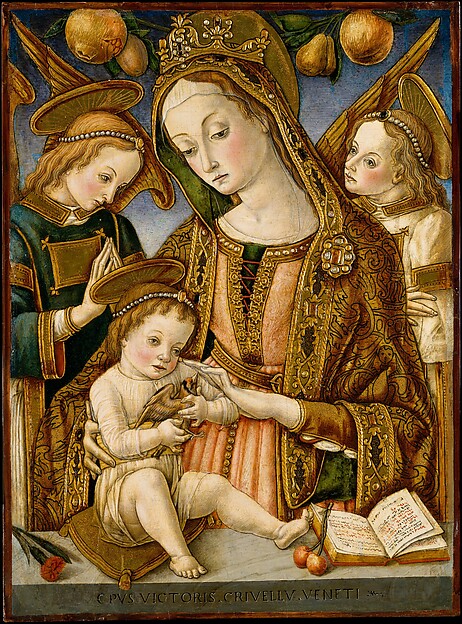
Painter of the Bible
Vittore Crivelli
Vittore Crivelli was a Venetian-born painter who, like his older brother Carlo Crivelli, spent his entire mature career in the small towns of the Marche on the Adriatic coast of central Italy producing altarpieces in the…

Their faith
Why Vittore Crivelli painted Christ
Vittore Crivelli, a Venetian-born painter, dedicated his life to creating sacred art that reflects his deep Christian faith. Born into a family of artists, he was trained by his father, Jacopo Crivelli, and alongside his brother Carlo, both of whom were influential figures in the late-Gothic and early Renaissance art movements. Despite the challenges he faced, including exile from Venice, Crivelli's commitment to his faith remained steadfast. His works, primarily altarpieces and polyptychs, showcase a reverence for scripture and the divine, often infused with the rich traditions of his Catholic upbringing. The meticulous attention to detail in his paintings, such as the elaborate gold backgrounds and the vibrant colors, speaks to a devotional practice that sought to glorify God through art.
Crivelli's faith profoundly influenced his artistic vision, evident in masterpieces like the "Madonna of Humility" and various altarpieces housed in the Pinacoteca Civica of Fermo. These works not only display his technical skill and the characteristic Crivelli style but also invite viewers into a deeper contemplation of the sacred. The figures he painted, often adorned in intricate garments and surrounded by lush botanical details, serve as conduits for spiritual reflection and devotion. Crivelli's art continues to inspire and uplift, allowing viewers to connect with the divine through his vibrant representations of faith, reminding us that the beauty of the sacred can be experienced through the lens of artistic expression.
Life & work
Vittore Crivelli was a Venetian-born painter who, like his older brother Carlo Crivelli, spent his entire mature career in the small towns of the Marche on the Adriatic coast of central Italy producing altarpieces in the late-Gothic-into-Renaissance manner that the Crivelli family workshop made into the regional Marche pictorial signature. Born in Venice around 1440 to the painter Jacopo Crivelli (the founding patriarch of the Crivelli workshop), trained in Venice in his father's workshop alongside his older brother Carlo, and exiled from Venice (probably in connection with the same family difficulties that drove Carlo into Adriatic exile in 1457), he settled in Zara (modern Zadar) in Dalmatia for nearly two decades before joining his brother in the Marche around 1481. He worked in Fermo and the smaller hill towns of the southern Marche for the rest of his life and died in Fermo around 1502.
His Christian religious work is concentrated in altarpieces and polyptychs in his characteristic combination of late-Gothic Venetian decorative refinement and the deliberately archaizing pictorial vocabulary that the Crivelli workshop maintained against the contemporary Italian Renaissance Florentine and Roman pictorial currents. The polyptych altarpieces in the Pinacoteca Civica of Fermo, the great Madonna and Child with Saints panels in the Marche regional churches and museums, the Madonna of Humility (multiple workshop variants), and the small devotional Madonnas now scattered across the European and American collections fill the painted corpus.
His personal style is closely modeled on his older brother Carlo's manner — figures in elongated late-Gothic proportions modeled with intense jewel-bright color, against tooled-gold backgrounds, framed by elaborate carved-and-gilded architectural altarpiece structures, and decorated with the unmistakable Crivelli touches of swag-and-fruit garlands, embroidered silks, and minute observation of botanical specimens. The two brothers' workshops produced altarpieces in close stylistic dialogue across the Marche through the 1480s and 1490s, and individual surviving panels are sometimes hard to attribute decisively to one Crivelli brother rather than the other.
He proudly signed himself in the late altarpieces with the parallel formula his brother had used: VICTOR CRIVELLUS VENETUS (Vittore Crivelli the Venetian) — both brothers continued to identify with their native Venice across their decades of Marche-regional residence.
Notable works in detail
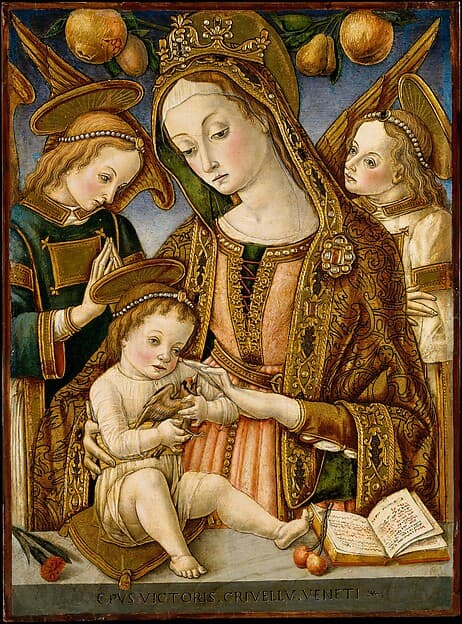
Madonna and Child with Two Angels
Madonna and Child with Two Angels, painted by Vittore Crivelli around 1481 in tempera and gold on panel and now in the Metropolitan Museum of Art in New York, is a small altarpiece panel from his Marche-regional workshop years. The composition shows the Virgin in three-quarter view holding the standing Christ Child upright on her lap; two small attending angels lean in at her shoulders to offer the Christ Child small bunches of fruit. The chromatic palette of saturated crimson, ultramarine, and tooled gold against the patterned gold-tooled background is the unmistakable late-Crivelli workshop signature, with the characteristic swag-and-fruit garland border decoration that distinguished both Crivelli brothers' altarpiece production across the Marche region.
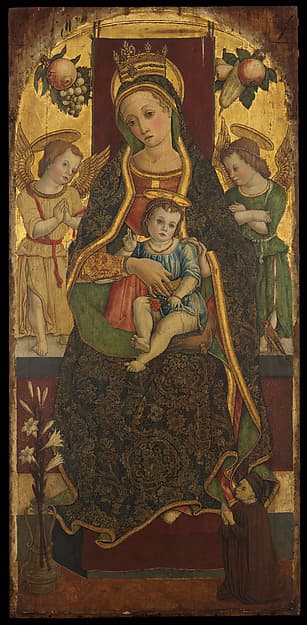
Madonna and Child Enthroned with Two Angels and a Donor
Madonna and Child Enthroned with Two Angels and a Donor, painted by Vittore Crivelli around 1481 in tempera and gold on panel and now in the Metropolitan Museum of Art in New York, is a small altarpiece panel from the same Marche-regional workshop period. The composition shows the Virgin enthroned with the Christ Child on her lap in the conventional sacra conversazione format, with two small attending angels at her shoulders and a small kneeling donor figure in the lower foreground. The chromatic palette and the careful tooled-gold background continue the Vittore Crivelli workshop signature, and the panel demonstrates the close stylistic relationship between Vittore's painted output and his older brother Carlo's contemporary altarpiece production in the same Marche region.
Bible scenes Vittore Crivelli painted
Luke