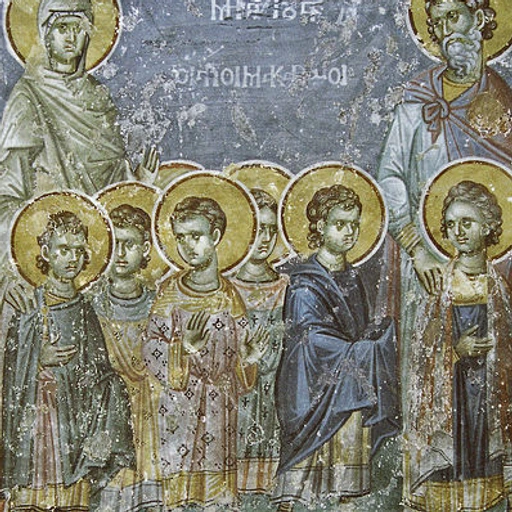
Who was The Seven Maccabean Brothers in the Bible?
The seven brothers were sons of one mother who chose to die rather than break the law of God when a foreign king tried to force them.
Brothers Martyred for the Law
c. 167 BC
The seven brothers were sons of one mother who chose to die rather than break the law of God when a foreign king tried to force them.
Follow the reading trailBEYOND THE NAME
In 4 Maccabees 8, the seven brothers are brought before the tyrant Antiochus and commanded to forsake the law of their fathers, beginning with the eating of forbidden food. One by one they refuse, encouraging one another, and endure terrible tortures rather than betray their God. Their reasoned, fearless courage forms the heart of the book’s argument that devout reason can master suffering and the fear of death.
Themes in the authored commentary
FOLLOW THE PASSAGES
These are chapter studies associated with this record. Their order follows the books and chapters, rather than a reconstructed timeline of the person’s life.
seven brothers who each in turn refused to eat pork and were martyred, proclaiming resurrection
Some chapters of Scripture are hard to read because they are so violent, and this is one of them. A mother and her seven sons are arrested under the persecution of Antiochus and commanded to eat what the law of God forbids. The price of refusal is torture and death, and the king means them to watch one another die. Yet what the chapter records is a strange and unbreakable courage. Each brother, as he is dying, says something, and what he says again and again is that death is not the end of the story. The King of the world will raise up those who die for His laws.
Chapter overview from the authored study guide.brothers who declare their readiness to die for the law and are tortured one by one beginning with the eldest
The first of the seven brothers is dragged to the wheel. The tyrant has one demand: eat the unclean meat, renounce the law, and live. The brother will not. The arguments are over now. What is left is a body fastened to the rack and a will the rack cannot reach. The author has spent eight chapters claiming that devout reason rules the passions. Here is where the claim meets iron.
Chapter overview from the authored study guide.remaining brothers who endure successive tortures, each refusing to apostatize and mocking the tyrant's power over the body
By chapter 10 the proof has stopped being an argument and become bodies. Two of the seven brothers are already dead. The third is led in, and the crowd does the tyrant’s work for him - voices begging him to taste the meat and live. One bite and the pain stops. He will not. Same father, same mother, same teachings, same kinship: he will not betray it. Ye are not able to touch… my soul (v. 4).
Chapter overview from the authored study guide.the youngest brother, who rejects Antiochus's offer and leaps into the fire to die with his brothers
Six brothers are dead. The tyrant Antiochus has spent his whole arsenal on them - fire, the wheel, every cruelty he could invent - and not one broke. Now the seventh stands before him, the youngest of all, a boy already in chains. And the king changes tactics. He stops threatening and turns gentle: he felt strong compassion for this child… and tried to console him (vv. 2-3). The same demand as before - forsake your God - but wrapped now in kindness.
Chapter overview from the authored study guide.brothers whose mutual love and shared reasoning are praised as the bond that made their collective faithfulness possible
Seven brothers are tortured to death, one at a time, in front of each other. None of them breaks. The watching is meant to wear them down; instead they turn it into a chorus, cheering each departing one on - a holy choir of righteousness (v. 8). The line that steadies them is the one the chapter turns on: Let us not fear him who thinketh he kills (v. 14). They look past the man who holds the fire to the God who holds their souls, and the fear lets go.
Chapter overview from the authored study guide.brothers whose collective death the author declares a victory over the tyrant and a ransom for the nation
The seven sons are dead, and now the soldiers come for the mother. Rather than let them touch her, she threw herself into the flames (v. 1). The narrative breaks off there. The author stops telling the story and begins to speak over it - a funeral oration that turns a slaughter into a coronation. She is more august than the moon in heaven, with the stars (v. 5). Then the controlling image arrives: the games.
Chapter overview from the authored study guide.THE PEOPLE AROUND THE PERSON
Relationships follow the source graph. Some are interpretive or uncertain, and individual verse citations are not yet available for every connection.
STUDY & INTERPRETATION
The seven brothers are the central witnesses of 4 Maccabees, young men who answer a tyrant’s threats with shared resolve and meet death as free men rather than break covenant with God. Their endurance is offered as proof that faith and right reason can rule over pain, and their willingness to suffer is spoken of as a sacrifice that purifies and pleads for their people. Their constancy joins the long line of biblical witnesses who held fast to God through fire, looking beyond present torment to the hope of life with Him. In the larger story of Scripture, such faithful suffering for the sake of others and the trust in resurrection beyond death find their fullness in the One who endured the cross, despising the shame, and was raised to bring many sons to glory.
From the Learn of Christ person commentary. Read alongside the linked Scripture passages.KEEP SCRIPTURE CLOSE
9 authored chapter guides feature this person. This is guide coverage, not an exhaustive count of biblical mentions.
ASK A BETTER QUESTION
Identity, story, early-life sources, family, and where to read.
The seven brothers were sons of one mother who chose to die rather than break the law of God when a foreign king tried to force them.
In 4 Maccabees 8, the seven brothers are brought before the tyrant Antiochus and commanded to forsake the law of their fathers, beginning with the eating of forbidden food. One by one they refuse, encouraging one another, and endure terrible tortures rather than betray their God. Their reasoned, fearless courage forms the heart of the book’s argument that devout reason can master suffering and the fear of death.
Our authored studies connect The Seven Maccabean Brothers with 2 Maccabees, 4 Maccabees. The linked chapters provide reading context, not proof that an unnamed or inferred identity is explicitly named there. A verified, identity-specific verse index is not yet available for this record, so these chapter tags should not be treated as an exhaustive list of mentions.
The linked source context describes The Seven Maccabean Brothers within its biblical setting. Read their recorded role in context, and distinguish the narrative’s direct statements from theological interpretation or later traditions.
The Seven Maccabean Brothers’s source record lists Father of the Seven Brothers (father), Mother of the Seven Brothers (mother). These are source-graph relationships; legal family, uncertain identifications, and ancestral language require the cautions below. Individual verse evidence is not yet retained for every family edge.
The seven brothers are the central witnesses of 4 Maccabees, young men who answer a tyrant’s threats with shared resolve and meet death as free men rather than break covenant with God. Their endurance is offered as proof that faith and right reason can rule over pain, and their willingness to suffer is spoken of as a sacrifice that purifies and pleads for their people.
Answers draw on our existing authored biography and linked chapter studies. Where supplied, verse assignments come from the individualized STEP Bible index. Childhood answers distinguish documented events from gaps in the available sources.
YOUR OWN OBSERVATIONS
Notes, saved people, and study marks stay in this browser. They do not sync to your account.
KEEP EXPLORING
People featured in the same study guides. Sharing a chapter does not establish a family relationship.