
- Starting price
- Free
- Free tier
- Yes
- Platforms
- iOS · Android · Web
- Developer
- Cru / JESUS Film Project
- Launched
- 1979 (film) · 2010s (app)
- Updated
- May 25, 2026
The verdict
The JESUS Film Project app is a single-purpose streaming utility built around one of the most-watched pieces of religious media ever produced - and its 2,000-plus language library has no real competitor at any price. If you want the JESUS film, Magdalena, or Rivka in a heart language no other app carries, this is the only place to get them.
Try The JESUS Film Project ↗Opens jesusfilm.org
The JESUS Film Project app has quietly become the workhorse of cross-cultural evangelism - the app the missionary, the diaspora pastor, and the village showing-group all reach for when they need the gospel of Luke on a phone screen in a language nobody else has bothered to dub. The hook is the catalog. The 1979 film simply called JESUS, produced by Cru (then Campus Crusade for Christ) and based almost line-for-line on the Gospel of Luke, has been translated into more than 2,000 languages and is by a long margin the most-translated motion picture in human history. The app exists to stream it.
It is not a Bible app. It does not have reading plans. It does not have a community feed. It does not try to be Hallow or YouVersion or The Chosen. What it does - pull a specific language version of a specific film from a deep, deep server farm and play it on your phone - it does well, free, and without ads.
For most U.S. readers reaching for an English-language Jesus drama, this is not the obvious first pick - The Chosen has displaced it culturally, and the 1979 production values feel their age. But the moment you step outside English, or outside the most common dozen world languages, the JESUS Film app becomes the only option on the field. Russian, Mandarin, Hindi, Swahili, Hausa, Urdu, Tagalog, Quechua, Cherokee - and roughly 1,990 other tongues - are not in The Chosen app, are not in Pure Flix, are not anywhere else. They are here.
✓ The good
- Unmatched language catalog - more than 2,000 dubbed versions of the JESUS film, by a wide margin the most-translated film ever made
- Genuinely free with no ads, no subscription, no paywalled chapters - Cru funds distribution as part of its mission, and the app reflects that
- Companion shorts library - Magdalena (Mary Magdalene's perspective), Rivka, Walking with Jesus, the Falashas film, and a steady stream of newer culturally-specific shorts
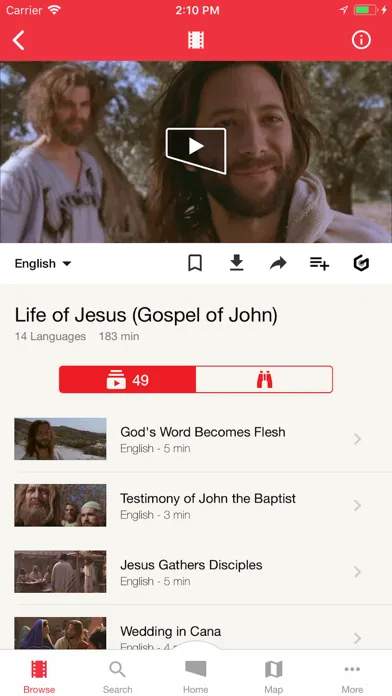
- Built for offline showings - download a film in your chosen language and play it without data, which is the entire point in field-evangelism use
- Search by language is the killer UX - type your heart language and the app finds what version exists, including dialects most platforms ignore
- Lightweight install with low device requirements - runs fine on older Android hardware common in two-thirds-world contexts
- A "share" / response flow built into the experience for ministry use, including prayer-decision tracking that ties into JESUS Film Project follow-up resources
✗ Watch out
- The base JESUS film is from 1979 - the production values, pacing, and acting feel period-correct for the late 70s, and modern Western viewers will notice
- Catalog is narrow by design - this is the JESUS film and its specific companion shorts, not a general Christian streaming service
- No original-language Bible text, study notes, or commentary - it is a video player, not a study app
- Discovery inside the app is functional rather than delightful - you arrive knowing what you want, or you wander
- Some companion shorts exist in far fewer languages than the main film, so non-English viewers may find Magdalena but not the newer titles
- No Chromecast / AirPlay polish on par with Netflix-tier apps (yet) - casting works but is not the focus
Best for
- Missionaries and cross-cultural workers needing the gospel of Luke in heart languages
- Diaspora pastors and immigrant church leaders serving multilingual congregations
- Field evangelism teams running showings without reliable connectivity
- Anyone curious to see the film that has reportedly recorded billions of viewings worldwide
Avoid if
- You want a modern, high-production Jesus drama with multi-season storytelling - The Chosen app is the answer
- You want a broad library of Christian films and family movies - Pure Flix covers that lane
- You want a Bible-reading or study app with the gospels in text form
- You want algorithmic content discovery - this app assumes you know what you came for
What The JESUS Film Project is
The JESUS Film Project app is a free streaming and download app published by Cru's JESUS Film Project ministry. Its core content is the 1979 film JESUS - a 128-minute dramatization of the Gospel of Luke produced by John Heyman and originally distributed by Warner Bros. - together with a growing library of companion shorts (Magdalena, Rivka, Walking with Jesus, the Falashas story, and a series of newer culturally-specific films aimed at women, children, and unreached people groups).
What sets the app apart is not the catalog's breadth but its depth in a single dimension: language. The flagship film has been dubbed into more than 2,000 languages and counting, a translation effort that has been running continuously since 1979 and is widely cited as the most ambitious media-translation project in history. The app is the front door to that catalog. Pick a language, pick a film, stream or download.
Why missionaries and diaspora pastors use The JESUS Film Project app
The single biggest practical difference between this app and every other Christian video app is the language depth. Most apps proudly advertise that they support twenty or thirty languages. The JESUS Film Project app supports more than two thousand - including hundreds of languages with under a million speakers, where no commercial streamer has any business case to translate anything. That is the entire point. The film was conceived from the beginning as a tool for cross-cultural evangelism, and the app is the modern face of that effort.
In practice this means a pastor in Kazakhstan can hand a Tajik refugee a phone with the JESUS film in Tajik, Persian, or Uzbek and have it actually work. A diaspora church in Houston can show Magdalena in Amharic to a women's group. A field worker in Papua New Guinea can pull a version dubbed in a language with fewer than fifty thousand speakers. This is not a feature any other app on the market can match - not The Chosen, not Pure Flix, not anything. The Bible app comes closest with its audio catalog, but for video evangelism the JESUS Film Project app is alone in its lane.
2,000+ language film streaming: the differentiator that has no peer
Open the app, tap the language selector, and you are looking at a list that scrolls past every language you have ever heard of and into hundreds you have not. Major world languages are there - Mandarin, Spanish, Arabic, Hindi, Bengali, Russian, Portuguese, French, Swahili - each typically with multiple regional dubs. Then come the long-tail entries: Quechua variants, Hausa, Yoruba, Fulani dialects, Cherokee, Navajo, Hmong, Karen, dozens of Indonesian and Filipino languages, indigenous languages of the Andes and the Amazon, scores of African languages that have full Bible translations but no other commercial media. The catalog passed the 2,000-language mark, and Cru continues to fund new dubs.
This sounds like a small thing. In practice it is transformative for the way cross-cultural ministry actually works. When the gospel arrives in a heart language rather than a trade language, the response is materially different - and the JESUS Film Project has cited millions of recorded conversion responses across the film's history, with viewing estimates running into the billions globally. Whether you take those numbers at full weight or with a grain of salt, the underlying point stands: this app is the only place on a phone where a particular village in northern Nigeria or a particular highland valley in Peru can hear the Luke narrative spoken in the language children learn from their mothers.
Companion shorts library: Magdalena, Rivka, Falashas, and the cultural-specifics
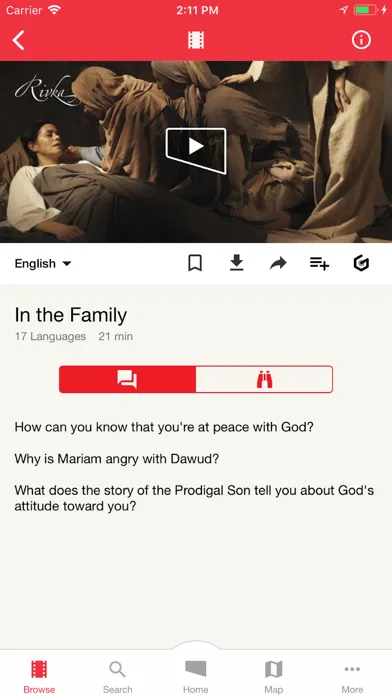
The catalog is bigger than the 1979 film. The companion library includes Magdalena: Released from Shame - a feature-length film telling the gospel from Mary Magdalene's perspective, designed for women's ministry contexts and now itself translated into more than two hundred languages - along with Rivka (a contemporary drama bridging into the gospel story), Walking with Jesus, The Story of Jesus for Children (a child-targeted edit), and a steady stream of newer shorts targeted at specific unreached people groups. The Falashas film, telling the story of Ethiopian Jewish believers, is among the more historically interesting entries; recent additions include culturally-specific dramas built for South Asian, Central Asian, and East African audiences.
For a U.S. viewer used to The Chosen, the production values across the shorts vary widely. The newer culturally-specific films often look excellent and are built with native casts; older shorts share the late-70s look of the flagship. But the same language-depth logic applies - Magdalena alone in 200+ languages outpaces almost any other piece of Christian media in translation reach. For ministries targeting women, children, or specific unreached groups, the shorts library is the reason to keep the app installed.
Mission and evangelism use case: built for showings, not bingeing
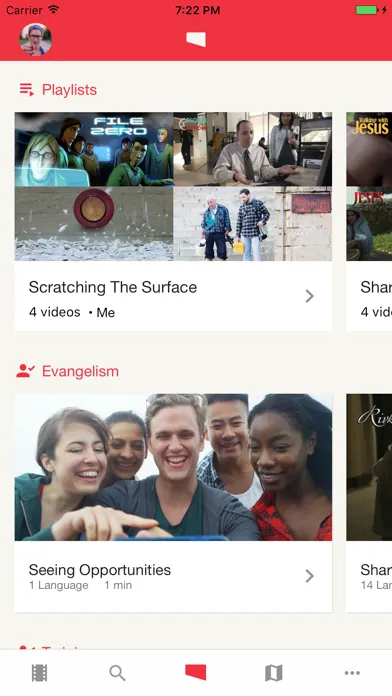
The app is engineered around an evangelism workflow rather than a consumer-streaming workflow, and once you notice it you cannot un-notice it. Offline download is front and center, because the assumption is that the film will be shown somewhere without reliable connectivity. Language selection is the first decision, because the assumption is that you are looking for a specific dub. The interface includes share flows, response prompts, and ties back to follow-up resources from JESUS Film Project for the showing leader to send to interested viewers. Decision-recording tools are quietly built in - Cru tracks the millions of recorded responses across the film's history through exactly this kind of feedback loop.
For an individual viewer just curious about the film, this is invisible - you tap, you watch, the experience is fine. For a field worker, a church planter, or a campus ministry student running a showing in a dorm common room, the workflow is the point. There is no other Christian video app in the App Store that is this deliberately built around the showing-and-conversation use case, and that lineage shows up everywhere from the icon set to the help content.
Pricing
Free
Free
Full access to the entire 2,000+ language catalog, all companion shorts, offline downloads, and sharing tools. No ads, no in-app purchases, no premium tier.
Donate to Cru
Optional
The app itself is permanently free. Cru funds translation and distribution through donations on jesusfilm.org - giving is invitational, never gated.
There is no pricing to discuss in the usual sense. The JESUS Film Project app is permanently free, with no ads, no subscription tier, no in-app purchases, and no paywalled chapters or languages. Every dub, every short, every download is available to every user from install onwards.
Cru funds the translation, dubbing, and distribution work through donations to JESUS Film Project on the ministry side. Giving is invitational rather than gated - the app surfaces opportunities to give to translation projects, including funding new language dubs for unreached groups, but no feature of the app is locked behind giving.
For a missionary or pastor planning a showing, the practical implication is that there is nothing to expense, nothing to provision, nothing to license. Install the app, pick the language, download for offline, go.
Most users will not need to think about money at all. The donation surface is there for people who specifically want to fund the next language translation, and the costs of a single language dub are surprisingly transparent if you go look - Cru publishes per-language funding asks on the ministry site for donors who want to sponsor specific projects.
Where The JESUS Film Project falls behind
No modern Jesus drama. The flagship film is from 1979. The cinematography, pacing, and acting are period-correct for the late seventies and have not been remastered into modern-feeling production. Viewers coming from The Chosen will feel the gap immediately, and there is no equivalent multi-season prestige content in the catalog.
No Bible text, no study tools, no original-language helps. This is a video player, not a study app. If you want to read along in Luke, follow a verse cross-reference, or pull up a commentary, you are doing that in a different app on a different tab.
Discovery is utilitarian rather than delightful. There is no algorithmic recommendation feed, no editor's picks, no "watch next" UX of the kind that consumer-streaming apps spend millions on. You arrive knowing what you want, or you scroll. For the target user that is the right tradeoff; for casual browsers it can feel sparse.
Casting and second-screen polish lag (yet). Chromecast and AirPlay both work in current builds, but the experience is not at the level a Netflix or Disney+ user expects. For a phone-to-projector showing on a missions trip this is fine; for a living-room movie night it is noticeably more friction than the consumer-grade apps.
Some companion shorts have shallower language coverage than the main film. The flagship JESUS film is the deepest catalog; Magdalena reaches 200+ languages; newer culturally-specific shorts may only exist in their target language plus English. If you want a specific short in a non-major language, check before assuming it is there.
The JESUS Film app vs. The Chosen app vs. Pure Flix
These three apps look like they belong in the same category - Christian video streaming - but they are actually three different products solving three different problems. The JESUS Film Project app is a translation and distribution tool wrapped around one specific film and its companions, optimized for cross-cultural and offline use. The Chosen app is a prestige-drama streamer built around Dallas Jenkins's multi-season series and its growing studio universe, optimized for the modern binge experience. Pure Flix is a general Christian-and-family video subscription service in the Netflix mold, with thousands of titles spanning Christian films, family movies, and original series.
Different strengths. The JESUS Film app is unmatched on language depth and free-distribution scale - there is literally nothing else in the App Store that streams a feature-length Jesus drama in 2,000+ languages. The Chosen app is better at modern storytelling, production values, and emotional engagement with a Western audience; it is what you reach for if you want someone moved by a contemporary Jesus drama, and the bulk of its catalog is free in its own way (ad-supported with optional Pay-It-Forward giving). Pure Flix is broader - thousands of titles, family-friendly programming, originals - but charges a monthly subscription and stays mostly in the English market.
A reasonable household keeps two of these installed and not all three. If you do cross-cultural ministry or speak a heart language other than English, JESUS Film is non-negotiable. If you want modern Jesus drama for personal or small-group use, The Chosen app is the default. If you want a Christian Netflix for family movie nights, Pure Flix is the subscription that delivers. The JESUS Film app is the one whose role no other app can fill.
The bottom line
The JESUS Film Project app is a single-purpose, mission-shaped streaming utility that is the only viable option for the cross-cultural evangelism use case it was built for. Its 2,000+ language catalog has no competitor at any price, the Magdalena and Rivka shorts extend that reach into women's and contemporary contexts, and the entire app is permanently free with no ads. The 1979 production feels its age and the interface is utilitarian rather than delightful - real gaps, but they are worth knowing about going in rather than dealbreakers. For missionaries, diaspora pastors, and anyone curious about the most-translated film in history, this app earns its place on the home screen.
Alternatives to The JESUS Film Project
 The ChosenThe modern multi-season Jesus drama by Dallas Jenkins - prestige production values, contemporary storytelling, and the cultural center of gravity for Jesus-on-screen in the 2020s. The English-language default.
 Pure FlixSubscription Christian-and-family streaming service in the Netflix mold. Thousands of titles spanning faith films, family movies, and originals. The right pick for living-room movie nights, not for translation depth.
 CruThe parent ministry behind the JESUS Film Project. The Cru site is the home for the larger campus and missions ecosystem, including The Four Spiritual Laws, KnowGod.com, and the donor pathway that funds new film translations.
 Bible.isFaith Comes By Hearing's audio Bible app with the largest audio-Scripture catalog in existence - 1,800+ languages of dramatized and non-dramatized Scripture. The audio parallel to what JESUS Film does with video.
 Life on MissionNAMB’s free 3 Circles and Best News visual gospel presentations, now with an optional AI role-play coach for conversation practice.
Frequently asked questions
Is The JESUS Film Project app really free?
Yes. The app is permanently free with no ads, no subscription tier, and no in-app purchases. Every dub of the JESUS film, every companion short, and the offline download feature are all included at no cost. Cru funds the translation and distribution work through donations on the ministry side, but giving is invitational and no feature of the app is gated behind it.
How many languages does the JESUS film come in?
More than 2,000 and counting. The 1979 JESUS film is by a wide margin the most-translated motion picture in history, and Cru continues to fund new dubs each year - including languages with under a million speakers where no commercial studio would translate anything. Companion shorts like Magdalena exist in more than 200 languages of their own.
What is Magdalena and how is it different from the main JESUS film?
Magdalena: Released from Shame is a feature-length companion film that tells the gospel from Mary Magdalene's perspective and is built specifically for women's ministry contexts. It is shorter, more emotionally focused, and now translated into 200-plus languages of its own. Many ministry teams find it works better than the flagship JESUS film for women's groups and small-group settings.
Who made the JESUS film and what tradition does it represent?
The film was produced in 1979 by John Heyman and distributed by Cru (then Campus Crusade for Christ), a broadly evangelical Protestant ministry founded by Bill Bright. The script follows the Gospel of Luke almost line-for-line, which keeps the film close to the biblical text and tends to make it usable across a wide range of Christian traditions, though its background and distribution network are evangelical Protestant.
Can I download films for offline use?
Yes - and this is one of the app's most important features. Offline download is front-and-center in the interface because much of the app's use happens in field-evangelism and missions contexts without reliable connectivity. Pick a language, download the film, and play it later with no data needed.
How does The JESUS Film Project app compare to The Chosen app?
Different products solving different problems. The Chosen app is a modern multi-season Jesus drama in the prestige-TV mold, optimized for English-speaking binge viewing. The JESUS Film Project app is a translation and distribution tool wrapped around the 1979 film and its shorts, optimized for cross-cultural and offline use. Most households end up with both installed for different occasions.
Is the 1979 JESUS film still worth watching given modern alternatives?
For a U.S. viewer with English as a first language, The Chosen will likely feel more immediately engaging because the production is contemporary. But the 1979 film has its own strengths: its near-verbatim Luke script keeps it close to the text, and outside English it is genuinely the only option in most languages. For anyone interested in the film's historical impact - billions of estimated viewings, millions of recorded conversion responses across more than four decades - it is worth seeing the original at least once.
Sources & further reading
More Christian Streaming Apps
 Good Feed MediaGood Feed Media streams complete discipleship series, Bible study tools and all six volumes of 33 The Series without a subscription—an unusually generous library whose optional books, mature themes and Subsplash data layers need clear group leadership.
 Olive Christian RadioOlive Christian Radio offers a free stream of current worship, inspirational songs, timeless selections and short biblical encouragement with favorites and a sleep timer—but its app-store privacy label omits data the official policy describes.
 ZipWave TVA free live-channel bundle mixing faith, international news and family programming without a required iOS account—more convenient than channel-hopping, but neither ad-free nor uniformly child-safe.
 Every Man MinistriesEvery Man Ministries packages Kenny Luck’s evangelical men’s teaching, video studies, daily devotions, Bible plans, livestreams, prayer, and group discussion into a polished subscription app—but a narrowly gendered library, tiny store sample, identifier tracking, broad Vimeo-powered data collection, and a yearly plan that saves almost nothing deserve a clear-eyed trial.
 BCC MediaA Norwegian nonprofit streams polished, ad-free Bible animation, children’s series, studies, sermons, shorts, and interactive lessons across mobile, TV, and web—but the library represents Brunstad Christian Church’s teaching, account history is retained broadly, and families still need to preview.
 MyTRIBE.watchA homegrown, funny, chronological Bible-video subscription with printable family activities and real creative personality—promising for elementary-age engagement, but expensive and undermined by contradictory prices, age terms, and stale privacy documents.