1 Kings 12
People in this chapter
At the end of Solomon's reign, the kingdom he ruled is fractured beneath a facade of splendor. The building projects are magnificent, but the burden on the people is crushing. Heavy taxes. Forced labor. A yoke, as the text will say, that has become grievous.
Tap any highlighted phrase to jump to the commentary that unpacks it.
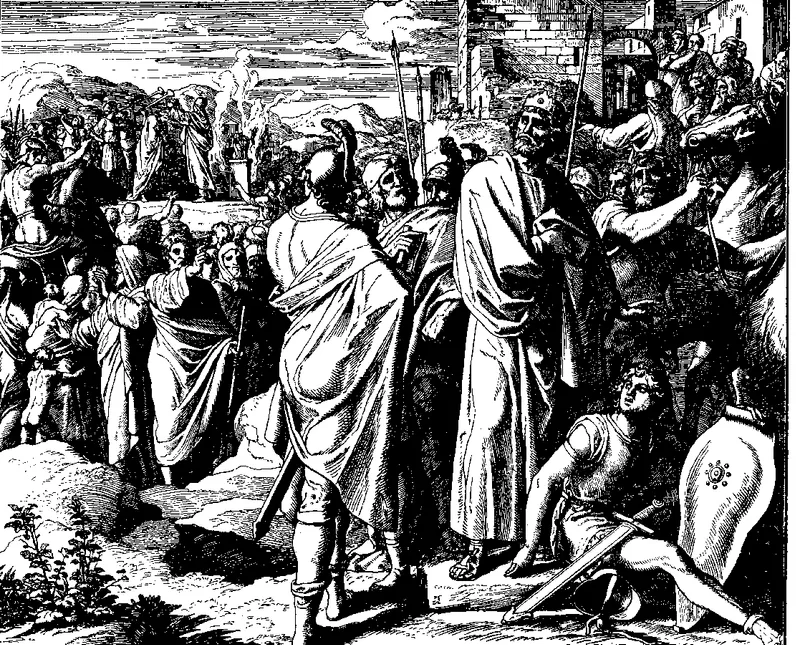
1 Kings 12:1-7The People Make a Plea
1And Rehoboam went to Shechem: for all Israel were come to Shechem to make him king. 2And it came to pass, when Jeroboam the son of Nebat, who was yet in Egypt, heard of it, (for he was fled from the presence of king Solomon, and Jeroboam dwelt in Egypt;) 3That they sent and called him. And Jeroboam and all the congregation of Israel came, and spake unto Rehoboam, saying,
Rehoboam goes to Shechem, where all Israel has gathered to make him king. Hearing of it, Jeroboam returns from Egypt, where he had fled from Solomon, and the assembly sends for him to speak on their behalf before the new king.123
4Thy father made our yoke grievous: now therefore make thou the grievous service of thy father, and his heavy yoke which he put upon us, lighter, and we will serve thee. 5And he said unto them, Depart yet for three days, then come again to me. And the people departed. 6And king Rehoboam consulted with the old men, that stood before Solomon his father while he yet lived, and said, How do ye advise that I may answer this people? 7And they spake unto him, saying, If thou wilt be a servant unto this people this day, and wilt serve them, and answer them, and speak good words to them, then they will be thy servants for ever.
The Hebrew word used here, ol, speaks of a yoke - the wooden frame that binds oxen together, forcing them to pull in the direction their master wishes. Solomon's heavy taxation and forced labor have made the people feel less like free subjects and more like beasts of burden. The memory is raw. They do not come in rebellion; they come in exhaustion.
The people's request is not unreasonable. They offer continued service - loyalty and obedience - in exchange for a lighter hand. They are willing to accept a new king, to submit themselves to his rule. All they ask is that the burden be eased. It is an act of mercy they extend to their new sovereign, a chance for him to build his reign on the willing consent of the governed.
The old men - counselors who served Solomon when he was alive - understand what makes a kingdom stable. They counsel service: the willingness to listen, to bear the people's burdens, to speak kind words. A servant-king is the strongest kind of king - one whose authority rests on the willing loyalty of those beneath him.
1 Kings 12:8-14The Young Men's Counsel
8But he forsook the counsel of the old men, which they had given him, and consulted with the young men that were grown up with him, and which stood before him: 9And he said unto them, What counsel give ye that we may answer this people, who have spoken to me, saying, Make the yoke which thy father did put upon us lighter? 10And the young men that were grown up with him spake unto him, saying, Thus shalt thou speak unto this people that spake unto thee, saying, Thy father made our yoke heavy, but make thou it lighter unto us; thus shalt thou say unto them, My little finger shall be thicker than my father’s loins.
Rehoboam turns away from the counsel of the elders and consults instead the young men he grew up with. They urge him to answer the people with a boast of raw power, telling him to declare that his little finger is thicker than his father's waist.
11And now whereas my father did lade you with a heavy yoke, I will add to your yoke: my father hath chastised you with whips, but I will chastise you with scorpions. 12So Jeroboam and all the people came to Rehoboam the third day, as the king had appointed, saying, Come to me again the third day. 13And the king answered the people roughly, and forsook the old men’s counsel that they gave him; 14And spake to them after the counsel of the young men, saying, My father made your yoke heavy, and I will add to your yoke: my father also chastised you with whips, but I will chastise you with scorpions.
Rehoboam rejects the counsel of experience and accepts the counsel of peers. The young men promise him that a show of strength - a declaration that his hand will be even heavier than his father's - will secure the people's submission. They are wrong. Strength without wisdom is tyranny. And the people sense it immediately.
The whip was Solomon's tool of coercion - heavy taxation, forced labor, the exaction of resources. Rehoboam promises something far worse: where his father used the whip, he will use the scorpion. This is hyperbole, but powerful hyperbole: you think my father was harsh? I will be merciless.
The scorpion suggests torture more severe than mere beating. It is a threat that crosses a line - from demanding labor and tribute to promising suffering and pain. In making this threat, Rehoboam reveals something fundamental about himself: he has mistaken raw power for kingship, threats for authority, and fear for the loyalty that is worth having.
The text emphasizes that Rehoboam answered roughly - harshly, without mercy, without the diplomacy a wise king would employ. He does not say these words in sorrow or reluctance. He speaks them with the arrogance of a young man who believes his youth is invincibility and his harshness is strength.
1 Kings 12:15-17To Your Tents, O Israel
15Wherefore the king hearkened not unto the people; for the cause was from the LORD, that he might perform his saying, which the LORD spake by Ahijah the Shilonite unto Jeroboam the son of Nebat. 16So when all Israel saw that the king hearkened not unto them, the people answered the king, saying, What portion have we in David? neither have we inheritance in the son of Jesse: to your tents, O Israel: now see to thine own house, David. So Israel departed unto their tents. 17But as for the children of Israel which dwelt in the cities of Judah, Rehoboam reigned over them.
The text states plainly: this division was part of God's sovereign purpose. Ahijah the prophet had already announced to Jeroboam that he would rule ten tribes. Solomon's sin - his turning from the path, his multiplying of wives and wealth - bore its fruit in his son's generation as well as his own. Rehoboam's foolishness revealed what God had already decreed.
This cry, "to your tents, O Israel," echoes an earlier moment in Scripture (2 Samuel 20:1), when a man named Sheba used the same words to call Israel away from David. It was the rallying cry of rebellion, the refusal of the southern kingdom's authority. Now it is spoken again. An old fault line - the tension between north and south that has simmered since the beginning of the united kingdom - tears open.
The people ask: "What portion have we in David?" This is not a new complaint. For decades, the north has felt dominated by the south, its interests secondary to Jerusalem and Judah. Now, faced with Rehoboam's arrogance, they see no reason to remain bound to a dynasty that offers them nothing but burden. They choose their own way.
1 Kings 12:18-20Jeroboam Made King
18Then king Rehoboam sent Adoram, who was over the tribute; and all Israel stoned him with stones, that he died. Therefore king Rehoboam made speed to get him up to his chariot, to flee to Jerusalem. 19So Israel rebelled against the house of David unto this day. 20And it came to pass, when all Israel heard that Jeroboam was come again, that they sent and called him unto the congregation, and made him king over all Israel: there was none that followed the house of David, but the tribe of Judah only.
1 Kings 12:25-27Jeroboam Fears for His Throne
25Then Jeroboam built Shechem in mount Ephraim, and dwelt therein; and went out from thence, and built Penuel. 26And Jeroboam said in his heart, Now shall the kingdom return to the house of David: 27If this people go up to do sacrifice in the house of the LORD at Jerusalem, then shall the heart of this people turn again unto their lord, even unto Rehoboam king of Judah, and they shall kill me, and go again to Rehoboam king of Judah.
1 Kings 12:28-30The Golden Calves
28Whereupon the king took counsel, and made two calves of gold, and said unto them, It is too much for you to go up to Jerusalem: behold thy gods, O Israel, which brought thee up out of the land of Egypt. 29And he set the one in Bethel, and the other put he in Dan. 30And this thing became a sin: for the people went to worship before the one, even unto Dan.
Jeroboam's fear is understandable. If his people travel south to worship at the temple in Jerusalem, will they not renew their allegiance to Rehoboam? Will his new kingdom not collapse? And so he makes two golden calves - one in Bethel, one in Dan, at the northern and southern borders of his realm. Let his people worship without traveling. Let them be bound to him by ease and proximity.
The appeal to convenience is shrewd. "It is too much for you to go all the way to Jerusalem." Why endure hardship? Why not worship here, at home, where your king has prepared a place for you? Spiritual convenience is a powerful tool of deception. The easier path rarely leads toward truth.
But notice what Jeroboam says - the exact words matter. "Behold thy gods, O Israel, which brought thee up out of the land of Egypt." These are the words of Aaron, spoken in Exodus 32:4, when the people grew impatient with Moses and demanded a god they could see, touch, hold. Jeroboam repeats Aaron's sin. History is repeating itself as catastrophe.
The text does not shy away from judgment. "This thing became a sin." Sin - because it replaces the true worship of God with a substitute, worship designed for human comfort and convenience. And the people, having seen their kingdom divided, now see worship itself divided from reality.
1 Kings 12:31-33A Substitute Religion
31And he made an house of high places, and made priests of the lowest of the people, which were not of the sons of Levi. 32And Jeroboam ordained a feast in the eighth month, on the fifteenth day of the month, like unto the feast that is in Judah, and he offered upon the altar. So did he in Bethel, sacrificing unto the calves that he had made: and he placed in Bethel the priests of the high places which he had made. 33So he offered upon the altar which he had made in Bethel the fifteenth day of the eighth month, even in the month which he had devised of his own heart; and ordained a feast unto the children of Israel: and he offered upon the altar, and burnt incense.
Jeroboam sets up two calves and then builds an entire apparatus of false worship around them. High places - altars on hills and ridges - scatter across the northern kingdom. Each one is a rival to the temple in Jerusalem, a place where the people can worship without leaving home. Convenience multiplied.
Jeroboam bypasses the sons of Levi - the tribe set apart by God for priestly service - and fills his priesthood from the lowest of the people. This is radical. He strips the priesthood of its sacred status and makes it a political office, filled by royal appointment. The entire structure of true worship is dismantled and replaced with a bureaucracy.
The true feast - Tabernacles - occurs in the seventh month. Jeroboam moves it to the eighth month, changing even the calendar of worship to suit his political purposes. This is a wholesale invention of a substitute religion, one that looks like the real thing but is designed by human hands for human convenience.
Research trail
Sources & further study
These references support the historical, linguistic, manuscript, and contextual notes in this chapter. Scripture remains the primary text; external sources are provided so readers can inspect the research directly.
- Solomon's Reign and TempleSolomon's ascension to the throne and his building of the first temple in Jerusalem.
- Solomonic Period ArtifactsMuseum collection of objects from Solomon's era (10th century BCE).
- Archaeology of the Solomonic PeriodExcavation evidence for urban centers and building projects attributed to Solomon's reign.