1 Kings 13
People in this chapter
King Jeroboam stands at his counterfeit altar in Bethel, burning incense to gods he invented. A stranger walks out of Judah and cries against the stone. He names a child not yet born, Josiah, who will one day burn human bones on this very spot. The altar splits. The king's hand shrivels in midair. One sentence, spoken with no credential but the word of the Lord, and the whole false system cracks open.
Tap any highlighted phrase to jump to the commentary that unpacks it.
1 Kings 13:1-5The Prophecy Against the Altar
1And, behold, there came a man of God out of Judah by the word of the LORD unto Bethel: and Jeroboam stood by the altar to burn incense. 2And he cried against the altar in the word of the LORD, and said, O altar, altar, thus saith the LORD; Behold, a child shall be born unto the house of David, Josiah by name; and upon thee shall he offer the priests of the high places that burn incense upon thee, and men’s bones shall be burnt upon thee. 3And he gave a sign the same day, saying, This is the sign which the LORD hath spoken; Behold, the altar shall be rent, and the ashes that are upon it shall be poured out. 4And it came to pass, when king Jeroboam heard the saying of the man of God, which had cried against the altar in Bethel, that he put forth his hand from the altar, saying, Lay hold on him. And his hand, which he put forth against him, dried up, so that he could not pull it in again to him. 5The altar also was rent, and the ashes poured out from the altar, according to the sign which the man of God had given by the word of the LORD.
He arrives with nothing. No name, no introduction, no priesthood, no place in any official register of prophets. In a world where authority came from your bloodline and your office, this stranger from Judah carries one thing into Bethel: thus saith the Lord. That is his entire standing, and it is enough to make a king reach out to seize him. The word does not need a pedigree to land.
The prophecy is startlingly exact: a king named Josiah, born to the house of David, will come and burn human bones on this very altar. More than three hundred years pass before 2 Kings 23 records it happening, almost word for word. The man of God announces an ending he will never live to see. He simply trusts that the word he carries will outlast the kingdom he is standing in - and it does. If you have ever prayed something into the dark and wondered whether God filed it away, this is the chapter that answers you: the word He sends does not expire while you wait.
The altar splits. The ashes pour out. The sign is immediate and undeniable. Jeroboam's hand withers. These are signs that announce the presence of God in unmistakable terms, signs that cannot be explained away. The false system fractures under the weight of a true word. And yet - Jeroboam will not turn from his idolatry. He will repent for a moment, ask for prayer, experience restoration. And then he will go back to building priests from the lowest of the people.
1 Kings 13:6-10"Eat No Bread, nor Drink Water"
6And the king answered and said unto the man of God, Intreat now the face of the LORD thy God, and pray for me, that my hand may be restored me again. And the man of God besought the LORD, and the king’s hand was restored him again, and became as it was before. 7And the king said unto the man of God, Come home with me, and refresh thyself, and I will give thee a reward. 8And the man of God said unto the king, If thou wilt give me half thine house, I will not go in with thee, neither will I eat bread nor drink water in this place: 9For so was it charged me by the word of the LORD, saying, Eat no bread, nor drink water, nor turn again by the same way that thou camest. 10So he went another way, and returned not by the way that he came to Bethel.
Jeroboam's hand is healed. But notice: his repentance is shallow. He saw the sign. He experienced restoration. And yet in the next breath, he offers the man of God comfort, honor, and reward. He does not say, "I have sinned; I will tear down these altars." He says, "Come to my house, be refreshed, take a reward." He wants to own the prophet, to make him part of his court, to domesticate the word that has just unmade his authority.
The man of God refuses. His reason is obedience, plain and entire. He has been charged by the word of the Lord with a specific command: eat nothing, drink nothing, and return by a different road. This is a particular word for a particular moment. The prophet understands something crucial: the word of the Lord stands firm. It cannot be bent to accommodate courtesy or custom or the king's generosity.
1 Kings 13:11-22The Old Prophet's Deception
11Now there dwelt an old prophet in Bethel; and his sons came and told him all the works that the man of God had done that day in Bethel: the words which he had spoken unto the king, them they told also to their father. 12And their father said unto them, What way went he? For his sons had seen what way the man of God went, which came from Judah. 13And he said unto his sons, Saddle me the ass. So they saddled him the ass: and he rode thereon, 14And went after the man of God, and found him sitting under an oak: and he said unto him, Art thou the man of God that camest from Judah? And he said, I am.
Watch how ordinary the danger looks as it arrives. The old prophet does not thunder or threaten. He saddles a donkey, rides out, finds the tired traveler resting under an oak, and asks him home for a meal. Everything about the scene reads as hospitality, the very thing a worn-out man would welcome. The hook is not the lie yet; the hook is the warmth.
15Then he said unto him, Come home with me, and eat bread. 16And he said, I may not return with thee, nor go in with thee: neither will I eat bread nor drink water with thee in this place: 17For it was said to me by the word of the LORD, Thou shalt eat no bread nor drink water there, nor turn again to go by the way that thou camest. 18He said unto him, I am a prophet also as thou art; and an angel spake unto me by the word of the LORD, saying, Bring him back with thee into thine house, that he may eat bread and drink water. But he lied unto him.
An old prophet dwells in Bethel. We are not told whether he is a true prophet or a false one - only that he is old and he lives among the people. When his sons bring him news of the man of God and the sign, he saddles his ass and goes in pursuit. Why? We are not told. But his next words will reveal his intent: he brings a lie.
Notice the rank of the authority the old prophet invokes. He reaches for the highest credential heaven has - an angel speaking by the word of the Lord - and forges it. Centuries later Paul will draw the line exactly here: even an angel from heaven preaching another gospel is to be refused. That is what makes the lie so well-built. It speaks Scripture's own dialect, it climbs above the man of God's authority, and it hands him precisely what a tired, hungry traveler wants - a roof, a table, a reason to stop.
Deception shows up looking like a kindness with better paperwork.
The text says explicitly: "But he lied unto him." This is unambiguous. The old prophet lied. And in that lie, he becomes an instrument of the man of God's ruin.
1 Kings 13:23-32The Lion and God's Strange Justice
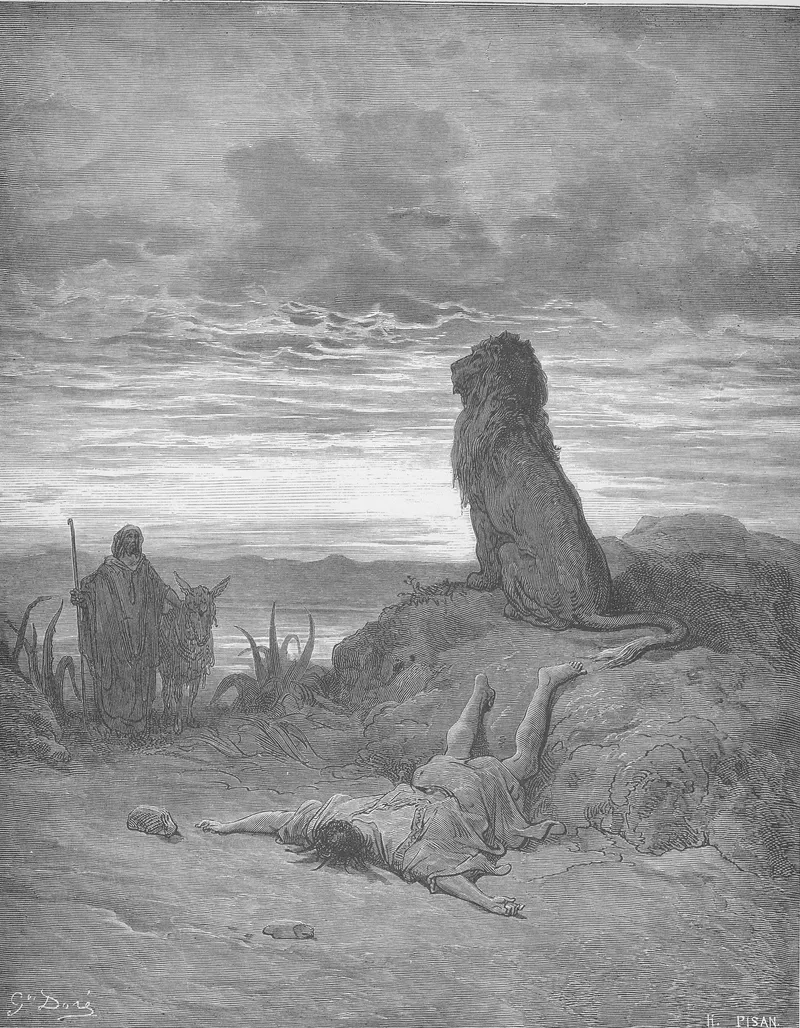
23And it came to pass, after he had eaten bread, and after he had drunk, that he saddled for him the ass, to wit, for the prophet whom he had brought back. 24And when he was gone, a lion met him by the way, and slew him: and his carcase was cast in the way, and the ass stood by it, the lion also stood by the carcase. 25And, behold, men passed by, and saw the carcase cast in the way, and the lion standing by the carcase: and they came and told it in the city where the old prophet dwelt. 26And when the prophet that brought him back from the way heard thereof, he said, It is the man of God, who was disobedient unto the word of the LORD: therefore the LORD hath delivered him unto the lion, which hath torn him, and slain him, according to the word of the LORD, which he spake unto him. 27And he spake to his sons, saying, Saddle me the ass. And they saddled him.
The end comes on the road, almost in passing. He has eaten, the donkey is saddled, he turns toward home, and a lion meets him. No trial, no last words, no chance to explain that he was misled. The man who faced down a king and walked away untouched dies quietly on the way back, because the word he was given was not a guideline he could renegotiate over dinner.
28And he went and found his carcase cast in the way, and the ass and the lion standing by the carcase: the lion had not eaten the carcase, nor torn the ass. 29And the prophet took up the carcase of the man of God, and laid it upon the ass, and brought it back: and the old prophet came to the city, to mourn and to bury him. 30And he laid his carcase in his own grave; and they mourned over him, saying, Alas, my brother! 31And it came to pass, after he had buried him, that he spake to his sons, saying, When I am dead, then bury me in the sepulchre wherein the man of God is buried; lay my bones beside his bones: 32For the saying which he cried by the word of the LORD against the altar in Bethel, and against all the houses of the high places which are in the cities of Samaria, shall surely come to pass.
The judgment is swift and absolute. A lion meets the man of God on the road and kills him - the one attacker no one arranges. There is no reading this as a sad accident of travel. It is the hand of God falling, terrible and immediate, on a prophet who broke the very word entrusted to his keeping.
Then comes the detail that makes travelers stop and stare. The lion has killed, but it has not fed. The body lies untouched, the donkey stands unharmed a few feet away, and the killer simply waits beside them on the road. No wild animal behaves like this. The scene is staged. What looks at first like savagery is actually a posted sign, a witness left in the open so that everyone who passes knows: this was the word of the Lord keeping its appointment. Even here, judgment is under orders.
The deceiver reads the scene instantly and names it without flinching: this is the man of God, disobedient to the word, given over to the lion. He knows exactly whose lie set the road. Something turns in him there. He offers no excuse, builds no defense, simply rides out, gathers the torn body, and lays it in his own grave. Then he tells his sons to bury him in that same tomb when his time comes, his bones beside these bones.
A man who could counterfeit an angel cannot, it turns out, outrun the weight of what he has done. He carries it to his own burial.
1 Kings 13:33-34Jeroboam Returns to His Evil Way
33After this thing Jeroboam returned not from his evil way, but made again of the lowest of the people priests of the high places: whosoever would, he consecrated him, and he became one of the priests of the high places. 34And this thing became sin unto the house of Jeroboam, even to cut it off, and to destroy it from off the face of the earth.
Jeroboam has seen the sign. His hand has withered and been restored. He has heard the prophecy that his altar will be desecrated by a king named Josiah, centuries hence. He has watched the man of God refuse his reward, refuse his hospitality, refuse his favor. And yet - "Jeroboam returned not from his evil way." He continues his course. He makes more priests from the lowest of the people. He deepens his commitment to idolatry.
The same sign cuts two ways. The split altar and the healed hand could have been the mercy that turned Jeroboam around; instead they become the evidence that condemns him, the thing that grows into sin against his whole house until it is wiped off the face of the earth. He had every ingredient repentance needs - a clear word, an undeniable wonder, his own restored hand still warm. He simply would not turn. It is worth sitting with, because the danger he models is seeing the proof and walking back to the idol anyway.
A heart can watch the altar break and harden in the very same hour.
Where this echoes in Scripture
The Old Prophet's Deception
- 1 John 4:1Believe not every spirit, but try the spirits whether they are of God: because many false prophets are gone out into the world.The duty the man of God forgot under the oak: to take a new word back to God before obeying it.
- Deuteronomy 13:1-3If there arise among you a prophet... and the sign come to pass... thou shalt not hearken.A sign or wonder never overrides a word God has already spoken - exactly the test the old prophet fails.
- 2 Corinthians 11:14And no marvel; for Satan himself is transformed into an angel of light.Why an appeal to an angel proves nothing - the costume is the oldest trick.
- Matthew 7:15Beware of false prophets, which come to you in sheep's clothing, but inwardly they are ravening wolves.The deceiver looks like a brother and shares the same vocabulary, as the old prophet does here.
Jeroboam Returns to His Evil Way
- John 1:1In the beginning was the Word, and the Word was with God, and the Word was God.The word that splits the altar and outlasts kings is, John says, a Person.
- Galatians 1:8Though we, or an angel from heaven, preach any other gospel unto you... let him be accursed.Paul names the exact trap that killed the man of God: a fresh word, an angel's claim, a smoother message.
- Isaiah 55:11So shall my word be that goeth forth out of my mouth: it shall not return unto me void.Why the Josiah prophecy stands for three centuries - the word God sends always lands.
- 2 Kings 23:15-16Josiah... burned the high place... took the bones out of the sepulchres, and burned them upon the altar.The prophecy of verse 2 fulfilled to the letter, generations later.