1 Samuel 1
People in this chapter
The era of kings and prophets opens with a barren woman weeping at the house of the Lord, her lips moving with no sound. The priest thinks she is drunk. She is praying1. Out of that silent, bitter prayer comes Samuel, the boy who will anoint Israel's first kings. Before the throne, there is a woman on her knees.
Tap any highlighted phrase to jump to the commentary that unpacks it.
1 Samuel 1:1-8Elkanah and His Two Wives
1Now there was a certain man of Ramathaimzophim, of mount Ephraim, and his name was Elkanah, the son of Jeroham, the son of Elihu, the son of Tohu, the son of Zuph, an Ephrathite: 2And he had two wives; the name of the one was Hannah, and the name of the other Peninnah: and Peninnah had children, but Hannah had no children.
Ramathaim-zophim is in the hill country of Ephraim, in central Palestine. The name means "two hills of the watchers" - a place on a height, a place of watching. Hannah will be remembered here, and generations will watch what God does through her123.
Elkanah is himself a Levite, a line running back through Zuph to ancient priestly stock. He is a man of faith, a man who "went up yearly" to worship. The genealogy matters - God's work runs through family lines, even when a line appears broken.
Hannah is barren. In the ancient world that meant cursed, suspect, less than a woman - or so the culture whispered, year after year, until she half believed it. Scripture never explains why God closes a womb. It refuses you the tidy reason you might want. It simply names her emptiness and then watches what happens when one woman prays.
3And this man went up out of his city yearly to worship and to sacrifice unto the LORD of hosts in Shiloh. And the two sons of Eli, Hophni and Phinehas, the priests of the LORD, were there.
4And when the time was that Elkanah offered, he gave to Peninnah his wife, and to all her sons and her daughters, portions: 5But unto Hannah he gave a worthy portion; for he loved Hannah: but the LORD had shut up her womb.
Elkanah loves Hannah. When the sacrifice is divided, she receives double - a worthy portion - even though she has no children. His love is not conditional on her fertility. In a culture that measured a woman's value by the children she bore, Elkanah honors her as a person.
6And her adversary also provoked her sore, for to make her fret, because the LORD had shut up her womb. 7And as he did so year by year, when she went up to the house of the LORD, so she provoked her; therefore she wept, and did not eat. 8Then said Elkanah her husband to her, Hannah, why weepest thou? and why eatest thou not? and why is thy heart grieved? am not I better to thee than ten sons?
Year after year, Peninnah provokes Hannah - a quiet cruelty, repeated on purpose, timed to Hannah's deepest wound. The text calls Peninnah Hannah's "adversary." Jealousy and shame intertwine. And Elkanah, loving as he is, cannot heal this wound with ten sons' worth of love. Some griefs can only be brought to God.
1 Samuel 1:9-18Hannah's Prayer in Silence
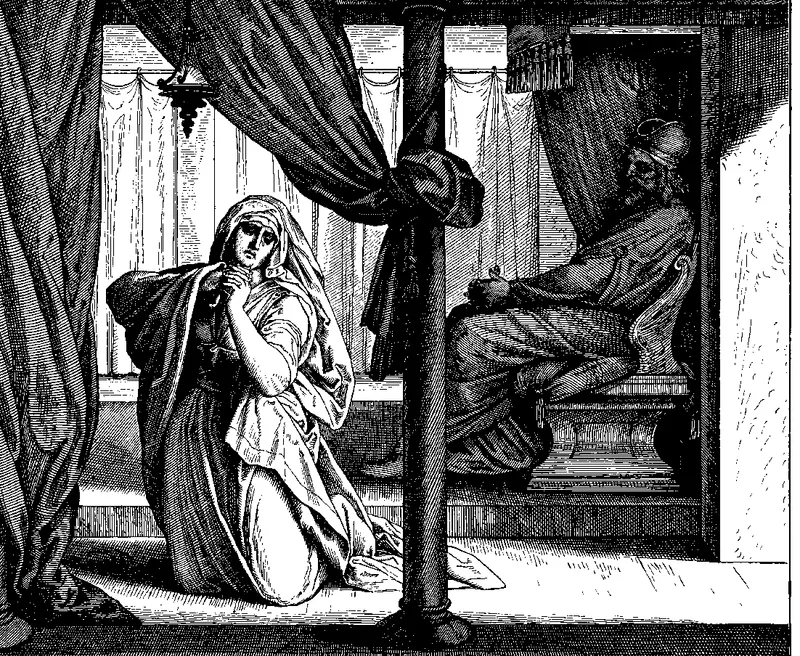
9So Hannah rose up after they had eaten in Shiloh, and after they had drunk. Now Eli the priest sat upon a seat by a post of the temple of the LORD. 10And she was in bitterness of soul, and prayed unto the LORD, and wept sore.
Hannah leaves the meal, leaves Peninnah's voice, and goes to the temple. The act itself is prayer - the turning away from what grieves, the turning toward God. She stands before the Lord in what the text calls "bitterness of soul": a grief that has a voice.
The Hebrew for "wept sore" is bakah - a word for deep weeping, tears that cannot be held back. This is a woman whose body is speaking what her mouth cannot yet shape into words.
11And she vowed a vow, and said, O LORD of hosts, if thou wilt indeed look on the affliction of thine handmaid, and remember me, and not forget thine handmaid, but wilt give unto thine handmaid a man child, then I will give him unto the LORD all the days of his life, and there shall no razor come upon his head.
Hannah addresses God by His new name - Lord of hosts. She, a woman with no power, no army, no position, cries out to the God of armies. She prays to the One who commands the hosts of heaven. And He listens.123
Hannah does not ask for any child. She asks for "a man child" - a son. In the ancient world, a son meant inheritance rights, survival of the family line, fulfillment of a woman's deepest calling. She is asking for everything her culture has told her she needs.
And here is the extraordinary part: Hannah vows that if God gives her a son, she will give him back. Not to Elkanah, not to his family line - to the Lord. All the days of his life. She will bear him, nurse him, raise him - and then release him to belong wholly to God.
12And it came to pass, as she continued praying before the LORD, that Eli marked her mouth. 13Now Hannah, she spake in her heart; only her lips moved, but her voice was not heard: therefore Eli thought she had been drunken. 14And Eli said unto her, How long wilt thou be drunken? put away thy wine from thee.
Hannah prays in her heart. Her lips move, but no sound comes out. She is so entirely alone with God, so deep in her own grief, that she has forgotten the world - forgotten that anyone is watching. Her prayer is purely between her and the Lord of hosts.
15And Hannah answered and said, No, my lord, I am a woman of a sorrowful spirit: I have drunk neither wine nor strong drink, but have poured out my soul before the LORD. 16Count not thine handmaid for a daughter of Belial: for out of the abundance of my complaint and grief have I spoken hitherto.
Falsely accused, Hannah does not flare up. She names her condition plainly and without shame: a sorrowful spirit poured out before God. She had not been hiding her grief at all - Eli simply read it wrong, as the world often reads a person at prayer. The wound is real, the prayer is real, and the One she came for already knows the difference.
"Daughter of Belial" - a daughter of worthlessness, of wickedness. Hannah is asking Eli not to judge her as a woman breaking ranks, as someone behaving inappropriately. She is asking to be seen truly: as someone pouring out her soul before God.
17Then Eli answered and said, Go in peace: and the God of Israel grant thee thy petition that thou hast asked of him. 18And she said, Let thine handmaid find grace in thy sight. So the woman went her way, and did eat, and her countenance was no more sad.
Eli, the high priest, blesses Hannah. He releases her with a word: "Go in peace. The God of Israel grant thee thy petition." And something shifts. She rises from her knees, goes back to eat, and "her countenance was no more sad." She has brought her petition to the Lord of hosts, a priest has confirmed it, and the burden has been placed somewhere else.
1 Samuel 1:19-20The Lord Remembered Her
19And they rose up in the morning early, and worshipped before the LORD, and returned, and came to their house to Ramah: and Elkanah knew Hannah his wife; and the LORD remembered her.
The text is deliberate in its language. "Elkanah knew Hannah his wife" - the language of the marital act, of intimacy, of covenant. And at that moment, something opened. The Lord remembered her.
To be "remembered" by God in Scripture is to be acted toward: God moves on behalf of the one He remembers. When God "remembered" Noah, the waters receded (Genesis 8:1). When He "remembered" Rachel, she conceived (Genesis 30:22). The same word here: the Lord remembered Hannah. What was closed opened. What was barren bore fruit.
20Wherefore it came to pass, when the time was come about after Hannah had conceived, that she bare a son, and called his name Samuel, saying, Because I have asked him of the LORD.
Hannah names her son in plain sight of the prayer that brought him into being. She does not hide the miracle. She does not let anyone pretend he simply appeared. She says: "Because I have asked him of the Lord." The boy's name is a testimony.
1 Samuel 1:21-28Given Back to the Lord
21And the man Elkanah, and all his house, went up to offer unto the LORD the yearly sacrifice, and his vow. 22But Hannah went not up; for she said unto her husband, I will not go up until the child be weaned, and then I will bring him, that he may appear before the LORD, and there abide for ever.
Hannah does not forget her vow. While Elkanah goes up yearly to worship, Hannah stays home with Samuel, nursing him, caring for him, loving him - and waiting for the moment when she will release him. The child is fully hers, fully loved. And she is preparing to give him away.
23And Elkanah her husband said unto her, Do what seemeth thee good; tarry until thou have weaned him; only the LORD establish his word. So the woman abode, and gave her son suck until she weaned him.
Elkanah releases Hannah to care for Samuel in her own time, and then he speaks a blessing: "Only the Lord establish his word." He asks for the word of God to stand, not merely for a son to stay. Elkanah knows that Samuel is not theirs to keep. He is the Lord's.
24And when she had weaned him, she took him up with her, with three bullocks, and one ephah of flour, and a bottle of wine, and brought him unto the house of the LORD in Shiloh: and the child was young.
Hannah brings Samuel to Shiloh with an offering of three bullocks (a significant sacrifice), a large amount of flour, and wine. She does not bring him as though she were abandoning him. She brings him as a gift - with everything needed for a sacrifice, a feast, a covenant. She is keeping her vow.
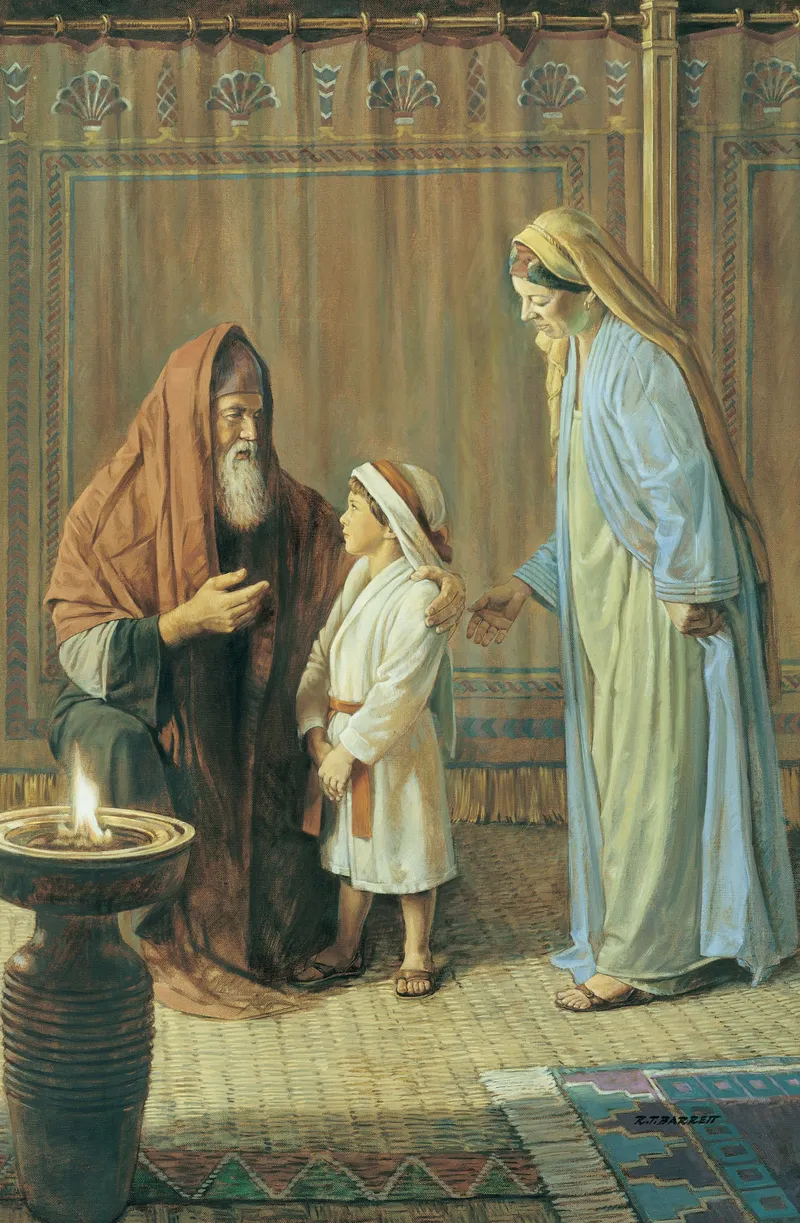
25And they slew a bullock, and brought the child to Eli. 26And she said, Oh my lord, as thy soul liveth, my lord, I am the woman that stood by thee here, praying unto the LORD. 27For this child I prayed; and the LORD hath given me my petition which I asked of him: 28Therefore also I have lent him to the LORD; as long as he liveth he shall be lent to the LORD. And he worshipped the LORD there.
Years on, Hannah comes back and makes sure Eli connects the boy to the prayer he once mistook for drunkenness. The silent prayer is now a standing child; the grief is now a gift. And then comes the line that turns the whole chapter: she lends him to the Lord for as long as he lives. She had asked for a son to give back, and she keeps her word.
Research trail
Sources & further study
These references support the historical, linguistic, manuscript, and contextual notes in this chapter. Scripture remains the primary text; external sources are provided so readers can inspect the research directly.
- Hannah's Prayer and DedicationComplete text with rabbinic commentary on Hannah's vow and Samuel's birth.
- Eli and Shiloh PriesthoodHistorical overview of Eli's role as judge and high priest during Iron Age I.
- Shiloh Temple RemainsExcavation evidence of the Shiloh sanctuary visited by Hannah and Elkanah.
Where this echoes in Scripture
Hannah's Prayer in Silence
- Matthew 6:6Pray to thy Father which is in secret; and thy Father which seeth in secret shall reward thee openly.Jesus describes the very prayer Hannah is already praying - unheard by anyone but God.
- Psalm 62:8Pour out your heart before him: God is a refuge for us.Hannah's own words for what she did: “poured out my soul before the Lord.”
- Romans 8:26The Spirit itself maketh intercession for us with groanings which cannot be uttered.A prayer too deep for words is not a lesser prayer.
The Lord Remembered Her
- Luke 1:46-53My soul doth magnify the Lord... he hath filled the hungry with good things.Mary's song reaches back and picks up Hannah's, almost word for word.
- 1 Samuel 2:1-10My heart rejoiceth in the LORD... he raiseth up the poor out of the dust.Hannah's own song, the one Mary will echo.
- Luke 1:18-20Thou shalt be dumb... because thou believest not my words.Another temple, another barren womb - and a priest struck silent for doubting.
- Genesis 30:22And God remembered Rachel... and opened her womb.The same verb of God “remembering” that turns Hannah's story.