1 Samuel 19
People in this chapter
Chapter 19 shows Saul in full descent into madness and paranoia. Jonathan's words from chapter 18 - his reasoned, faithful plea - seemed to work: Saul swore an oath that David would not be killed. But an oath, for Saul, is only as steady as his next fit of anger. When the evil spirit touches him again, the javelin comes out, and all the king's promises collapse.
Tap any highlighted phrase to jump to the commentary that unpacks it.
1 Samuel 19:1-7Jonathan's Plea
1And Saul spake to Jonathan his son, and to all his servants, that they should kill David.
Saul does not kill David himself. Instead, he commands his entire court - Jonathan, all his servants, everyone - to do it. He is trying to implicate them all, to make David's death a public policy. It is a direct test of Jonathan's loyalty to his father.123
This is an explicit command from the king to murder an innocent man - spoken aloud, in full court, to everyone. And this is the same king who, just chapters ago, swore before the Lord that David would not be killed.
Jonathan "delighted much in David" - Hebrew me'od, exceedingly, very greatly. Jonathan's love for David is a genuine, deep affection with real cost. And it will cost him something to honor it.
2But Jonathan Saul’s son delighted much in David: and Jonathan told David, saying, Saul my father seeketh to kill thee: now therefore, I pray thee, take heed to thyself until the morning, and abide in a secret place, and hide thyself: 3And I will go out and stand beside my father in the field where thou art, and I will commune with my father of thee; and what I see, that I will tell thee.
Jonathan promises to speak well of David to Saul. He will "commune with" his father - he will reason with him, plead for him. Jonathan's plan is persuasion: he believes that if he can help Saul see David's innocence and his worth, the king will relent.
4And Jonathan spake good of David unto Saul his father, and said unto him, Let not the king sin against his servant, against David; because he hath not sinned against thee, and because his works have been to thee-ward very good: 5For he did put his life in his hand, and slew the Philistine, and the LORD wrought a great salvation for all Israel: thou sawest it, and didst rejoice: wherefore then wilt thou sin against innocent blood, to slay David without a cause?
Jonathan does something remarkable: he calls David "thy servant" - using the language of deference and duty, reminding Saul that David serves him. Jonathan is reframing David as a loyal subject, the faithful man Saul himself once prized.
Jonathan reminds Saul of David's greatest act - slaying Goliath, the Philistine champion. "The Lord wrought a great salvation for all Israel." God worked through David, and Jonathan is appealing to Saul's memory of what that looked like.
Jonathan uses the language of sin and blood guilt. To kill David "without a cause" is sin before God, the spilling of innocent blood. Jonathan is appealing to Saul's conscience, to the law, to what Saul himself knows is right.
6And Saul hearkened unto the voice of Jonathan: and Saul sware, As the LORD liveth, he shall not be slain. 7And Jonathan called David, and Jonathan shewed him all those things. And Jonathan brought David to Saul, and he was in his presence, as in times past.
Saul listens. Jonathan's reasoned plea works - temporarily. The king swears an oath by the Lord: David will not be killed. Jonathan brings David back into Saul's presence, and for a moment, things seem restored. David is back "as in times past."
Saul takes an oath "as the Lord liveth." In the ancient world, an oath sworn by God's name was binding - the most solemn promise a king could make. But Saul's oath is only as steady as his next mood swing. An oath cannot heal a divided heart.
1 Samuel 19:8-10The Javelin Returned
8And there was war again: and David went out, and fought with the Philistines, and slew them with a great slaughter; and they fled from him.
War with the Philistines breaks out again. David goes out to fight - this is what he was made for, what Saul brought him into the court to do. He slaughters the Philistines and drives them to flight. David is still Saul's deliverer.
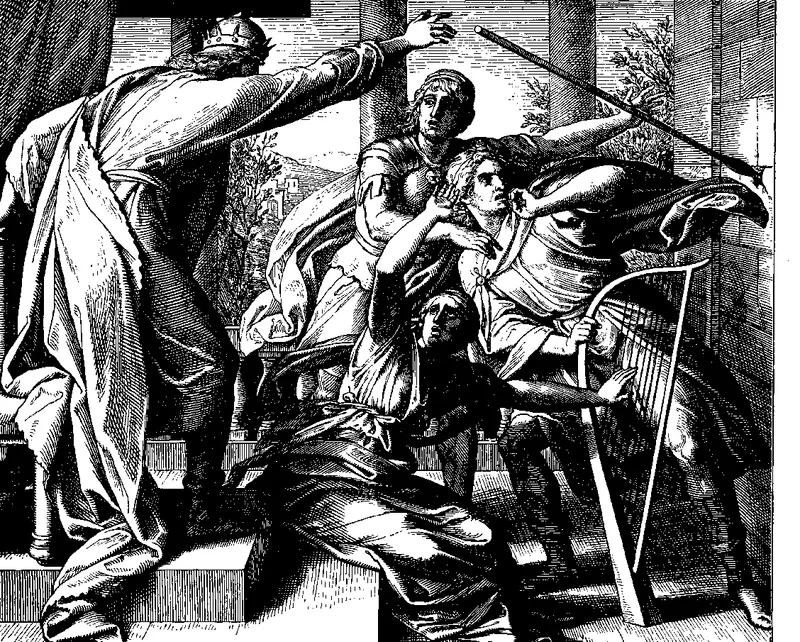
9And the evil spirit from the LORD was upon Saul, as he sat in his house with his javelin in his hand: and David played with his hand.
The evil spirit returns. Not because David has done anything wrong - he has just returned victorious from slaying Philistines. The spirit comes to Saul of its own dark volition, and Saul sits in his house with his javelin in hand. He is waiting. He is brooding.
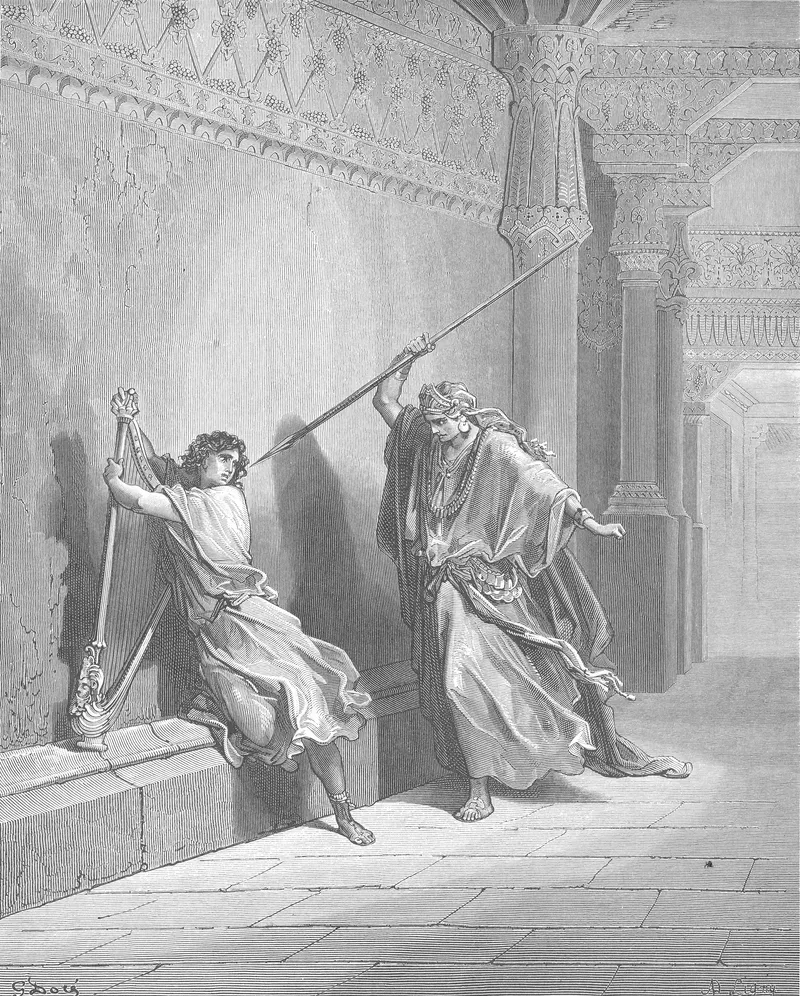
10And Saul sought to smite David even to the wall with the javelin, but he slipped away out of Saul’s presence, and he smote the javelin into the wall: and David fled, and escaped that night.
The javelin comes again. The same javelin that flew in chapter 18. Saul tries to pin David "even to the wall" - a full, deliberate throw aimed to impale him and hold him there. But David is quick. He moves, and the javelin goes into the wall behind him.
David runs. He does not confront Saul, does not try to reason with him, does not wait for morning. He escapes "that night" - fleeing in darkness. Jonathan's oath has become useless. Saul's madness has broken his word.
1 Samuel 19:11-17Michal Saves David
11Saul also sent messengers unto David’s house, to watch him, and to slay him in the morning: and Michal David’s wife told him, saying, If thou save not thy life to night, to morrow thou shalt be slain.
Saul sends men to watch David's house, to keep him under surveillance, and to kill him at dawn. It is a siege. Saul is boxing David in, trapping him where he is defenseless - in his own bed.
Michal is Saul's daughter, but she is David's wife. When Saul gave her to David as a bride (as a reward, as a snare), he did not know what would happen: she would choose her husband. She loves David more than she fears her father. She will now act on that love.
12So Michal let David down through a window: and he went, and fled, and escaped.
Michal lowers David through a window. It is an act of quick thinking and courage. She chooses her husband's life over her father's authority. She is risking everything - Saul's anger, her own safety, her standing in the royal house.
13And Michal took an image, and laid it in the bed, and put a pillow of goats’ hair for his bolster, and covered it with a cloth.
14And when Saul sent messengers to take David, she said, He is sick. 15And Saul sent the messengers again to see David, saying, Bring him up to me in the bed, that I may slay him. 16And when the messengers were come in, behold, there was an image in the bed, with a pillow of goats’ hair for his bolster.
Michal tells Saul's messengers that David is sick. When Saul demands that David be brought to him in his bed so he can be killed there, the messengers return to find only the idol. It is a simple deception, but it works. Michal has bought David time to escape - time that may have saved his life.
17And Saul said unto Michal, Why hast thou deceived me so, and sent away mine enemy, that he is escaped? And Michal answered Saul, He said unto me, Let me go; why should I kill thee?
Michal faces Saul's wrath with a lie. She claims David threatened to kill her if she did not let him escape - a threat that probably never happened. She is protecting David. And her lie is daring: she is essentially saying, "I chose my husband's life over obedience to you, and you cannot change that."
1 Samuel 19:18-24At Ramah with Samuel
18So David fled, and escaped, and came to Samuel to Ramah, and told him all that Saul had done to him. And he and Samuel went and dwelt in Naioth.
David flees to Ramah, the home of Samuel the prophet. He tells Samuel everything. And they withdraw together to Naioth - a prophetic community or settlement where Samuel lived with the company of prophets. It is a place of refuge, a place where God's presence is tangible.
19And it was told Saul, saying, Behold, David is at Naioth in Ramah. 20And Saul sent messengers to take David: and when they saw the company of the prophets prophesying, and Samuel standing as appointed over them, the Spirit of God was upon the messengers of Saul, and they also prophesied.
Saul sends men to capture David. But when they arrive at Naioth and see the company of prophets in the midst of their prophesying, with Samuel standing at their head, something supernatural happens. The Spirit of God falls on the messengers. They are overwhelmed, possessed, and they begin to prophesy. They cannot carry out Saul's orders. God has stopped them by flooding them with His own presence.
21And when it was told Saul, he sent other messengers, and they prophesied likewise. And Saul sent messengers again the third time, and they prophesied also.
Saul is bewildered. His orders are not being followed. So he sends more men - and the same thing happens. A third time. Each batch of messengers arrives and is overcome by the Spirit of God. The pattern is clear: God is protecting David by making it impossible for Saul to reach him.
22Then went he also to Ramah, and came to a great well that is in Sechu: and he asked and said, Where are Samuel and David? And one said, Behold, they be at Naioth in Ramah. 23And he went thither to Naioth in Ramah: and the Spirit of God was upon him also, and he went on, and prophesied, until he came to Naioth in Ramah.
Saul himself goes to Ramah. And the same thing happens. The Spirit of God falls on him. The persecutor is overtaken by the very God whose anointed he is trying to kill.
24And he stripped off his clothes also, and prophesied before Samuel in like manner, and lay down naked all that day and all that night. Wherefore they say, Is Saul also among the prophets?
Saul strips off his clothes and lies naked, prophesying all day and night. This is the same scene from chapter 10, when Samuel first anointed Saul - he was stripped and prophesied then too. But the meaning has reversed. Where that first stripping was a sign of the Spirit's power upon him, this one is a sign of the Spirit stripping him bare, undoing his pretense, his power, his authority. The proverb "Is Saul also among the prophets?" now carries irony: the king prophesies as a man overcome, undone, made nothing by the Spirit of God.
Research trail
Sources & further study
These references support the historical, linguistic, manuscript, and contextual notes in this chapter. Scripture remains the primary text; external sources are provided so readers can inspect the research directly.