1 Samuel 20
People in this chapter
David runs to Jonathan with a wound, carrying nothing forward but his questions. What have I done? what is mine iniquity? He soothed the king's torment, killed the giant, won the wars, married into the house - and now Saul hunts his life. He cannot find the crime, because there is none.1 He names how near the danger stands in one bare word: there is but a step between me and death.
Tap any highlighted phrase to jump to the commentary that unpacks it.
1 Samuel 20:1-11A Step Between Me and Death
1And David fled from Naioth in Ramah, and came and said before Jonathan, What have I done? what is mine iniquity? and what is my sin before thy father, that he seeketh my life? 2And he said unto him, God forbid; thou shalt not die: behold, my father will do nothing either great or small, but that he will shew it me: and why should my father hide this thing from me? it is not so. 3And David sware moreover, and said, Thy father certainly knoweth that I have found grace in thine eyes; and he saith, Let not Jonathan know this, lest he be grieved: but truly as the LORD liveth, and as thy soul liveth, there is but a step between me and death.
David comes to Jonathan and does not begin with a plan; he begins with a wound. Four questions tumble out, each circling the same impossible fact: What have I done? what is mine iniquity? and what is my sin before thy father, that he seeketh my life? This is not false modesty. David genuinely cannot find the crime. He has been the most loyal servant in the kingdom - he calmed Saul's tormented spirit with the harp, he faced Goliath when every other man hid, he led Saul's armies to victory after victory, he married into the royal house.
And the return for all of it is a king who hunts his life. Here is one of the Bible's rawest portraits of innocent suffering: a righteous man, faithful in everything, persecuted precisely because of the favor and the gifting that should have won him honor. The question what have I done? has no answer in David's conduct. The answer lies entirely in Saul's jealousy - which is to say, David suffers not for his sin but for another man's.
4Then said Jonathan unto David, Whatsoever thy soul desireth, I will even do it for thee. 5And David said unto Jonathan, Behold, to morrow is the new moon, and I should not fail to sit with the king at meat: but let me go, that I may hide myself in the field unto the third day at even. 6If thy father at all miss me, then say, David earnestly asked leave of me that he might run to Bethlehem his city: for there is a yearly sacrifice there for all the family. 7If he say thus, It is well; thy servant shall have peace: but if he be very wroth, then be sure that evil is determined by him.
There is no hedging in Jonathan's reply - no I will see what I can do, no within reason, no quiet weighing of the cost. He commits to whatsoever David's soul desires before he has heard a single thing David wants. It is the language of a blank covenant, a promise signed before the terms are named. This is what makes the rest of the chapter possible: before any plan is laid, the loyalty is already total.
And it runs uphill. David is the man who will take Jonathan's throne; by every worldly calculation Jonathan should be guarding his own claim, not pledging himself to his rival. He does the opposite. Imagine being loved like that - by the one person who stood to lose the most from your rise. The friendship is not equals trading favors. It is the one who has more giving himself wholly to the one who has less, and standing to lose by it.
David lays out the test with care. Tomorrow is the new moon - a monthly feast at which his place at the king's table is expected to be filled. He will absent himself and hide in the field, and Jonathan will explain the empty seat with something true and humble: David earnestly asked leave of me that he might run to Bethlehem his city: for there is a yearly sacrifice there for all the family. The detail is shrewd precisely because it is plausible - a son of Bethlehem returning to a household sacrifice asks no suspicion of itself.
The genius of the test is that it makes Saul reveal his own heart. If the king accepts the explanation calmly, then David's fear was overdrawn and there is peace. But if he be very wroth, if a routine absence detonates the king's fury, then the truth is out: evil is determined by him. A man's reaction to a small thing exposes what he has been concealing about the large thing. David is about to read Saul's settled intention in the size of his anger.
8Therefore thou shalt deal kindly with thy servant; for thou hast brought thy servant into a covenant of the LORD with thee: notwithstanding, if there be in me iniquity, slay me thyself; for why shouldest thou bring me to thy father? 9And Jonathan said, Far be it from thee: for if I knew certainly that evil were determined by my father to come upon thee, then would not I tell it thee? 10Then said David to Jonathan, Who shall tell me? or what if thy father answer thee roughly? 11And Jonathan said unto David, Come, and let us go out into the field. And they went out both of them into the field.
Jonathan recoils at the mere suggestion that he might leave David in the dark: Far be it from thee… if I knew certainly that evil were determined by my father… then would not I tell it thee? The offense in his voice is itself a kind of proof - the loyalty is so settled that David's doubt wounds him. Yet David presses the practical question that doubt always asks: Who shall tell me? or what if thy father answer thee roughly? It is a fair question.
Suppose Saul's rage falls on Jonathan himself; suppose Jonathan cannot get word out; how then will David learn the truth in time to run? The two of them are reckoning honestly with how dangerous this has become - not for David only, but for Jonathan, who is about to put himself between the hunted man and the king's spear. And so Jonathan ends the exchange by moving them out of doors: Come, and let us go out into the field. What must be sworn now is too weighty, and too dangerous, to be spoken under Saul's roof.
1 Samuel 20:12-23The Covenant and the Arrow-Signal
12And Jonathan said unto David, O LORD God of Israel, when I have sounded my father about to morrow any time, or the third day, and, behold, if there be good toward David, and I then send not unto thee, and shew it thee; 13The LORD do so and much more to Jonathan: but if it please my father to do thee evil, then I will shew it thee, and send thee away, that thou mayest go in peace: and the LORD be with thee, as he hath been with my father. 14And thou shalt not only while yet I live shew me the kindness of the LORD, that I die not: 15But also thou shalt not cut off thy kindness from my house for ever: no, not when the LORD hath cut off the enemies of David every one from the face of the earth.
Out in the open field, away from any listening ear, Jonathan turns the plan into an oath sworn before God: O LORD God of Israel… The LORD do so and much more to Jonathan if he fails to report the truth. He calls down God's own judgment on himself should he keep David in the dark - the most serious form of promise a man could make. And then he says the quiet sentence that reveals he has understood everything: the LORD be with thee, as he hath been with my father. Jonathan knows.
He knows that the LORD has departed from Saul and rests now on David; he knows the kingdom is passing from his own house to his friend's. He could have fought that knowledge, resented it, schemed against it. Instead he blesses it. The heir prays that the LORD would be with the man who will take his crown - and means it. There is no jealousy in him at all, only the rarest thing: a man who would rather see God's will done than his own advantage served.
Jonathan's request widens the covenant past the two of them and into the future itself. He sees clearly what is coming: David will rise, David will reign, and David's enemies will be cut off… every one from the face of the earth. In that world, the surviving sons of the old king's house are exactly the people a new dynasty destroys to secure its throne - it was the ordinary cruelty of ancient succession.
Jonathan, knowing this, asks David to be different: thou shalt not cut off thy kindness from my house for ever. He is binding the future king, by sworn covenant, to preserve rather than slaughter the line of the man he is replacing. There is something deeply moving in the realism of it. Jonathan looks the danger to his children full in the face and provisions against it with the one thing stronger than political self-interest - a covenant of chesed sworn in the name of the LORD.
He trusts David's sworn word to hold where, in that age, swords usually fell.
16So Jonathan made a covenant with the house of David, saying, Let the LORD even require it at the hand of David’s enemies. 17And Jonathan caused David to swear again, because he loved him: for he loved him as he loved his own soul. 18Then Jonathan said to David, To morrow is the new moon: and thou shalt be missed, because thy seat will be empty. 19And when thou hast stayed three days, then thou shalt go down quickly, and come to the place where thou didst hide thyself when the business was in hand, and shalt remain by the stone Ezel.
The narrator states it plainly: Jonathan made a covenant with the house of David. Not merely with David the man, but with his house - his dynasty, his descendants, the kingdom he will found. And the reason is given with disarming simplicity in the next verse: because he loved him. The whole elaborate apparatus of the covenant - the oaths, the self-curses, the careful provisions for the future - rests at bottom on a single fact of the heart.
Jonathan does none of this for duty or fear or advantage. He does it because he loves David. It is love that does the binding; love that lays down the throne; love that builds a shelter of sworn promises around a friend and his unborn children. The legal weight is real, but the text will not let us read it as cold legalism: the covenant is the form that love has chosen to take, the way devotion makes itself permanent and dependable rather than merely felt.
20And I will shoot three arrows on the side thereof, as though I shot at a mark. 21And, behold, I will send a lad, saying, Go, find out the arrows. If I expressly say unto the lad, Behold, the arrows are on this side of thee, take them; then come thou: for there is peace to thee, and no hurt; as the LORD liveth. 22But if I say thus unto the young man, Behold, the arrows are beyond thee; go thy way: for the LORD hath sent thee away. 23And as touching the matter which thou and I have spoken of, behold, the LORD be between thee and me for ever.
The signal is a small marvel of love's ingenuity. Jonathan will come to the field as if for ordinary archery practice, a lad with him to fetch the arrows, and he will let the direction of his own words to the boy carry the verdict to David hidden nearby. The arrows are on this side of thee, take them - that means peace; come home; you are safe. But the arrows are beyond thee; go thy way - that means flee; the LORD has sent you away; do not look back.
The beauty of the scheme is that it speaks the one thing Jonathan cannot say aloud without betraying David to any servant within earshot. Love finds a way to get the truth through - coded into a boy's errand, hidden in the flight of an arrow, a private language between two souls that the world around them cannot read. An instrument of war is bent into an instrument of rescue; the arrow that kills becomes the arrow that saves a life.
1 Samuel 20:24-34The Feast and the Javelin
24So David hid himself in the field: and when the new moon was come, the king sat him down to eat meat. 25And the king sat upon his seat, as at other times, even upon a seat by the wall: and Jonathan arose, and Abner sat by Saul’s side, and David’s place was empty. 26Nevertheless Saul spake not any thing that day: for he thought, Something hath befallen him, he is not clean; surely he is not clean. 27And it came to pass on the morrow, which was the second day of the month, that David’s place was empty: and Saul said unto Jonathan his son, Wherefore cometh not the son of Jesse to meat, neither yesterday, nor to day?
The narrator slows down to let us feel the empty seat. Saul takes his usual place by the wall; Abner the captain sits at his side; Jonathan rises; and there, in the middle of the scene, is the thing everyone notices and no one mentions: David's place was empty. On the first day Saul holds his tongue, reasoning that David must be ceremonially unclean and unfit to eat - a charitable enough explanation. But the silence is not peace; it is a held breath.
The king is watching that empty place, and an empty place at a king's table is a loud thing. David, hidden in the field, has wagered everything on what this vacancy will provoke. The test he designed is now running on its own, and the whole feast turns, unknowing, around the absence of one man.
By the second day the silence breaks, and the way it breaks tells the truth before Saul says a single hostile word. Wherefore cometh not the son of Jesse to meat? He reaches past the harpist who soothed him, past the captain who won his wars, past my son-in-law, and lands on the son of Jesse - a cold reduction of David to mere parentage, the language of a man putting distance between himself and someone he has decided to hate.
In a single phrase the affection of earlier years is gone, scraped down to contempt. The reader hears in it exactly what David feared: this is no longer a king inquiring after an absent servant. This is a hunter who has noticed his prey is missing.
28And Jonathan answered Saul, David earnestly asked leave of me to go to Bethlehem: 29And he said, Let me go, I pray thee; for our family hath a sacrifice in the city; and my brother, he hath commanded me to be there: and now, if I have found favour in thine eyes, let me get away, I pray thee, and see my brethren. Therefore he cometh not unto the king’s table. 30Then Saul’s anger was kindled against Jonathan, and he said unto him, Thou son of the perverse rebellious woman, do not I know that thou hast chosen the son of Jesse to thine own confusion, and unto the confusion of thy mother’s nakedness? 31For as long as the son of Jesse liveth upon the ground, thou shalt not be established, nor thy kingdom. Wherefore now send and fetch him unto me, for he shall surely die.
Jonathan delivers the prepared explanation smoothly - the family sacrifice, the brother's summons, the humble request for leave - and Saul erupts. Thou son of the perverse rebellious woman - he curses his own son by cursing the mother who bore him, the ugliest insult a man could throw. And then the rage names what it has been hiding: thou hast chosen the son of Jesse. Saul sees the alliance clearly now; Jonathan has sided with the rival, and the king reads it, rightly, as a threat to the dynasty: as long as the son of Jesse liveth upon the ground, thou shalt not be established, nor thy kingdom. Here is the tragedy of Saul laid bare.
He is so consumed with securing the throne for his line that he cannot see he is destroying that line in the attempt - turning his heir into an enemy, poisoning his own house. And the demand that follows is murder, plain and unconcealed: send and fetch him unto me, for he shall surely die. The test is answered. There is no more doubt to be had.1
32And Jonathan answered Saul his father, and said unto him, Wherefore shall he be slain? what hath he done? 33And Saul cast a javelin at him to smite him: whereby Jonathan knew that it was determined of his father to slay David. 34So Jonathan arose from the table in fierce anger, and did eat no meat the second day of the month: for he was grieved for David, because his father had done him shame.
Jonathan answers his father's death-sentence with the same question David had asked at the chapter's opening: Wherefore shall he be slain? what hath he done? It is a brave and simple defense of an innocent man - and the king's reply is a spear. Saul cast a javelin at him to smite him. The same weapon Saul had twice hurled at David he now hurls at his own son, and in that flying javelin every doubt dies: whereby Jonathan knew that it was determined of his father to slay David. The proof David needed has come, and it has nearly cost Jonathan his life to obtain it.
Notice what finally moves Jonathan from the table: grief for his friend. He has absorbed a spear and a public curse on his mother, and what drives him from the room is that he was grieved for David, because his father had done him shame. He rises in fierce anger and refuses to eat, his hunger swallowed by sorrow. He has seen, with terrible clarity, that the man he loves as his own soul is now condemned to die - and that to keep his covenant he must give David up to exile.
1 Samuel 20:35-37The Arrow Beyond
35And it came to pass in the morning, that Jonathan went out into the field at the time appointed with David, and a little lad with him. 36And he said unto his lad, Run, find out now the arrows which I shoot. And as the lad ran, he shot an arrow beyond him. 37And when the lad was come to the place of the arrow which Jonathan had shot, Jonathan cried after the lad, and said, Is not the arrow beyond thee?
1 Samuel 20:38-40Make Speed, Stay Not
38And Jonathan cried after the lad, Make speed, haste, stay not. And Jonathan’s lad gathered up the arrows, and came to his master. 39But the lad knew not any thing: only Jonathan and David knew the matter. 40And Jonathan gave his artillery unto his lad, and said unto him, Go, carry them to the city.
In the morning Jonathan keeps his word to the letter. He goes out at the time appointed, a little lad with him, and shoots: he shot an arrow beyond him. The single word beyond carries the whole verdict. By the code they had sworn, an arrow falling short meant peace and homecoming; an arrow flying past meant flight and exile. Jonathan shoots beyond - and then, in case the hidden David should miss it, he cries the meaning aloud under cover of instructing the boy: Is not the arrow beyond thee? Make speed, haste, stay not. Every word is for David.
To the lad it is only an order to hurry; to the man crouched behind the stone it is the breaking of a world - run, do not delay, do not come back. There is something almost unbearable in it: the rescue and the loss are the same signal. The arrow that saves David's life is the arrow that sends him away. And the lad, gathering the bow and arrows and trotting back to the city, knew not any thing - the deepest matter passes right over the head of the one nearest to it, and only the two friends understand what has just been decided in a field.
1 Samuel 20:41-42The Parting
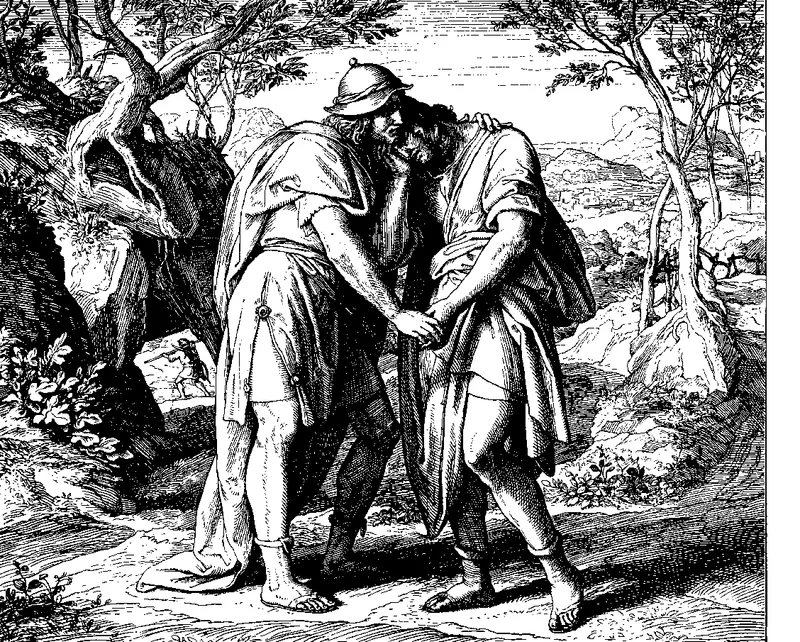
41And as soon as the lad was gone, David arose out of a place toward the south, and fell on his face to the ground, and bowed himself three times: and they kissed one another, and wept one with another, until David exceeded. 42And Jonathan said to David, Go in peace, forasmuch as we have sworn both of us in the name of the LORD, saying, The LORD be between me and thee, and between my seed and thy seed for ever. And he arose and departed: and Jonathan went into the city.
The boy is sent off to the city, and only now, with the field empty, can the friends do what the signal forbade them to do in the open: meet, and grieve. David rises from his hiding place toward the south, falls on his face, and bows himself three times - the homage of a subject to a king, even here, even now, as if David already honors in Jonathan the royalty Jonathan is laying down.
And then the formality dissolves: they kissed one another, and wept one with another, until David exceeded. This is no restrained farewell. It is two souls torn apart, weeping until David is overcome, beyond what words or composure can hold. They had sworn a covenant for ever; now they must live it apart, the one fleeing to the wilderness, the other returning to the murderous house of his father. Love does not always get to stay together.
Sometimes the most faithful thing love can do is let the beloved go - send him into safety though it means sending him away - and trust the covenant sworn in the name of the LORD to hold across all the distance and the years.
Research trail
Sources & further study
These references support the historical, linguistic, manuscript, and contextual notes in this chapter. Scripture remains the primary text; external sources are provided so readers can inspect the research directly.
- 1 Samuel 20 - Translators' NotesThe NET Bible's detailed footnotes on 1 Samuel 20 - the customs of the new moon feast, the force of Saul's curse against Jonathan in verse 30, the textual questions around the arrow-signal, and the legal weight of a covenant cut “in the name of the LORD.”
- 1 Samuel 20 · Hebrew + classical Jewish commentaryThe Hebrew text of 1 Samuel 20 with Rashi, Radak, and other classical commentators side by side - useful for berith (the “covenant” of vv. 8, 16), for chesed (the “kindness of the LORD,” vv. 14-15), and for the vivid idiom of verse 3, that there is but a step - pesa' - between David and death.
- 1 Samuel 20 ↔ Proverbs 18 · John 15 · Hebrews 13Traces the threads tying Jonathan's covenant love - sworn in the name of the LORD… for ever (v. 42), holding to David as he loved his own soul (v. 17) - to the friend that sticketh closer than a brother (Prov. 18:24), to greater love hath no man than this (John 15:13), and to the blood of the everlasting covenant (Heb. 13:20).
Where this echoes in Scripture
A Step Between Me and Death
- Psalm 59:3For, lo, they lie in wait for my soul... not for my transgression, nor for my sin, O LORD.David's own prayer from the days Saul hunted him - persecuted, he insists, for no fault of his own.
- 1 Samuel 18:1The soul of Jonathan was knit with the soul of David, and Jonathan loved him as his own soul.The bond behind this whole chapter - the covenant friendship first formed, now tested under threat.
- John 15:25They hated me without a cause.David's what have I done? deepened - the wholly innocent One hated, like David, for no fault at all.
- Proverbs 17:17A friend loveth at all times, and a brother is born for adversity.Jonathan's whatsoever thy soul desireth - the friend who proves himself precisely in the hour of danger.
The Covenant and the Arrow-Signal
- 2 Samuel 9:7I will surely shew thee kindness for Jonathan thy father's sake, and will restore thee all the land of Saul thy father; and thou shalt eat bread at my table continually.The chesed of verse 14 kept - David honors the covenant to Jonathan's crippled son, years after Jonathan's death.
- John 15:13Greater love hath no man than this, that a man lay down his life for his friends.Jonathan loving David as his own soul (v. 17), surrendering his throne - the love Christ named and then perfected.
- Proverbs 18:24There is a friend that sticketh closer than a brother.The friendship the chapter portrays - loyalty nearer than blood, pointing to the Friend who never lets go.
- Hebrews 13:20That great shepherd of the sheep, through the blood of the everlasting covenant.The berith “for ever” sworn in the field - a shadow of the everlasting covenant sealed in better blood.
- Luke 22:20This cup is the new testament in my blood, which is shed for you.The covenant Jonathan swears in the name of the LORD - answered in the bond Christ seals in His own blood.
- John 13:1Having loved his own which were in the world, he loved them unto the end.Jonathan loved David as his own soul (v. 17); the love of Jesus for His own carried all the way to the end.
The Feast and the Javelin
- 1 Samuel 18:11And Saul cast the javelin; for he said, I will smite David even to the wall with it.The same weapon Saul twice hurled at David now flies at his own son - the rage that spares no one.
- 1 Samuel 19:6And Saul sware, As the LORD liveth, he shall not be slain.Saul's own broken oath - the king who swore David would not die now commands his death outright.
- Matthew 27:23And the governor said, Why, what evil hath he done?Jonathan's what hath he done? echoed at another trial - the innocent condemned while the question goes unanswered.
- Proverbs 27:4Wrath is cruel, and anger is outrageous; but who is able to stand before envy?Saul's jealousy laid bare - envy of David driving a father to cast a spear at his own heir.
The Parting
- 2 Samuel 1:26I am distressed for thee, my brother Jonathan: very pleasant hast thou been unto me: thy love to me was wonderful.David's lament when Jonathan falls in battle - the covenant love of this field remembered to the end.
- John 15:13Greater love hath no man than this, that a man lay down his life for his friends.Jonathan letting David go at his own cost - the self-giving love the Lord named and fulfilled.
- Hebrews 13:5I will never leave thee, nor forsake thee.Where Jonathan and David must part, the covenant Friend gives the opposite promise - presence that never ends.
- Matthew 28:20Lo, I am with you alway, even unto the end of the world.The tearful “for ever” sworn in the field, answered fully - a covenant presence no distance can break.
- John 15:25They hated me without a cause.The hunted, innocent David sent into exile - a shadow of the Anointed hated for no fault and driven toward death.
- Hebrews 13:20Through the blood of the everlasting covenant.The bond sworn “in the name of the LORD… for ever” - fulfilled in the covenant sealed in better blood.