2 Samuel 17
People in this chapter
Absalom has the throne. David is running. In the rebel tent, Ahithophel lays out the kill: twelve thousand men, tonight, while the old king is tired and weak-handed. Strike David alone, and the rest come home in peace. The plan is flawless. The timing is perfect. Every elder in the room nods, because this counselor's word lands like a word from God. 1
Tap any highlighted phrase to jump to the commentary that unpacks it.
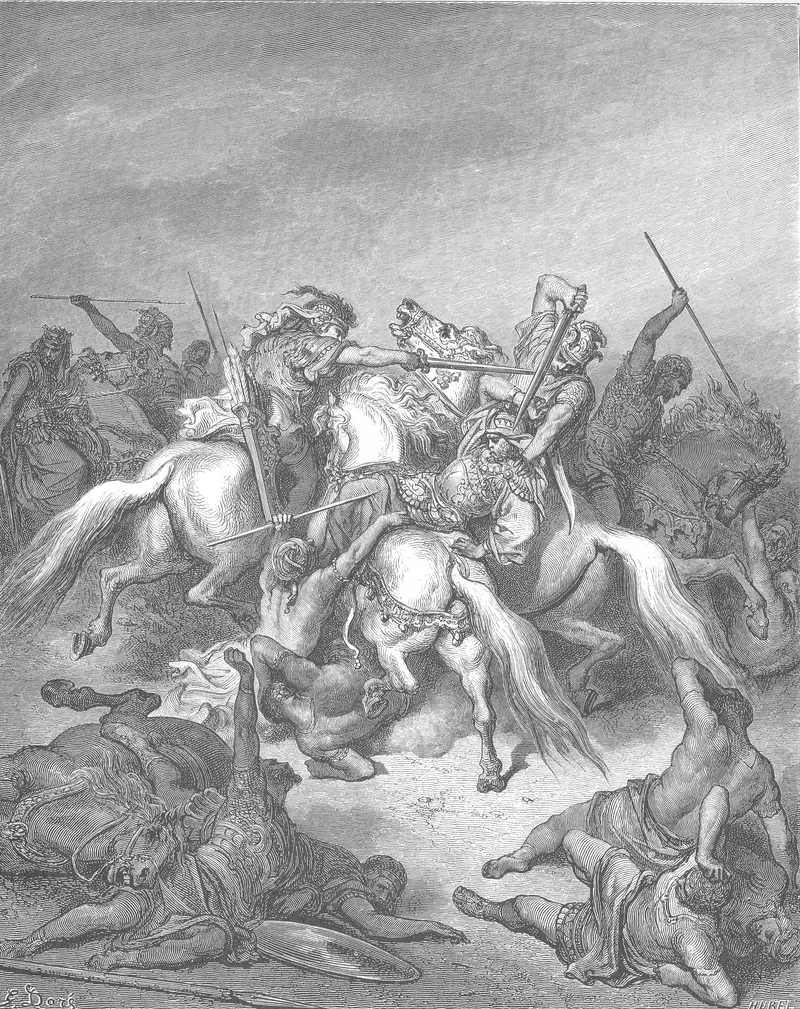
2 Samuel 17:1-13Counsel of War: Ahithophel vs. Hushai
1Moreover Ahithophel said unto Absalom, Let me now choose out twelve thousand men, and I will arise and pursue after David this night: 2And I will come upon him while he is weary and weak handed, and will make him afraid: and all the people that are with him shall flee; and I will smite the king only: 3And I will bring back all the people unto thee: the man whom thou seekest is as if all returned: so all the people shall be in peace.
Ahithophel's plan is clear and ruthless. He wants to move tonight, catch David exhausted and unprepared, kill the king alone, and let everyone else come back unharmed. The people will follow Absalom out of relief - their king will be dead, and they can go home. It is the counsel of a military strategist who has thought through the problem completely.123
The text later notes (verse 14) that Ahithophel's counsel was considered "as if a man had enquired at the oracle of God." He has a reputation as someone whose advice is infallible, as reliable as a direct word from God. That reputation is about to work against him.
4And the saying pleased Absalom well, and all the elders of Israel.
Ahithophel's plan appeals to Absalom. It appeals to the elders. It makes sense. It will work. But Absalom does something unexpected: he asks for another opinion.
5Then said Absalom, Call now Hushai the Archite also, and let us hear likewise what he saith. 6And when Hushai was come to Absalom, Absalom spake unto him, saying, Ahithophel hath spoken after this manner: shall we do after his saying? if not; speak thou.
Hushai is David's friend (verse 14 confirms this later). He has infiltrated Absalom's court as a spy, sent by David to "defeat the counsel of Ahithophel." Now he is called to give his opinion. He listens to Ahithophel's perfectly good plan - and he is about to reject it.
7And Hushai said unto Absalom, The counsel that Ahithophel hath given is not good at this time. 8For, said Hushai, thou knowest thy father and his men, that they be mighty men, and they be chafed in their minds, as a bear robbed of her whelps in the field: and thy father is a man of war, and will not lodge with the people.
Hushai appeals to what Absalom knows but Ahithophel has ignored: David is a warrior who has spent his whole life in battle. He will not be caught unprepared.
9Behold, he is hid now in some pit, or in some other place: and it will come to pass, when some of them be overthrown at the first, that whosoever heareth it will say, There is a slaughter among the people that follow Absalom. 10And he also that is valiant, whose heart is as the heart of a lion, shall utterly melt: for all Israel knoweth that thy father is a mighty man, and they which be with him are valiant men.
11Therefore I counsel that all Israel be generally gathered unto thee, from Dan even to Beersheba, as the sand that is by the sea for multitude; and that thou go to battle in thine own person. 12So shall we come upon him in some place where he shall be found, and we will light upon him as the dew falleth on the ground: and of him and of all the men that are with him there shall not be left so much as one.
Hushai's counter-counsel sounds even more appealing than Ahithophel's. He suggests gathering "all Israel, from Dan to Beersheba," an enormous force that will be impossible for David to hide from. Absalom himself will lead the armies. The language is grandiose and flattering: Absalom at the head of all Israel, a force as countless as sand. And as for any city where David hides, they will destroy it stone by stone. It appeals to Absalom's vanity and his desire to be seen as the chosen leader of all Israel.
13Moreover, if he be gotten into a city, then shall all Israel bring ropes to that city, and we will draw it into the river, until there be not one small stone found there.
Absalom chooses. The choice seems reasonable - Hushai's plan is thorough, it flatters the king, and it seems more complete than Ahithophel's quick strike. But the Bible tells us the real reason for the choice.
Here is the invisible hand: "For the Lord had appointed to defeat the good counsel of Ahithophel." God is working through Hushai's words, through Absalom's choice, through human counsel that sounds wise but leads to destruction. Providence is not coercion - Absalom genuinely chooses. But his choice is guided by God toward the end God intends.
2 Samuel 17:14-22The Message Sent in Secret
14And Absalom and all the men of Israel said, The counsel of Hushai the Archite is better than the counsel of Ahithophel. For the LORD had appointed to defeat the good counsel of Ahithophel, to the intent that the LORD might bring evil upon Absalom. 15Then said Hushai unto Zadok and to Abiathar the priests, Thus and thus did Ahithophel counsel Absalom and the elders of Israel; and thus and thus have I counselled.
Hushai runs to the priests Zadok and Abiathar - men loyal to David. He tells them the truth: this is what Ahithophel wanted to do, and this is what I told Absalom instead. But now Absalom has chosen my counsel, which means Ahithophel's quick strike is not coming. David has a window, but only if he moves immediately.
16Now therefore send quickly, and tell David, saying, Lodge not this night in the plains of the wilderness, but speedily pass over; lest the king be swallowed up, and all the people that are with him.
Jonathan (the son of the priest Abiathar) and Ahimaaz (the son of Zadok) are waiting at En-rogel, a spring outside Jerusalem. They cannot come into the city openly without being noticed. So a servant girl brings them the message from Hushai, and they prepare to run to David.
17Now Jonathan and Ahimaaz stayed by Enrogel; for they might not be seen to come into the city: and a wench went and told them; and they went and told king David.
A servant boy sees them and reports them to Absalom. The couriers run for their lives and reach a house in Bahurim whose owner has a well in his courtyard. They climb down into the well to hide.
18Nevertheless a lad saw them, and told Absalom: but they went both of them away quickly, and came to a man’s house in Bahurim, which had a well in his court; whither they went down.
The woman of the house spreads a cloth over the well and scatters grain on top of it - making it look like grain is simply being dried there. It is the kind of quick, practical deception that appears throughout Scripture when the faithful must hide God's anointed.
19And the woman took and spread a covering over the well’s mouth, and spread ground corn thereon; and the thing was not known.
Absalom's men arrive and demand to know where the couriers are. The woman lies. She says they went over the brook. The men search and find nothing. They return to Jerusalem. The deception holds.
20And when Absalom’s servants came to the woman to the house, they said, Where is Ahimaaz and Jonathan? And the woman said unto them, They be gone over the brook of water. And when they had sought and could not find them, they returned to Jerusalem. 21And it came to pass, after they were departed, that they came up out of the well, and went and told king David, and said unto David, Arise, and pass quickly over the water: for thus hath Ahithophel counselled against you.
Once Absalom's men have left, Jonathan and Ahimaaz climb out of the well and rush to David. They deliver the message: Ahithophel was planning to strike tonight. You must move. Now.
22Then David arose, and all the people that were with him, and they passed over Jordan: by the morning light there lacked not one of them that was not gone over Jordan.
David does not hesitate. He and all his people rise up and cross the Jordan River. By dawn, not a single person remains on the western bank. The king and his followers have escaped.
2 Samuel 17:23Ahithophel's End
23And when Ahithophel saw that his counsel was not followed, he saddled his ass, and arose, and gat him home to his house, to his city, and put his household in order, and hanged himself, and died, and was buried in the sepulchre of his father.
For Ahithophel this is the ground giving way. His advice had been treated as near-infallible, the closest thing in Israel to a direct word from God. Now, for the first time, it has been set aside - and set aside for the plan of a lesser man. He can read the future from here. The window to kill David has closed, the king will regroup, and the rebellion he gambled on is finished.
Watch how deliberate it is. He settles his affairs first - the cold, orderly grief of a man who has already decided. He would rather not be alive to see his own advice proven right by David's death. A counselor whose word carried the weight of an oracle could not survive being overruled once. It is the only premeditated suicide in the Old Testament, and centuries later it will be read as a shadow falling forward.
2 Samuel 17:24-29The King Cared For
24Then David came to Mahanaim. And Absalom passed over Jordan, he and all the men of Israel with him.
Of all the towns east of the Jordan, the fleeing king lands at the one with a memory. Mahanaim means "two camps," the name Jacob gave it when he too was running for his life and met the angels of God and said, "This is God's host" (Genesis 32:2). The exiled heir keeps coming back to this ground for the same reason - it is where heaven has shown up before.
25And Absalom made Amasa captain of the host instead of Joab: which Amasa was a man’s son, whose name was Ithra an Israelite, that went in to Abigail the daughter of Nahash, sister to Zeruiah Joab’s mother.
Absalom appoints Amasa as his general, replacing Joab (who remained loyal to David). Amasa is a relative of Joab and of David - the son of Ithra (or Jether), an Ishmaelite. So even in this rebellion, David's kinsmen are divided.
26So Israel and Absalom pitched in the land of Gilead. 27And it came to pass, when David was come to Mahanaim, that Shobi the son of Nahash of Rabbah of the children of Ammon, and Machir the son of Ammiel of Lodebar, and Barzillai the Gileadite of Rogelim, 28Brought beds, and basons, and earthen vessels, and wheat, and barley, and flour, and parched corn, and beans, and lentiles, and parched pulse,
Three men come to David with supplies: Shobi (an Ammonite, whose father was the king of Ammon - normally an enemy of Israel), Machir (a man from Lo-debar who had sheltered Mephibosheth, Saul's grandson, and became his adopted son), and Barzillai (a wealthy Gileadite). They bring a massive provision: beds, vessels, grain, legumes, honey, butter, sheep, cheese. They see that David and his followers are exhausted and hungry.
This is a moment of profound grace. Shobi, son of an Ammonite king (from a nation that had been at war with Israel), chooses to serve David. Machir, who had hidden Saul's grandson and shown him kindness, now shows the same kindness to the anointed king. Barzillai, a man of wealth and standing, brings everything he has. The king who has been abandoned is now surrounded by the faithful.
29And honey, and butter, and sheep, and cheese of kine, for David, and for the people that were with him, to eat: for they said, The people is hungry, and weary, and thirsty, in the wilderness.
The text does not say they were commanded to do this. It says they saw the need. The king is in the wilderness, weary and thirsty. These three men choose to care for him.
Research trail
Sources & further study
These references support the historical, linguistic, manuscript, and contextual notes in this chapter. Scripture remains the primary text; external sources are provided so readers can inspect the research directly.
- David as King of IsraelDavid's consolidation of power and establishment of monarchy over united Israel.
- City of David ExcavationsContinuous excavation revealing David-era structures and urban development in Jerusalem.
- Jerusalem CapturedDavid's capture of the Jebusite city and establishment as Israel's capital.
Where this echoes in Scripture
Ahithophel's End
- Acts 1:16-20“Men and brethren, this scripture must needs have been fulfilled … concerning Judas … Let his habitation be desolate.”Peter reads Judas through the Psalms of David's betrayal - the same template Ahithophel fits.
- Psalm 41:9“Yea, mine own familiar friend, in whom I trusted, which did eat of my bread, hath lifted up his heel against me.”David's line about a table-companion turned enemy; Jesus quotes it of Judas in John 13:18.
- John 13:18“He that eateth bread with me hath lifted up his heel against me.”Jesus lifts David's words at the last supper, the night the insider leaves to betray Him.
- Matthew 27:3-5“He cast down the pieces of silver … and departed, and went and hanged himself.”Judas ends exactly as Ahithophel did - the only two men in Scripture who hang themselves.
- 2 Samuel 15:31“O LORD, I pray thee, turn the counsel of Ahithophel into foolishness.”The short prayer this whole chapter is quietly answering.