2 Samuel 16
People in this chapter
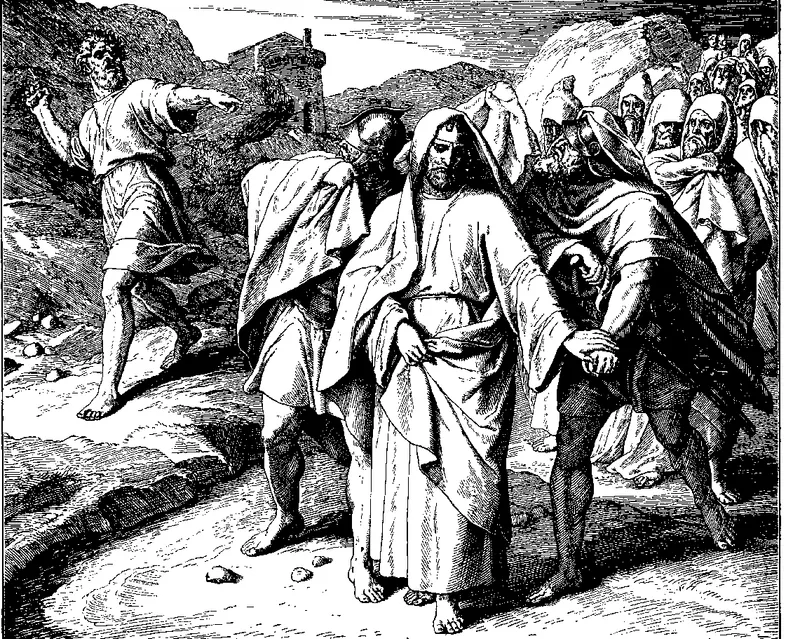
A man walks the hillside opposite the fleeing king, screaming curses, flinging stones and dust across the road. His name is Shimei, and he calls David a murderer. The king's nephew reaches for his sword. David stops him: let him alone, and let him curse; for the LORD hath bidden him. A crowned man with the power to silence his accuser in one stroke chooses instead to bend under the curse and keep climbing.1
Tap any highlighted phrase to jump to the commentary that unpacks it.
2 Samuel 16:1-4Ziba's Gift, and the Slander That Wins an Estate
1And when David was a little past the top of the hill, behold, Ziba the servant of Mephibosheth met him, with a couple of asses saddled, and upon them two hundred loaves of bread, and an hundred bunches of raisins, and an hundred of summer fruits, and a bottle of wine. 2And the king said unto Ziba, What meanest thou by these? And Ziba said, The asses be for the king’s household to ride on; and the bread and summer fruit for the young men to eat; and the wine, that such as be faint in the wilderness may drink.
Ziba arrives at the precise moment David is most exposed - a little past the top of the hill, over the crest of the Mount of Olives, the city he has just fled at his back. He comes laden: a string of saddled asses, two hundred loaves, a hundred clusters of raisins, summer fruit, a skin of wine.2 The gift is generous and practical, exactly what a king in flight needs for his weary household.
And the timing is perfect - perhaps too perfect. Ziba is the servant who manages the lands of Mephibosheth, Jonathan's crippled son, the man to whom David had shown covenant kindness for Jonathan's sake. He knows what to bring a king in distress, and he knows that a man stripped of everything is a man inclined to be grateful. Generosity offered in another's hour of need can be the truest of loves - or the shrewdest of investments.
The next verses will show which this was.
3And the king said, And where is thy master’s son? And Ziba said unto the king, Behold, he abideth at Jerusalem: for he said, To day shall the house of Israel restore me the kingdom of my father.
Then comes the poison, slipped in beneath the kindness. David asks after Mephibosheth, and Ziba answers with a charge: his master has stayed behind in Jerusalem, hoping that this upheaval will hand him back the kingdom of my father - the throne of his grandfather Saul. It is a calculated accusation, and a cruel one. It paints the very man David swore to protect, the son of the friend he loved as his own soul, as a traitor lying in wait to profit from David's ruin.
We will learn later, when Mephibosheth himself meets the returning king, that the charge was a lie - that the lame man had mourned for David and could not follow only because Ziba had not saddled him a beast (2 Sam. 19:24-30). But here, in the moment, David hears only the accusation, from the only witness present, at the lowest hour of his life.
4Then said the king to Ziba, Behold, thine are all that pertained unto Mephibosheth. And Ziba said, I humbly beseech thee that I may find grace in thy sight, my lord, O king.
David rules on the spot, and an entire household's lands and goods change hands in a single sentence - on the unverified word of one interested party, granted by a king too exhausted and too betrayed to weigh it. Ziba's smooth reply has the polish of a man who has gotten exactly what he came for. There is a hard lesson here about judgment made in the heat of pain. When you have just been betrayed, a story of betrayal sounds true; when you are grieving disloyalty, an accusation of disloyalty slides easily past your guard.
David, who will later have to scramble to undo this, shows how even a good and discerning man can be played in the hour when his heart is raw and only one voice is speaking.
2 Samuel 16:5-14Let Him Curse: Shimei and the King's Restraint
5And when king David came to Bahurim, behold, thence came out a man of the family of the house of Saul, whose name was Shimei, the son of Gera: he came forth, and cursed still as he came. 6And he cast stones at David, and at all the servants of king David: and all the people and all the mighty men were on his right hand and on his left. 7And thus said Shimei when he cursed, Come out, come out, thou bloody man, and thou man of Belial: 8The LORD hath returned upon thee all the blood of the house of Saul, in whose stead thou hast reigned; and the LORD hath delivered the kingdom into the hand of Absalom thy son: and, behold, thou art taken in thy mischief, because thou art a bloody man.
At Bahurim, a village on the eastward road in the territory of Benjamin - Saul's own tribe - a man comes out of the house of Saul and begins to curse. His name is Shimei, the son of Gera, and his grievance is old: David sits on the throne that once belonged to his clan. He does not curse from a safe distance and fall silent; the text says he came forth, and cursed still as he came, walking along the hillside opposite the column of the king, hurling stones and dust and accusation as though cursing were now his whole occupation.
His charge is specific and cutting: thou bloody man - a man of blood - and thou man of Belial, a man of worthlessness. He claims that all the blood of the house of Saul has now come back on David's head, that Absalom's revolt is God's own repayment, that the king is at last taken in thy mischief. It is rage that has waited years for its hour, and it has chosen the hour of David's deepest weakness to strike.
9Then said Abishai the son of Zeruiah unto the king, Why should this dead dog curse my lord the king? let me go over, I pray thee, and take off his head.
Loyalty reaches for the sword. Abishai, David's fierce nephew, sees a nobody - this dead dog - reviling the LORD's anointed in the open road, and to him the answer is obvious: one stroke ends it. He is being protective by the standards of his world, offering David the quickest way to reassert that he is still king: silence the mockery by force. The whole moral weight of the scene now hangs on what David does with that offer. The power to crush Shimei is real, and it is right there in Abishai's hand, waiting only for a word.
10And the king said, What have I to do with you, ye sons of Zeruiah? so let him curse, because the LORD hath said unto him, Curse David. Who shall then say, Wherefore hast thou done so? 11And David said to Abishai, and to all his servants, Behold, my son, which came forth of my bowels, seeketh my life: how much more now may this Benjamite do it? let him alone, and let him curse; for the LORD hath bidden him. 12It may be that the LORD will look on mine affliction, and that the LORD will requite me good for his cursing this day.
David's refusal is one of the great moments of restraint in all of Scripture. He waves Abishai off - What have I to do with you, ye sons of Zeruiah? - and then makes a claim that goes far beyond mere tolerance of an insult. He receives Shimei's curse as something permitted, even appointed, by God: so let him curse, because the LORD hath said unto him, Curse David. David does not mean that God dictated Shimei's hatred; he means that he will receive this affliction as something the LORD has allowed to reach him - and that he therefore has no business silencing it by force.
Then he speaks the deeper grief beneath it all: Behold, my son, which came forth of my bowels, seeketh my life. His own child is hunting him; against that wound, a Benjamite's stones are a small thing. If God has let the greater sorrow come, who is David to rage against the lesser?
And then, out of the lowest place, comes a flicker of hope that is almost startling: It may be that the LORD will look on mine affliction, and that the LORD will requite me good for his cursing this day. David does not demand vindication; he hopes for mercy. He bends his ear past Shimei's voice to listen for God's. He reasons that a man who humbly bears an unjust curse, and leaves the judgment of it with the LORD, may find that the LORD turns the very cursing into a channel of good.
This is the faith of a man who has handed the scales to Someone he trusts to weigh them rightly. The king who could have answered the curse with a sword answers it with a prayer half-spoken - it may be - and keeps walking.
13And as David and his men went by the way, Shimei went along on the hill’s side over against him, and cursed as he went, and threw stones at him, and cast dust. 14And the king, and all the people that were with him, came weary, and refreshed themselves there.
Shimei does not stop. He keeps pace on the opposite slope, cursing as he goes, flinging stones and casting dust into the air - a small, relentless humiliation walked out over hours. And David keeps walking, absorbing it, until at last the king and all the people came weary, and refreshed themselves there. The word is fitting: weary. David is worn not only by flight but by the long, grinding work of bearing an insult he has chosen not to answer.
There is a particular exhaustion in restraint - in holding your hand still when every nerve wants to strike, in letting the dust fall on you mile after mile. But at the end of that hard road there is rest. The king who would not avenge himself lies down to be refreshed, his honor left in God's keeping.
2 Samuel 16:15-23Absalom in Jerusalem, and the Counsel of Ahithophel
15And Absalom, and all the people the men of Israel, came to Jerusalem, and Ahithophel with him. 16And it came to pass, when Hushai the Archite, David’s friend, was come unto Absalom, that Hushai said unto Absalom, God save the king, God save the king. 17And Absalom said to Hushai, Is this thy kindness to thy friend? why wentest thou not with thy friend? 18And Hushai said unto Absalom, Nay; but whom the LORD, and this people, and all the men of Israel, choose, his will I be, and with him will I abide. 19And again, whom should I serve? should I not serve in the presence of his son? as I have served in thy father’s presence, so will I be in thy presence.
The scene shifts to the abandoned city. Absalom enters Jerusalem in triumph, his counselor Ahithophel at his side, and there to meet him is Hushai the Archite - introduced pointedly as David's friend. Hushai hails the usurper twice: God save the king, God save the king. Absalom is suspicious - Is this thy kindness to thy friend? - but Hushai's answer is a small masterpiece of double meaning. Whom the LORD, and this people, and all the men of Israel, choose, his will I be. To Absalom's ear it sounds like ready allegiance to the new power.
But Hushai knows what Absalom does not: the one whom the LORD chose is David, and it is to David that his loyalty truly runs. He has come, in fact, as David's agent, sent back into the city to defeat the counsel of Ahithophel from within. His words are crafted so that the deceiver hears only what he wishes to hear - a reminder that in a chapter full of speech, the danger is not only the open curse of a Shimei, but the smooth assurance that conceals its real meaning.
20Then said Absalom to Ahithophel, Give counsel among you what we shall do. 21And Ahithophel said unto Absalom, Go in unto thy father’s concubines, which he hath left to keep the house; and all Israel shall hear that thou art abhorred of thy father: then shall the hands of all that are with thee be strong.
Absalom asks Ahithophel for counsel, and the counsel he receives is a brutal piece of political logic. Ahithophel tells him to go in to the concubines David left behind to keep the house. The act is statecraft: in that world, to take a fallen king's women was to make an open, irrevocable claim to his throne - a public declaration that the old reign was over and there could be no reconciliation.2 All Israel shall hear that thou art abhorred of thy father, Ahithophel says, then shall the hands of all that are with thee be strong. He is telling Absalom to burn the last bridge so that the men who have joined the revolt, knowing there is now no road back to David's favor, will commit themselves fully.
It is the cold reasoning of a man who understands power and has bent his great gifts entirely toward the king's destruction.
22So they spread Absalom a tent upon the top of the house; and Absalom went in unto his father’s concubines in the sight of all Israel.
A tent is pitched on the palace roof, and Absalom takes his father's throne by this public act in the sight of all Israel. The narrator records it plainly and moves on; it is a deed of shame and judgment, not a thing to linger over. But its weight lies in where it lands in the larger story. Years before, Nathan the prophet had stood before David after the sin against Uriah and his wife and spoken the word of the LORD: Behold, I will raise up evil against thee out of thine own house, and I will take thy wives before thine eyes, and give them unto thy neighbour, and he shall lie with thy wives in the sight of this sun. For thou didst it secretly: but I will do this thing before all Israel, and before the sun (2 Sam. 12:11-12).
What David had done in secret is now done in the open daylight by his own son, on the very rooftop where his fall began. The prophecy spoken in private has become an act witnessed by a nation. The chapter is not sensational about it; it is sober. This is what it looks like when the word of God, long delayed, comes openly to pass.
23And the counsel of Ahithophel, which he counselled in those days, was as if a man had enquired at the oracle of God: so was all the counsel of Ahithophel both with David and with Absalom.
The narrator pauses to tell you just how dangerous Absalom's new counselor is. To ask Ahithophel was, men said, like asking God Himself - his judgment so uncannily sound that David in his day and Absalom in his both leaned on it as though it were infallible. And yet this same flawless counselor has just advised an act of open wickedness. Here is a sober truth the narrator leaves standing: that a plan is brilliant, that it will work, that its author is never wrong, does not make it right.
Ahithophel's genius is real, and it is bent toward destruction. The reader who knows the next chapter knows the rest - that this counsel which was “as the oracle of God” will, in the one crucial hour, be set aside for Hushai's, because the LORD had purposed to defeat it (2 Sam. 17:14). The sharpest mind in Israel, turned against the LORD's anointed, will be quietly overruled by the God who sits above all counsel.
Research trail
Sources & further study
These references support the historical, linguistic, manuscript, and contextual notes in this chapter. Scripture remains the primary text; external sources are provided so readers can inspect the research directly.
- 2 Samuel 16 - Translators' NotesThe NET Bible's detailed footnotes on 2 Samuel 16 - the sense of Ziba's gift and his charge against Mephibosheth, the force of the verb behind Shimei's cursing, the idiom man of Belial, and the legal and political meaning of Absalom's act on the rooftop.
- Art of the Ancient Near East · Heilbrunn TimelineThe Met's survey of the ancient Near Eastern world that frames the scene - the laden asses and provisions a subject brings to a king (vv. 1-2), and the public taking of a fallen king's household as the open assertion of a rival's claim to the throne (vv. 21-22).
- 2 Samuel 16 · Hebrew + classical Jewish commentaryThe Hebrew text of 2 Samuel 16 with Rashi, Radak, and other classical commentators side by side - useful for qalal (vv. 5-13, the word for Shimei's cursing, carrying the double sense of “to curse” and “to make light of”), and for the long discussion of David's restraint and his words the LORD hath bidden him.
- 2 Samuel 16 ↔ 1 Peter 2 · Romans 12 · Matthew 5Traces the threads tying David's refusal to answer his curser (vv. 10-12) to the One who, when he was reviled, reviled not again… but committed himself to him that judgeth righteously (1 Pet. 2:23), and the leaving of vengeance with God (Rom. 12:19) to the blessing pronounced on the reviled in the Sermon on the Mount.
Where this echoes in Scripture
Ziba's Gift, and the Slander That Wins an Estate
- Proverbs 18:17He that is first in his own cause seemeth just; but his neighbour cometh and searcheth him.The wisdom David sets aside - one side sounds true until the other is heard, as Ziba's charge will later be answered.
- 2 Samuel 9:7I will surely shew thee kindness for Jonathan thy father's sake… and thou shalt eat bread at my table continually.The covenant kindness now slandered - the very man David swore to protect, painted as a traitor.
- 2 Samuel 19:26My lord, O king, my servant deceived me… because thy servant is lame.The fuller story David could not hear in the moment - Mephibosheth had not betrayed him; Ziba had lied.
Let Him Curse: Shimei and the King's Restraint
- 1 Peter 2:23Who, when he was reviled, reviled not again; when he suffered, he threatened not; but committed himself to him that judgeth righteously.The posture David takes on the road, named as the pattern Christ perfected for His people to follow.
- Romans 12:19Avenge not yourselves… for it is written, Vengeance is mine; I will repay, saith the Lord.Why David stays Abishai's hand - he will not seize a vengeance that belongs to God alone.
- Matthew 5:11-12Blessed are ye, when men shall revile you, and persecute you… Rejoice, and be exceeding glad.The blessing on the reviled that David is here living out on the road from Jerusalem.
- Psalm 3:1-3LORD, how are they increased that trouble me!… But thou, O LORD, art a shield for me.David's own psalm, headed “when he fled from Absalom” - the trust beneath his refusal to retaliate.
- Mark 15:3-5And the chief priests accused him of many things: but he answered nothing… so that Pilate marvelled.The silence David reaches toward - his greater Son, falsely charged, returning not a word in His own defense.
Absalom in Jerusalem, and the Counsel of Ahithophel
- 2 Samuel 12:11-12I will take thy wives before thine eyes… For thou didst it secretly: but I will do this thing before all Israel, and before the sun.Nathan's word to David, now openly fulfilled - the secret sin answered by a public judgment.
- 2 Samuel 17:14The LORD had appointed to defeat the good counsel of Ahithophel, to the intent that the LORD might bring evil upon Absalom.The end of the “oracle” counsel - the wisest mind in Israel overruled by the purpose of God.
- 1 Corinthians 3:19For the wisdom of this world is foolishness with God… He taketh the wise in their own craftiness.The lesson of Ahithophel - brilliant counsel bent against God is never as unstoppable as it appears.
- Psalm 41:9Yea, mine own familiar friend, in whom I trusted, which did eat of my bread, hath lifted up his heel against me.David's trusted counselor turned against him - a betrayal the Lord would later claim of His own (John 13:18).