2 Samuel 19
People in this chapter
The war is won and the king is weeping. Absalom is dead, the throne is David's again, and David has shut himself away to cry for the son who tried to kill him. The army that bled for him slinks home "as people being ashamed," as though they had lost. The victory has curdled into a funeral. One man's grief is quietly swallowing a whole kingdom.1
Tap any highlighted phrase to jump to the commentary that unpacks it.
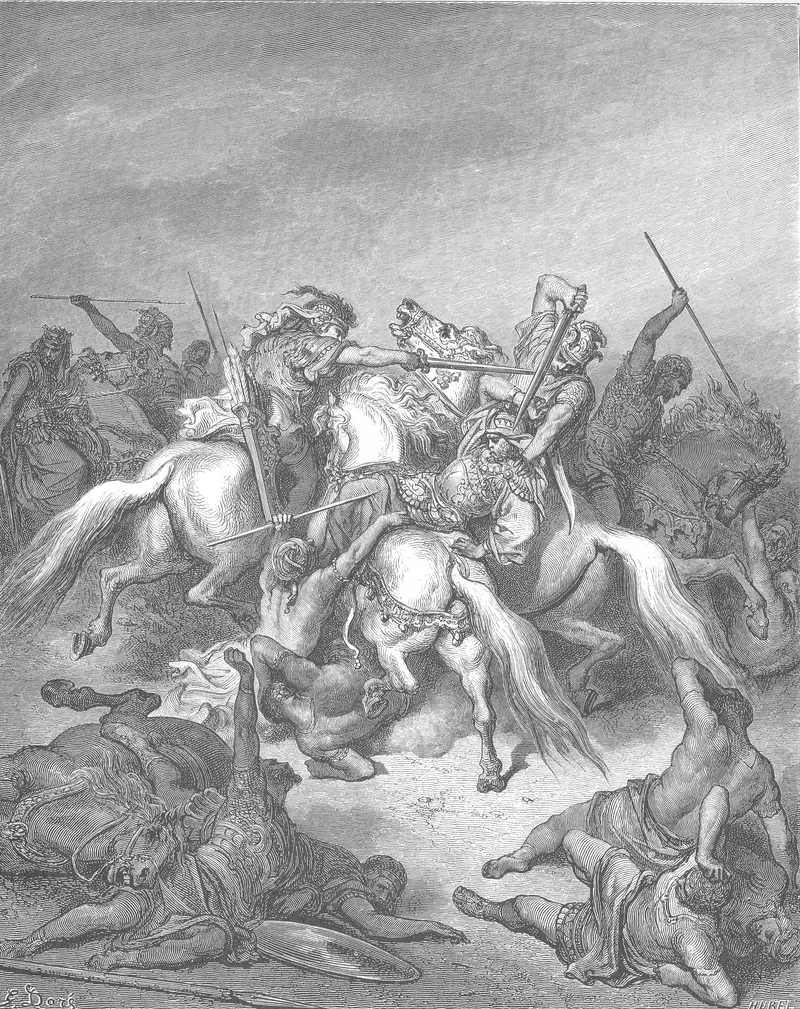
2 Samuel 19:1-8Joab Speaks Truth to the King
1And it was told Joab, Behold, the king weepeth and mourneth for Absalom. 2And the victory that day was turned into mourning unto all the people: for the people heard say that day how the king was grieved for his son. 3And the people gat them by stealth that day into the city, as people being ashamed steal away when they flee in battle. 4But the king covered his face, and the king cried with a loud voice, O my son Absalom, O Absalom, my son, my son!
The victory is turned to mourning. This is not the triumph a king should show after his forces have won. David's private anguish becomes the nation's crisis. The soldiers who bled for him come home in shame - their victory stolen by their king's openly displayed grief. The people do not celebrate. They sneak into the city "as people being ashamed."123
The wail is not muffled into a pillow. He cries it aloud, over and over, the same broken name circling back on itself - a father refusing to hide the wound. And here is the unbearable thing the chapter will not let us soften: this grief is right, and its timing is ruinous. A man is allowed to break over a dead child. A king cannot afford to break in public on the morning his throne hangs by a thread. If you have ever had to keep functioning while something inside you was screaming, you know exactly where David is standing.
5And Joab came into the house to the king, and said, Thou hast shamed this day the faces of all thy servants, which this day have saved thy life, and the lives of thy sons and of thy daughters, and the lives of thy wives, and the lives of thy concubines; 6In that thou lovest thine enemies, and hatest thy friends. For thou hast declared this day, that thou regardest neither princes nor servants: for this day I perceive, that if Absalom had lived, and all we had died this day, then it had pleased thee well.
Joab walks into the royal house and speaks words that would cost most men their heads. But Joab is not most men. He is the commander who has done David's bloody work. He killed Absalom - not in formal battle, but in the grove, in an act that probably violated the king's unexpressed wish that Absalom live. And now he must speak the truth that no one else dares to speak: David's grief has become a betrayal of the men who died for him, of his family, of his people.
"Thou lovest thine enemies, and hatest thy friends." Joab speaks as a man who has read David's heart accurately. David has always struggled with the men closest to him - he loves Absalom, the rebel; he is suspicious of Joab, his loyal commander. The imbalance is destroying the kingdom.
7Now therefore arise, go forth, and speak comfortably unto thy servants: for I swear by the LORD, if thou go not forth, there will not tarry one with thee this night: and that will be worse unto thee than all the evil that befell thee from thy youth until now. 8Then the king arose, and sat in the gate. And they told unto all the people, saying, Behold, the king doth sit in the gate. And all the people came before the king: for Israel had fled every man to his tent.
Joab's ultimatum is not gentle. "If thou go not forth, there will not tarry one with thee this night. And that will be worse unto thee than all the evil that befell thee from thy youth until now." The kingdom will abandon him if he does not show his face. Joab makes it clear: a king's private grief cannot come before his public duty.
2 Samuel 19:9-15A Divided Kingdom Calls for Its King
9And all the people were at strife throughout all the tribes of Israel, saying, The king saved us out of the hand of our enemies, and he delivered us out of the hand of the Philistines; and now he is fled out of the land for Absalom. 10And Absalom, whom we anointed over us, is dead in battle. Now therefore why speak ye not a word of bringing the king back?
The tribes are divided, quarreling. Some remember David's victories - he saved them from enemies and Philistines. Others are confused: why did he flee for Absalom? Why are they debating whether to bring him home? The people are looking for leadership that the king, in his grief, is not providing.
11And king David sent to Zadok and to Abiathar the priests, saying, Speak unto the elders of Judah, saying, Why are ye the last to bring the king back to his house? seeing the speech of all Israel is come to the king, even to his house. 12Ye are my brethren, ye are my bones and my flesh: wherefore then are ye the last to bring back the king? 13And say ye to Amasa, Art thou not of my bone, and of my flesh? God do so to me, and more also, if thou be not captain of the host before me continually in the room of Joab.
David is now taking action - he is using priests to rally the elders, he is making a promise that will have profound consequences. He tells Amasa, Joab's cousin: "Be captain of the host before me continually in the room of Joab." In one sentence, David promises to replace his most loyal but most violent commander with a man who has just fought against him. This is an act of mercy, or of political necessity, or of misreading the men around him - or perhaps all three.
Joab has just saved the kingdom by speaking hard truth. David will repay him by replacing him.
14And he bowed the heart of all the men of Judah, even as the heart of one man; so that they sent this word unto the king, Return thou, and all thy servants. 15So the king returned, and came to Jordan. And Judah came to Gilgal, to go to meet the king, to conduct the king over Jordan.
David's message to Judah works. The men of Judah are "bowed" - their hearts turn "as the heart of one man." They send word: Return. The king comes to Jordan. Judah comes to meet him at Gilgal. The machinery of reconciliation is beginning to turn. But it moves on a foundation that is already cracking.
2 Samuel 19:16-23Shimei's Mercy - A Curse Forgiven
16And Shimei the son of Gera, a Benjamite, which was of Bahurim, hasted and came down with the men of Judah to meet king David. 17And there were a thousand men of Benjamin with him, and Ziba the servant of the house of Saul, and his fifteen sons and his twenty servants with him; and they went over Jordan before the king. 18And there went over a ferry boat to carry over the king’s household, and to do what he thought good. And Shimei the son of Gera fell down before the king, as he was come over Jordan;
Shimei is a Benjamite - from the tribe of Saul, David's predecessor. Earlier in David's life, when David fled Jerusalem before Absalom, Shimei cursed him: "Come out, come out, thou bloody man, and thou man of Belial" (2 Sam 16:7). Shimei threw stones at David and his men. It was an act of rebellion, an act of courage (he was cursing the king), an act of grave insult. Abishai wanted David to let him kill Shimei. But David refused: "Let him curse" (2 Sam 16:11).
19And said unto the king, Let not my lord impute iniquity unto me, neither do thou remember that which thy servant did perversely the day that my lord the king went out of Jerusalem, that the king should take it to his heart.
The man who once stood on a ridge hurling rocks and curses now lies face-down in the mud at the water's edge. He brings a thousand armed Benjamites with him - part escort, part insurance - but the plea itself is naked. Do not hold the curse against me. Do not weigh the stones. The bravado of the bad day is gone; what is left is a man asking a king he wronged not to remember.
20For thy servant doth know that I have sinned: therefore, behold, I am come the first this day of all the house of Joseph to go down to meet my lord the king.
Shimei makes a claim: he is the first from the house of Joseph - the northern tribes - to come and meet David. It is a claim of loyalty, of priority, of repentance turned to action. He is saying: I know I sinned. I was wrong. I am here to make it right.
21But Abishai the son of Zeruiah answered and said, Shall not Shimei be put to death for this, because he cursed the LORD’s anointed? 22And David said, What have I to do with you, ye sons of Zeruiah, that ye should this day be adversaries unto me? shall there any man be put to death this day in Israel? for do not I know that I am this day king over Israel? 23Therefore the king said unto Shimei, Thou shalt not die. And the king sware unto him.
David stops Abishai coldly. He will not execute Shimei. The question he asks is pointed: "Shall there any man be put to death this day in Israel? For do not I know that I am this day king over Israel?" It is a strange statement. David has just learned that his people love him, that his kingdom is being restored. What does he choose to do with that power? He chooses mercy. He swears an oath to Shimei: you shall not die.
2 Samuel 19:24-30Mephibosheth - "Let Him Take All"
24And Mephibosheth the son of Saul came down to meet the king, and had neither dressed his feet, nor trimmed his beard, nor washed his clothes, from the day the king departed until the day he came again in peace.
Mephibosheth appears - Jonathan's son, Saul's grandson. He has not dressed his feet, not trimmed his beard, not washed his clothes. From the day David fled until David returned. In Hebrew, these are the marks of mourning, the physical signs of a man in distress. Mephibosheth has been living in anguish for his lord.
25And it came to pass, when he was come to Jerusalem to meet the king, that the king said unto him, Wherefore wentest not thou with me, Mephibosheth?
David asks the question that cuts. Mephibosheth is lame - he cannot walk properly. When David fled, Mephibosheth did not follow. Why not? The question carries accusation. Did you not flee with me because you were truly loyal to my son Absalom?
26And he answered, My lord, O king, my servant deceived me: for thy servant said, I will saddle me an ass, that I may ride thereon, and go to the king; because thy servant is lame. 27And he hath slandered thy servant unto my lord the king; but my lord the king is as an angel of God: do therefore what is good in thine eyes.
Mephibosheth answers carefully. His servant - Ziba - deceived him. Mephibosheth asked Ziba to saddle an ass so he could ride to David. But Ziba has slandered him. Ziba has told David that Mephibosheth stayed away to curry favor with Absalom. It is a lie. And Mephibosheth cannot prove it. His lameness kept him from following. His dependence on Ziba left him vulnerable to betrayal.
28For all of my father’s house were but dead men before my lord the king: yet didst thou set thy servant among them that did eat at thine own table. What right therefore have I yet to cry any more unto the king?
Mephibosheth speaks from a place of radical grace-consciousness. He says: all my father's house were dead men before you. We were Saul's line - your enemy. Yet you set me at your table. You gave me life when you could have taken it. "What right therefore have I yet to cry any more unto the king?" In other words: you have given me more than I deserved. How can I ask for anything more?
29And the king said unto him, Why speakest thou any more of thy matters? I have said, Thou and Ziba divide the land. 30And Mephibosheth said unto the king, Yea, let him take all, forasmuch as my lord the king is come again in peace unto his own house.
David splits the difference, and it is not really fair: the liar keeps half of what he tried to steal. Ziba slandered his master and walks away with an estate for it. You brace for Mephibosheth to protest - and instead he hands the rest away without a fight. The land was never the point. The point came home dry-shod across the Jordan with a crown on his head. Everything Mephibosheth wanted was already standing in front of him.
2 Samuel 19:31-39Barzillai - The Wisdom of Knowing Your Season
31And Barzillai the Gileadite came down from Rogelim, and went over Jordan with the king, to conduct him over Jordan. 32Now Barzillai was a very aged man, even fourscore years old: and he had provided the king of sustenance while he lay at Mahanaim; for he was a very great man.
Barzillai the Gileadite appears - a man of eighty years old. While David lay hiding from Absalom at Mahanaim, Barzillai fed him and his household: bread and water, beds and provisions. He was present in David's darkest hour without claiming reward or recognition.
33And the king said unto Barzillai, Come thou over with me, and I will feed thee with me in Jerusalem.
David offers Barzillai the highest honor - to come to court, to eat at the king's table, to live in Jerusalem. This is David's way of saying: you showed me kindness when I had nothing. Now you shall have everything. Come and live in the palace.
34And Barzillai said unto the king, How long have I to live, that I should go up with the king unto Jerusalem? 35I am this day fourscore years old: and can I discern between good and evil? can thy servant taste what I eat or what I drink? can I hear any more the voice of singing men and singing women? wherefore then should thy servant be yet a burden unto my lord the king?
Barzillai declines. And his words are a profound meditation on aging and human limitation. How long will he live? He is eighty. He can no longer taste his food, or hear music, or tell good from evil with clarity. What would be the point of coming to the court of the king if he cannot enjoy the sweetness of that court? He is reading his own body and his own season, and choosing not to be a burden on the king he loves.
36Thy servant will go a little way over Jordan with the king: and why should the king recompense it me with such a reward? 37Let thy servant, I pray thee, turn back again, that I may die in mine own city, and be buried by the grave of my father and of my mother. But behold thy servant Chimham; let him go over with my lord the king; and do to him what shall seem good unto thee.
Barzillai offers a compromise. He will go with David partway. But then he asks to return home - to his own city, to be buried by the grave of his father and mother. It is a statement of priorities. What matters is the continuity of his own life, the ground of his ancestors, the place where he will die. And he offers his son Chimham in his stead: let him go with the king, let the king take him into his service.
38And the king answered, Chimham shall go over with me, and I will do to him that which shall seem good unto thee: and whatsoever thou shalt require of me, that will I do for thee. 39And all the people went over Jordan. And when the king was come over, the king kissed Barzillai, and blessed him; and he returned unto his own place.
David accepts Barzillai's wisdom. He takes Chimham as his servant. And he does something profound: he kissed Barzillai and blessed him. Because Barzillai understood what he needed, and asked for it, and sent his son in his place. The king honors the old man's clarity about his own season.
2 Samuel 19:40-43Tribal Jealousy - The First Signs of Division
40Then the king went on to Gilgal, and Chimham went on with him: and all the people of Judah conducted the king, and also half the people of Israel.
The king presses on to Gilgal. Chimham travels with him. The people of Judah conduct him - and also "half the people of Israel." But note the language: Judah conducts the king. The northern tribes are present, but they are not the primary actors. A fracture is forming.
41And, behold, all the men of Israel came to the king, and said unto the king, Why have our brethren the men of Judah stolen thee away, and have brought the king, and his household, and all David’s men with him, over Jordan?
Now the northern tribes speak. They say Judah has "stolen thee away." They have not taken David to Jerusalem with them. Judah has claimed him, has brought him across Jordan first. The men of Israel are angry that Judah is getting first access to the king.
42And all the men of Judah answered the men of Israel, Because the king is near of kin to us: wherefore then be ye angry for this matter? have we eaten at all of the king’s cost? or hath he given us any gift?
Judah answers: the king is near of kin to us. Judah is David's tribe - the tribe from which he came. We have eaten at his cost? No. We are claiming nothing but priority. And yet the accusation hangs in the air: we are closer to him. We called him home first.
43And the men of Israel answered the men of Judah, and said, We have ten parts in the king, and we have also more right in David than ye: why then did ye despise us, that our advice should not be first had in bringing back our king? And the words of the men of Judah were fiercer than the words of the men of Israel.
Israel says: We have ten parts in the king. We are the ten northern tribes. We have more right in David than you do. Why did you despise us? Why did not our advice to bring the king home get heard first? The quarrel escalates. "The words of the men of Judah were fiercer than the words of the men of Israel." It is a sign of what is coming. Within a chapter, Sheba of Benjamin will raise a revolt. The kingdom will split.
This moment is the turning point. David has been restored. Mercy has been offered. Shimei has been forgiven. Mephibosheth has found grace. Barzillai has returned home in peace. But the kingdom is fractured. North against South. The quarrel over who gets the king, who gets first place, who has the most right - it will consume the next chapter and threaten to tear the nation apart. A king can be restored. But his kingdom, once fractured, is harder to heal.
Research trail
Sources & further study
These references support the historical, linguistic, manuscript, and contextual notes in this chapter. Scripture remains the primary text; external sources are provided so readers can inspect the research directly.
- David as King of IsraelDavid's consolidation of power and establishment of monarchy over united Israel.
- City of David ExcavationsContinuous excavation revealing David-era structures and urban development in Jerusalem.
- Jerusalem CapturedDavid's capture of the Jebusite city and establishment as Israel's capital.
Where this echoes in Scripture
Shimei's Mercy - A Curse Forgiven
- Luke 23:34Then said Jesus, Father, forgive them; for they know not what they do.The same opening move as David's oath in verse 23 - the wronged king's first word is pardon.
- John 20:19came Jesus and stood in the midst, and saith unto them, Peace be unto you.The risen King returns to the ones who fled Him and leads with peace, as David leads with “Thou shalt not die.”
- 2 Samuel 16:5-7he cursed... and said... Come out, come out, thou bloody man, and thou man of Belial.The curse now forgiven - Shimei's stones and slander on the day David fled Jerusalem.
- Romans 12:19avenge not yourselves... Vengeance is mine; I will repay, saith the Lord.Why David can sheathe the sword in verse 23 - the account is not dropped, it is handed up to God.
- 1 Kings 2:8-9thou hast with thee Shimei... hold him not guiltless... his hoar head bring thou down to the grave with blood.The harder sequel - David's deathbed counsel about Shimei shows mercy here was a personal oath, a reprieve held in trust.
Mephibosheth - "Let Him Take All"
- Matthew 16:26For what is a man profited, if he shall gain the whole world, and lose his own soul?The question Mephibosheth answers in verse 30 before it is ever asked - the estate is nothing next to the King.
- Matthew 13:44for joy thereof goeth and selleth all that he hath, and buyeth that field.“Let him take all” in parable form - the treasure makes the cost of everything else feel like a bargain.
- Philippians 3:8I count all things but loss for the excellency of the knowledge of Christ Jesus my Lord.Paul does Mephibosheth's arithmetic - what was gain reckoned as loss to gain the Lord Himself.
- 2 Samuel 9:7-13thou shalt eat bread at my table continually... So Mephibosheth dwelt in Jerusalem: for he did eat continually at the king's table.Why he does not grasp for land - he was a dead man of Saul's house given a permanent seat by sheer kindness.
Barzillai - The Wisdom of Knowing Your Season
- Luke 22:42saying, Father, if thou be willing, remove this cup from me: nevertheless not my will, but thine, be done.The fuller measure of Barzillai's “let me go home” - a body weighed honestly and a will surrendered to a greater good.
- John 15:13Greater love hath no man than this, that a man lay down his life for his friends.Barzillai already spent this love feeding David in exile (v. 32); his “no” to court is the same love, shaped to a different season.
- 2 Samuel 17:27-29Barzillai the Gileadite... brought beds... and wheat, and barley... for David, and for the people that were with him, to eat.The hidden kindness David is repaying here - provisions sent to a fugitive king who could promise nothing.
- Jeremiah 41:17the habitation of Chimham, which is by Bethlehem.Barzillai's son outlives him near Bethlehem - the old man's “let him go in my stead” quietly endures for generations.