1 Kings 2
People in this chapter
David is dying. The shepherd-boy who killed a giant, the fugitive who spared Saul, the king who danced before the ark and wept over Absalom, now gathers his strength for a few last words to his son. They are not sentimental. Be thou strong therefore, and shew thyself a man. Keep the law. Settle the accounts I could not settle. Then David sleeps with his fathers, and the throne is Solomon's.1
Tap any highlighted phrase to jump to the commentary that unpacks it.
1 Kings 2:1-4David's Charge to Solomon
1Now the days of David drew nigh that he should die; and he charged Solomon his son, saying, 2I go the way of all the earth: be thou strong therefore, and shew thyself a man; 3And keep the charge of the LORD thy God, to walk in his ways, to keep his statutes, and his commandments, and his judgments, and his testimonies, as it is written in the law of Moses, that thou mayest prosper in all that thou doest, and whithersoever thou turnest thyself: 4That the LORD may continue his word which he spake concerning me, saying, If thy children take heed to their way, to walk before me in truth with all their heart and with all their soul, there shall not fail thee (said he) a man on the throne of Israel.
A dying man does not waste words. David's first charge to his son reaches past treasure or armies to the inner man: courage, and the resolve to do what is right. The strength he means is in the spine that stands firm in truth and leads with conviction when leading is costly. A king weak in will cannot hold a kingdom. David is handing Solomon a weight to carry.23
David lays out the condition of the Davidic covenant: obedience to the law of the Lord. The statutes, commandments, judgments, and testimonies - the whole law of Moses - are the structural requirement of a righteous kingdom, the very foundation of the throne itself. Without obedience to God's law, the kingdom cannot stand.
Everything turns on a single small word, and the word is if. God's promise to David was never that his line would be flawless, only that his sons would keep the throne so long as they kept faith. The crown does not pass down the bloodline automatically; each generation has to choose obedience for itself. A name can be inherited; a heart belongs only to the one who carries it. That choice is the one thing no father can make for his son.
1 Kings 2:5-9Settling the Old Accounts
5Moreover thou knowest also what Joab the son of Zeruiah did to me, and what he did to the two captains of the hosts of Israel, unto Abner the son of Ner, and unto Amasa the son of Jether, whom he slew, and shed the blood of war in peace, and put the blood of war upon his girdle that was about his loins, and in his shoes that were on his feet. 6Do therefore according to thy wisdom, and let not his hoar head go down to the grave in peace. 7But shew kindness unto the sons of Barzillai the Gileadite, and let them be of those that eat at thy table: for so they came to me when I fled because of Absalom thy brother. 8And, behold, thou hast with thee Shimei the son of Gera, a Benjamite of Bahurim, which cursed me with a grievous curse in the day when I went to Mahanaim: but he came down to meet me at Jordan, and I sware to him by the LORD, saying, I will not put thee to death with the sword. 9Now therefore hold him not guiltless: for thou art a wise man, and knowest what thou oughtest to do unto him; but his hoar head bring thou down to the grave with blood.
David speaks of Joab with the weight of old wounds. Joab was his general, his right hand - and yet he murdered two rival commanders, Abner and Amasa, while posing as a friend. He killed them in peace, not in open battle, which made his crime a violation of the sacred law of warfare. "The blood of war in peace" - an act of treachery cloaked in brotherhood. This debt must be settled.
In contrast to the betrayers, David remembers Barzillai the Gileadite, who gave him shelter and provisions when he was a fugitive fleeing his own son Absalom. Kindness given in the darkest hour deserves to be honored. Solomon must repay this debt with royal favor - these kindnesses must eat at the king's table. This is how a righteous kingdom remembers.
Shimei comes from Saul's own house - a Benjamite who cursed David as he fled Jerusalem after Absalom's rebellion. The curse itself was a kind of violence, a spiritual assault. David was under tremendous pressure - his own son was taking his throne, his people were scattering. And Shimei added shame to that catastrophe, calling down curses on the fleeing king.
Here David makes a careful distinction: he swore to Shimei that he would not kill him with the sword. But he does not say Shimei will live. David leaves a judgment for Solomon - a puzzle wrapped in mercy. Solomon will need wisdom to understand what his father is asking.
1 Kings 2:10-12David's Death and the Throne Secured
10So David slept with his fathers, and was buried in the city of David. 11And the days that David reigned over Israel were forty years: seven years reigned he in Hebron, and thirty and three years reigned he in Jerusalem. 12Then sat Solomon upon the throne of David his father; and his kingdom was established greatly.
Forty years. That is David's legacy - the full cycle of a generation. Seven years in Hebron, marked by civil strife and the slow consolidation of power. Thirty-three years in Jerusalem, marked by conquest, the bringing of the ark, the building of his house, and the Davidic covenant itself. A long life, a long reign, and now it is done.
The text says Solomon's "kingdom was established greatly." But this establishment does not come without cost. The old rivalries are still alive. The men who opposed Solomon's coronation are still breathing. The throne will be stable only if Solomon is willing to do what his father has asked - to execute justice swiftly and without hesitation.
1 Kings 2:13-25Adonijah's Last Gambit
13And Adonijah the son of Haggith came to Bathsheba the mother of Solomon. And she said, Comest thou peaceably? And he said, Peaceably. 14He said moreover, I have somewhat to say unto thee. And she said, Say on. 15And he said, Thou knowest that the kingdom was mine, and that all Israel set their faces on me, that I should reign: howbeit the kingdom is turned about, and is become my brother’s: for it was his from the LORD. 16And now I ask one petition of thee, deny me not. And she said unto him, Say on. 17And he said, Speak, I pray thee, unto Solomon the king, (for he will not say thee nay,) that he give me Abishag the Shunammite to wife.
Adonijah's strategy shifts. He has lost the throne to Solomon. Now he moves with calculation, approaching Bathsheba with deference and a seemingly innocent request. But in the ancient world, marrying a former king's concubine was not personal - it was a claim on the throne itself. Adonijah is playing a dangerous game, one that reveals his unwillingness to accept the reality of Solomon's rule. He cannot seize the kingdom, so he reaches for a symbolic foothold.
18And Bathsheba said, Well; I will speak for thee unto the king. 19Bathsheba therefore went unto king Solomon, to speak unto him for Adonijah. And the king rose up to meet her, and bowed himself unto her, and sat down on his throne, and caused a seat to be set for the king’s mother; and she sat on his right hand. 20Then she said, I desire one small petition of thee; I pray thee, say me not nay. And the king said unto her, Ask on, my mother: for I will not say thee nay. 21And she said, Let Abishag the Shunammite be given to Adonijah thy brother to wife.
Bathsheba agrees to carry the request to her son. She comes before Solomon, who rises to meet her, bows, and sets a throne at his right hand for the queen mother, promising not to refuse her. She then asks that Abishag the Shunammite be given to Adonijah as a wife.
22And king Solomon answered and said unto his mother, And why dost thou ask Abishag the Shunammite for Adonijah? ask for him the kingdom also; for he is mine elder brother; even for him, and for Abiathar the priest, and for Joab the son of Zeruiah. 23Then king Solomon sware by the LORD, saying, God do so to me, and more also, if Adonijah have not spoken this word against his own life. 24Now therefore, as the LORD liveth, which hath established me, and set me on the throne of David my father, and who hath made me an house, as he promised, Adonijah shall be put to death this day. 25And king Solomon sent by the hand of Benaiah the son of Jehoiada; and he fell upon him that he died.
Watch how careful Adonijah is. He comes to the queen-mother soft, almost pious, even granting that the kingdom went to his brother because the Lord willed it. Every word is humble. None of it is honest. A man who has lost a crown rarely lets it go on the inside, and Adonijah is already feeling for a handhold back toward the throne, or at least a marker he can build on later.
When a man seeks to marry the widow or concubine of a fallen king, he is not making an innocent request. In the ancient Near East, taking the former king's wife or concubine was a claim on the throne itself. Absalom did this with David's concubines to signal that he was the new king. Adonijah is making the same move - a political chess piece disguised as a request for marriage.
18And Bathsheba said, Well; I will speak for thee unto the king. 19Bathsheba therefore went unto king Solomon, to speak unto him for Adonijah. And the king rose up to meet her, and bowed himself unto her, and sat down on his throne, and caused a seat to be set for the king’s mother; and she sat on his right hand. 20Then she said, I desire one small petition of thee; I pray thee, say me not nay. And the king said unto her, Ask on, my mother: for I will not say thee nay. 21And she said, Let Abishag the Shunammite be given to Adonijah thy brother to wife.
With her promise given, Bathsheba goes in to the king on Adonijah's behalf. Solomon honors her, rising and seating her at his right hand, and pledges to grant her petition. She asks that Abishag the Shunammite be given as wife to his brother Adonijah.
22And king Solomon answered and said unto his mother, And why dost thou ask Abishag the Shunammite for Adonijah? ask for him the kingdom also; for he is mine elder brother; even for him, and for Abiathar the priest, and for Joab the son of Zeruiah. 23Then king Solomon sware by the LORD, saying, God do so to me, and more also, if Adonijah have not spoken this word against his own life. 24Now therefore, as the LORD liveth, which hath established me, and set me on the throne of David my father, and who hath made me an house, as he promised, Adonijah shall be put to death this day. 25And king Solomon sent by the hand of Benaiah the son of Jehoiada; and he fell upon him that he died.
Bathsheba, who has become queen-mother, is used as a pawn in Adonijah's game. She goes to Solomon with what seems like a small, personal request - to give Abishag to Adonijah. Adonijah was counting on Solomon's filial respect, his disinclination to deny his mother. But Solomon is not naive.
Solomon's response is immediate and cutting: "Why dost thou ask Abishag the Shunammite for Adonijah? Ask for him the kingdom also." He sees through the pretense. He understands exactly what Adonijah is doing. And his words carry a warning: if you want to undermine the kingdom, you are asking for death.
Solomon does not deliberate. He binds himself with an oath in the name of God, and the verdict is already inside it: Adonijah has spoken these words against his own life. The plea for Abishag was never about a wife. It was a reach for the crown, and that is treason. Adonijah has sentenced himself with his own mouth. There is no appeal.
Benaiah, the captain of the guard, carries out the king's word. Adonijah is executed. The threat to the throne is removed. This is not personal cruelty - it is the establishment of order. A kingdom divided against itself cannot stand. Solomon has made his first hard decision as king.
1 Kings 2:26-27The Prophet's Word Fulfilled
26And unto Abiathar the priest said the king, Get thee to Anathoth, unto thine own fields; for thou art worthy of death: but I will not at this time put thee to death, because thou barest the ark of the LORD God before David my father, and because thou hast been afflicted in all wherein my father was afflicted. 27So Solomon thrust out Abiathar from being priest unto the LORD; that he might fulfil the word of the LORD, which he spake concerning the house of Eli in Shiloh.
Abiathar, the high priest, had supported Adonijah's claim to the throne. He backed the wrong heir, and for that, he could be executed. But Solomon shows him a kind of mercy: because Abiathar carried the ark, because he suffered alongside David, Solomon spares his life. He removes him from office, but does not kill him. It is a calculated mercy - one that honors Abiathar's service while establishing that disloyalty to the throne has consequences.
The text then reveals the deeper significance of this act: it fulfills an ancient prophecy. Centuries earlier, the prophet Samuel told Eli the priest that his house would be cut off from the priesthood. Eli's sons were corrupt. The priesthood would pass away from his line. And now, generations later, Abiathar (who was a descendant of Eli's line) is deposed. Zadok, of a different priestly line, replaces him. God's word, spoken so long ago, finally comes to pass.
1 Kings 2:28-35The Blood Debt Paid
28Then tidings came to Joab: for Joab had turned after Adonijah, though he turned not after Absalom. And Joab fled unto the tabernacle of the LORD, and caught hold on the horns of the altar. 29And it was told king Solomon that Joab was fled unto the tabernacle of the LORD; and, behold, he is by the altar. Then Solomon sent Benaiah the son of Jehoiada, saying, Go, fall upon him. 30And Benaiah came to the tabernacle of the LORD, and said unto him, Thus saith the king, Come forth. And he said, Nay; but I will die here. And Benaiah brought the king word again, saying, Thus said Joab, and thus he answered me. 31And the king said unto him, Do as he hath said, and fall upon him, and bury him; that thou mayest take away the innocent blood, which Joab shed, from me, and from the house of my father.
When the news reaches Joab, he flees to the tabernacle and lays hold of the horns of the altar. Solomon sends Benaiah to strike him down, but Joab refuses to leave, saying he will die there. The king orders that Joab be fallen upon at the altar, clearing David's house of the innocent blood Joab had shed.
32And the LORD shall return his blood upon his own head, who fell upon two men more righteous and better than he, and slew them with the sword, my father David not knowing thereof, to wit, Abner the son of Ner, captain of the host of Israel, and Amasa the son of Jether, captain of the host of Judah. 33Their blood shall therefore return upon the head of Joab, and upon the head of his seed for ever: but upon David, and upon his seed, and upon his house, and upon his throne, shall there be peace for ever from the LORD. 34So Benaiah the son of Jehoiada went up, and fell upon him, and slew him: and he was buried in his own house in the wilderness. 35And the king put Benaiah the son of Jehoiada in his room over the host: and Zadok the priest did the king put in the room of Abiathar.
Joab hears the news of what Solomon is doing - Adonijah has been executed, Abiathar deposed. Joab supported Adonijah. He knows what is coming. And in his desperation, he does what many desperate men do: he flees to the altar, seeking sanctuary. By grasping the horns of the altar, he invokes the ancient law that even a murderer might find safety at God's sanctuary. But Solomon sees through this last act of calculation.
The horns of the altar were meant for the penitent, for those truly seeking forgiveness before God. Joab comes calculating, looking for a way to escape consequences. His very act of fleeing to the altar is an abuse of it - turning God's sanctuary into a hiding place from justice, when it was made for genuine repentance.
Solomon overrides the sanctuary. Joab must be slain, and at the altar where he sought refuge. His blood will be shed in the same place where innocent blood was shed by those he murdered. The symmetry is exact: a man who shed blood deceptively dies at the altar; the innocent blood he spilled returns upon his own head.
The sentence Solomon pronounces is not his own invention. Behind it stands the old law of bloodguilt, which will not let innocent blood cry from the ground unanswered. Abner and Amasa were better men than the one who killed them, and David's house had carried their blood long enough. So the debt is sent back where it belongs, onto Joab and his line, and the throne is washed clean of it.
1 Kings 2:36-38A House in Jerusalem
36And the king sent and called for Shimei, and said unto him, Build thee an house in Jerusalem, and dwell there, and go not forth thence any whither. 37For it shall be, that on the day thou goest out, and passest over the brook Kidron, thou shalt know for certain that thou shalt surely die: thy blood shall be upon thine own head. 38And Shimei said unto the king, The saying is good: as my lord the king hath said, so will thy servant do. And Shimei dwelt in Jerusalem many days.
1 Kings 2:39-41Across the Brook
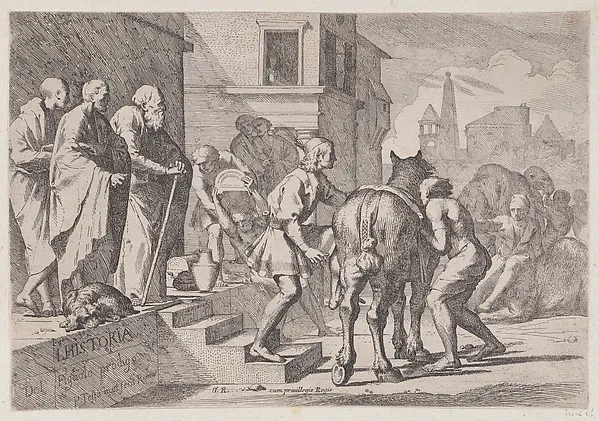
39And it came to pass at the end of three years, that two of the servants of Shimei ran away unto Achish son of Maachah king of Gath. And they told Shimei, saying, Behold, thy servants be in Gath. 40And Shimei arose, and saddled his ass, and went to Gath to Achish to seek his servants: and Shimei went, and brought his servants from Gath. 41And it was told Solomon that Shimei had gone from Jerusalem to Gath, and was come again.
Shimei had accepted the terms: he would remain in Jerusalem, bound by an oath. For three years, he honors it. But then his servants flee to Gath - a foreign kingdom. And Shimei, to retrieve them, crosses the boundary he was sworn not to cross. It seems a small matter - saving his servants. But the oath was clear. The boundary was explicit. In the moment of testing, when circumstances demand it, Shimei chooses his servants over his sacred word. The oath breaks.
1 Kings 2:42-46Solomon's Reckoning
42And the king sent and called for Shimei, and said unto him, Did I not make thee to swear by the LORD, and protested unto thee, saying, Know for a certain, on the day thou goest out, and walkest abroad any whither, that thou shalt surely die? and thou saidst unto me, The word that I have heard is good. 43Why then hast thou not kept the oath of the LORD, and the commandment that I have charged thee with? 44The king said moreover to Shimei, Thou knowest all the wickedness which thine heart is privy to, that thou didst to David my father: therefore the LORD shall return thy wickedness upon thine own head; 45And king Solomon shall be blessed, and the throne of David shall be established before the LORD for ever. 46So the king commanded Benaiah the son of Jehoiada; which went out, and fell upon him, that he died. And the kingdom was established in the hand of Solomon.
Solomon chooses a different path: he gives Shimei a chance to live, under conditions. Shimei must remain in Jerusalem. If he crosses the brook Kidron, he will die. It is a conditional mercy, and the condition is clear: stay within bounds, and your life is spared. Cross the boundary, and you accept the consequences. David had left this judgment to Solomon. Solomon chooses to give Shimei a path to live.
Shimei accepts the oath: "The saying is good." He understands the terms. He agrees to them. And for three years, he honors the oath. He dwells in Jerusalem. He does not depart. But then, his servants run away to Gath - to a foreign kingdom. What would a servant do in such a circumstance? Shimei goes after them. He crosses the boundary. He breaks the oath.
Solomon's question is sharp and exact: why was the oath not kept? Shimei had sworn before heaven, in the name of the Lord, and then traded that vow for two runaway servants. Solomon is not surprised. He reminds Shimei of the old wickedness his heart still knows, the cursing of David in the day of his flight. The boundary was never really about a brook. It was a test of whether this man could keep faith, and he could not.
With Shimei gone, the long account is finally closed. The chapter does not end on a coronation or a feast. It ends quietly, almost grimly: the kingdom is now secure in Solomon's hand. The rivals are dead, the oath-breaker is gone, and for the first time the new king can govern without watching the door. Peace has come, and it has cost a great deal to buy.
1 Kings 2:46The Kingdom Established
46So the king commanded Benaiah the son of Jehoiada; which went out, and fell upon him, that he died. And the kingdom was established in the hand of Solomon.
The throne came to Solomon by anointing. The kingdom came another way - through the hard settling of old debts, the keeping of his father's charge, the judgments no one enjoys but a king cannot refuse. A crown can be handed over in a single afternoon. A kingdom has to be held. Solomon now sits where David sat, and the long, costly work of becoming king is, at last, behind him.
Research trail
Sources & further study
These references support the historical, linguistic, manuscript, and contextual notes in this chapter. Scripture remains the primary text; external sources are provided so readers can inspect the research directly.
- Solomon's Reign and TempleSolomon's ascension to the throne and his building of the first temple.
- Solomonic Period ArtifactsMuseum collection of objects from Solomon's era revealing 10th-century Iron Age culture.
- Archaeology of the Solomonic PeriodExcavation evidence for urban centers and building projects attributed to Solomon.
Where this echoes in Scripture
The Blood Debt Paid
- Genesis 4:10The voice of thy brother's blood crieth unto me from the ground.The law of bloodguilt behind verse 32 - innocent blood is never silent before God.
- Exodus 21:14thou shalt take him from mine altar, that he may die.The altar gives no refuge to the deliberate murderer - the very ruling Solomon applies to Joab.
- Hebrews 9:22without shedding of blood is no remission.The same truth the chapter assumes - that blood-guilt has a cost - met and answered at the cross.
Solomon's Reckoning
- Ecclesiastes 5:4-5When thou vowest a vow unto God, defer not to pay it... Better is it that thou shouldest not vow, than that thou shouldest vow and not pay.The weight of the oath Shimei broke - a vow before God is not a thing to be traded away.
- Matthew 25:14-30thou wicked and slothful servant... cast ye the unprofitable servant into outer darkness.The same pattern as Shimei's - one charge given, an accounting required, and consequences for the one who fails it.
- Numbers 30:2he shall not break his word, he shall do according to all that proceedeth out of his mouth.The law standing behind Solomon's question in verse 43 - a sworn word binds the one who swears it.