2 Samuel 18
People in this chapter
Absalom marches out to take his father's throne, and the forest swallows him. Twenty thousand men fall in the wood of Ephraim, more devoured by the terrain than by the sword. The rebel prince rides under a great oak, his head catches in the boughs, and the mule walks on without him. He hangs between heaven and earth. Joab finds him helpless and drives three darts through his heart, against David's plea to spare him. 1
Tap any highlighted phrase to jump to the commentary that unpacks it.
2 Samuel 18:1-8David Sends Out His Army
1And David numbered the people that were with him, and set captains of thousands and captains of hundreds over them. 2And David sent forth a third part of the people under the hand of Joab, and a third part under the hand of Abishai the son of Zeruiah, Joab’s brother, and a third part under the hand of Ittai the Gittite. And the king said unto the people, I will surely go forth with you myself also.
David takes command. He numbers his forces, divides them into three companies, and declares he will march with them. His people have given him their loyalty; he will not ask them to bleed without him. But the next lines reveal that the people know something David has forgotten: a kingdom cannot afford to lose its king.123
3But the people answered, Thou shalt not go forth: for if we flee away, they will not care for us; neither if half of us die, will they care for us: but now thou art worth ten thousand of us: therefore now it is better that thou succour us out of the city.
The math is brutal and the soldiers say it to his face: if half of us fall, the rebels shrug, but if you fall, the kingdom falls with you. The commander is the symbol, the authority, the hope, a hope no one can replace. So David, who wanted to march out front, yields and stays behind the wall. The man who once ran toward Goliath now lets others carry the fight.
4And the king said unto them, What seemeth you best I will do. And the king stood by the gate side, and all the people came out by hundreds and by thousands. 5And the king commanded Joab and Abishai and Ittai, saying, Deal gently for my sake with the young man, even with Absalom. And all the people heard when the king gave all the captains charge concerning Absalom.
A king sending an army to crush a rebellion has every right to want the ringleader dead. David wants him spared. He gives the order loud enough that every captain and every soldier hears it: whatever Absalom has done, deal gently with him, bring the young man back alive. Three commanders, twenty thousand troops, and the last word ringing in their ears is mercy for the man they are marching out to stop.
This command sets up the tragedy. David loves his son more than he loves his throne. He would rather have Absalom alive, even in captivity, even in shame, than victorious in death. But mercy cannot always be preserved when passion runs hot and blood is spilling.
6So the people went out into the field against Israel: and the battle was in the wood of Ephraim; 7Where the people of Israel were slain before the servants of David, and there was there a great slaughter that day of twenty thousand men. 8For the battle was there scattered over the face of all the country: and the wood devoured more people that day than the sword devoured.
A haunting detail: the wood "devoured more people that day than the sword." By chaos and terrain, by the raw fact of being lost and tangled in wilderness, more men fall than in direct combat. When a kingdom tears itself apart, it is the land itself that reaps a bloody harvest.
2 Samuel 18:9-15Absalom Caught in the Oak
9And Absalom met the servants of David. And Absalom rode upon a mule, and the mule went under the thick boughs of a great oak, and his head caught hold of the oak, and he was taken up between the heaven and the earth; and the mule that was under him went away.
Absalom rode on a mule - a sign of nobility, a royal mount. Even in flight, he carried the mark of his pride. And then the forest intercepts him. The thick boughs of a great oak catch his head - whether his long, beautiful hair (which the text noted earlier) or simply his head itself - and he is trapped. The mule goes on; Absalom hangs suspended between heaven and earth, caught, defenseless, alone.
10And a certain man saw it, and told Joab, and said, Behold, I saw Absalom hanged in an oak.
A witness. Someone saw him trapped. In that moment, Absalom is utterly defenseless, just hanging. Waiting for whatever comes next.
11And Joab said unto the man that told him, And, behold, thou sawest him, and why didst thou not smite him there to the ground? and I would have given thee ten shekels of silver, and a girdle. 12And the man said unto Joab, Though I should receive a thousand shekels of silver in mine hand, yet would I not put forth mine hand against the king’s son: for in our hearing the king charged thee and Abishai and Ittai, saying, Beware that none touch the young man Absalom. 13Otherwise I should have wrought falsehood against mine own life: for there is no matter hid from the king, and thou thyself wouldest have set thyself against me.
This soldier has no name and gets no reward, and he is the most honorable man in the chapter. Joab dangles ten shekels and a soldier's belt, then leans on him with the logic of war: the man is the enemy, strike him and be paid. The soldier refuses. He stood in the crowd when the king said deal gently with Absalom, and he will not sell that word back for silver, not even when a general all but orders him to.
14Then said Joab, I may not tarry thus with thee. And he took three darts in his hand, and thrust them through the heart of Absalom, while he was yet alive in the midst of the oak. 15And ten young men that bare Joab’s armour compassed about and smote Absalom, and slew him.
Joab will not wait. He will not ask again. He takes three darts and drives them through the heart of a man hanging defenseless in an oak tree. Three darts - a business-like efficiency, the pragmatism of a general who sees a threat and eliminates it. But in doing so, Joab breaks the king's mercy. He chooses statecraft over love.
And then the ten young men circle the body and strike it down. Absalom is finished. No trial, no judgment, no word from the king. Just the cold logic of war: the threat is dead; move on.
2 Samuel 18:16-20The News of Victory
16And Joab blew the trumpet, and the people returned from pursuing after Israel: for Joab held back the people. 17And they took Absalom, and cast him into a great pit in the wood, and laid a very great heap of stones upon him: and all Israel fled every one to his tent.
Absalom is thrown into a pit, his body buried under a great heap of stones - the burial of a traitor. And Israel scatters. The rebellion is over. The kingdom is restored. But at what price?
18Now Absalom in his lifetime had taken and reared up for himself a pillar, which is in the king’s dale: for he said, I have no son to keep my name in remembrance: and he called the pillar after his own name: and it is called unto this day, Absalom’s place.
19Then said Ahimaaz the son of Zadok, Let me now run, and bear the king tidings, how that the LORD hath avenged him of his enemies. 20And Joab said unto him, Thou shalt not bear tidings this day, but thou shalt bear tidings another day: but this day thou shalt bear no tidings, because the king’s son is dead.
Ahimaaz wants to bring the king news - victory! The enemies are defeated! But Joab stops him. "This day thou shalt bear no tidings, because the king's son is dead." Joab understands something Ahimaaz does not: the king wants his son alive. All the triumph in the world cannot change that.
2 Samuel 18:21-32Is the Young Man Absalom Safe?
21Then said Joab to Cushi, Go tell the king what thou hast seen. And Cushi bowed himself unto Joab, and ran. 22Then said Ahimaaz the son of Zadok yet again to Joab, But howsoever, let me, I pray thee, also run after Cushi. And Joab said, Wherefore wilt thou run, my son, seeing that thou hast no tidings ready? 23But howsoever, said he, let me run. And he said unto him, Run. Then Ahimaaz ran by the way of the plain, and overran Cushi.
Ahimaaz runs anyway. He overtakes Cushi. He wants to bring the news first. But he still does not know what news he is bringing - he has not seen Absalom, does not know the cost of this victory. He runs blind, thinking he brings good news.
24And David sat between the two gates: and the watchman went up to the roof over the gate unto the wall, and lifted up his eyes, and looked, and behold a man running alone. 25And the watchman cried, and told the king. And the king said, If he be alone, there is tidings in his mouth. And he came apace, and drew near.
David is waiting. He is sitting between the two gates, listening. And when he sees a runner coming, he does not ask about the battle, about victory, about the numbers of the dead. He waits.
26And the watchman saw another man running: and the watchman called unto the porter, and said, Behold another man running alone. And the king said, He also bringeth tidings.
David recognizes Ahimaaz by the way he runs. "He is a good man, and cometh with good tidings." David wants to believe. The runner is fast, eager - he must bring good news. It must be good.
27And the watchman said, Me thinketh the running of the foremost is like the running of Ahimaaz the son of Zadok. And the king said, He is a good man, and cometh with good tidings. 28And Ahimaaz called, and said unto the king, All is well. And he fell down to the earth upon his face before the king, and said, Blessed be the LORD thy God, which hath delivered up the men that lifted up their hand against my lord the king.
Ahimaaz arrives breathless with good news, blessing God, listing the enemies struck down. David lets none of it land. He has one question, and it is about a boy. Everything the runner thinks the king wants to hear, the king waves aside to ask whether his son is alive. You can measure a heart by the first question it asks.
29And the king said, Is the young man Absalom safe? And Ahimaaz answered, When Joab sent the king’s servant, and me thy servant, I saw a great tumult, but I knew not what it was. 30And the king said unto him, Turn aside, and stand here. And he turned aside, and stood still. 31And, behold, Cushi came; and Cushi said, Tidings, my lord the king: for the LORD hath avenged thee this day of all them that rose up against thee.
David asks again. "Is the young man Absalom safe?" This is his obsession now. Victory means nothing. Tidings of vengeance mean nothing. Cushi's answer - indirect, careful, but clear - tells him what he fears: Absalom is dead. "As that young man is" - dead. Like him. Dead.
2 Samuel 18:33The King's Unbearable Cry
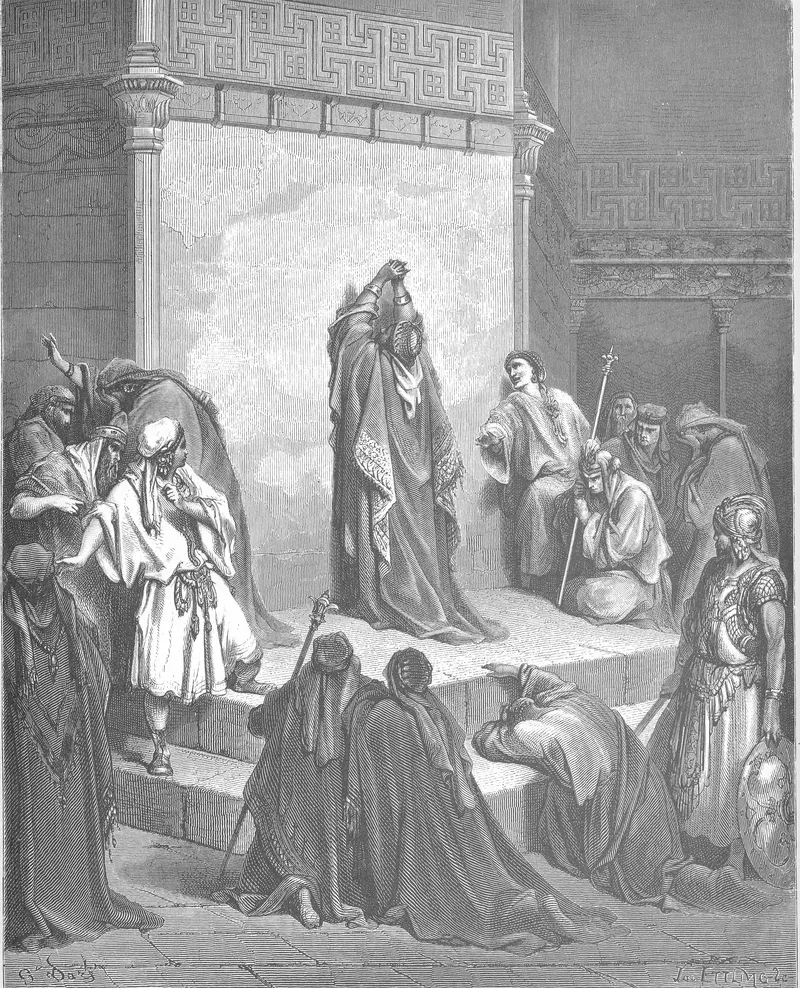
32And the king said unto Cushi, Is the young man Absalom safe? And Cushi answered, The enemies of my lord the king, and all that rise against thee to do thee hurt, be as that young man is. 33And the king was much moved, and went up to the chamber over the gate, and wept: and as he went, thus he said, O my son Absalom, my son, my son Absalom! would God I had died for thee, O Absalom, my son, my son!
There is no victory celebration. The king turns from the gate, climbs the stairs to the chamber above it, and shuts the door. What comes out is the same two words over and over, my son, my son, spoken to a boy who can no longer hear them. This is the sound a father makes when the worst has already happened and there is nothing left to do about it.
Notice what David does not say. He does not say "Why did you rebel?" He does not say "You brought this on yourself." He does not say "At least the kingdom is safe." He says only: "I wish I had died instead of you." A father's love, given freely regardless of obedience or worthiness: I would trade my life for yours. I would go into death if it meant you could live.
A father wishing himself dead so his rebel son could live. Read it slowly and it stops being only David. It is the oldest ache in love: to want, with your whole body, to take the death meant for someone you cannot save. David wants it and cannot do it. That is where the chamber over the gate opens onto the cross.
Research trail
Sources & further study
These references support the historical, linguistic, manuscript, and contextual notes in this chapter. Scripture remains the primary text; external sources are provided so readers can inspect the research directly.
- David as King of IsraelDavid's consolidation of power and establishment of monarchy over united Israel.
- City of David ExcavationsContinuous excavation revealing David-era structures and urban development in Jerusalem.
- Jerusalem CapturedDavid's capture of the Jebusite city and establishment as Israel's capital.
Where this echoes in Scripture
The King's Unbearable Cry
- John 3:16For God so loved the world, that he gave his only begotten Son.The Father's giving of the Son is the answer David's cry could not be.
- Romans 5:8While we were yet sinners, Christ died for us.Christ dies for rebels, the ones who had lifted their hand against the king.
- John 10:11I am the good shepherd: the good shepherd giveth his life for the sheep.The Son lays His life down freely; no Joab drives the darts.
- 1 John 3:1Behold, what manner of love the Father hath bestowed upon us, that we should be called the sons of God.Rebels are named children, welcomed home.