2 Samuel 24
People in this chapter
David wants a number. He sends Joab to count the fighting men of Israel and Judah, tribe by tribe, from Dan to Beer-sheba. Even Joab, no saint, can see the rot in it and begs him to stop. David counts anyway. Then his heart turns on him. Eight hundred thousand swords in Israel, five hundred thousand in Judah - and the king who tallied them is suddenly sick at what he has done.1
Tap any highlighted phrase to jump to the commentary that unpacks it.
2 Samuel 24:1-3The Temptation to Count
1And again the anger of the LORD was kindled against Israel, and he moved David against them to say, Go, number Israel and Judah. 2For the king said to Joab the captain of the host, which was with him, Go now through all the tribes of Israel, from Dan even to Beersheba, and number ye the people, that I may know the number of the people. 3And Joab said unto the king, Now the LORD thy God add unto the people, how many soever they be, an hundredfold, and that the eyes of my lord the king may see it: but why doth my lord the king delight in this thing?
Notice what the chapter withholds: the anger comes first, and the cause is never spelled out. Heaven is already displeased before David lifts a finger. The parallel in 1 Chronicles 21:1 puts a tempter behind the impulse to count; here the verse leaves the prompting in the LORD's shadow. You do not have to untangle the mechanics to feel the weight of it - permission, temptation, and a king's own choice all run together, and the census becomes the place where a deeper displeasure surfaces.
What David does with the thought is what the chapter will press on.123
Joab's response is crucial. His protest comes on almost spiritual grounds: "the Lord thy God add unto the people ... an hundredfold." Joab is saying: May God bless the people. His protest is subtle but cutting. He asks David directly: "why doth my lord the king delight in this thing?" Why this obsession with counting? The implication: trust in God is the measure of blessing, and this counting replaces it.
2 Samuel 24:4-7From Dan to Beersheba
4Notwithstanding the king’s word prevailed against Joab, and against the captains of the host. And Joab and the captains of the host went out from the presence of the king, to number the people of Israel. 5And they passed over Jordan, and pitched in Aroer, on the right side of the city that lieth in the midst of the river of Gad, and toward Jazer: 6Then they came to Gilead, and to the land of Tahtimhodshi; and they came to Danjaan, and about to Zidon, 7And came to the strong hold of Tyre, and to all the cities of the Hivites, and of the Canaanites: and they went out to the south of Judah, even to Beersheba.
2 Samuel 24:8-9The Count Comes Back
8So when they had gone through all the land, they came to Jerusalem at the end of nine months and twenty days. 9And Joab gave up the sum of the number of the people unto the king: and there were in Israel eight hundred thousand valiant men that drew the sword; and the men of Judah were five hundred thousand men.
The census is complete. Eight hundred thousand in Israel, five hundred thousand in Judah. These are not small numbers. They represent a kingdom of immense military power. And now David knows the count. He has what he sought - the measure of his strength. But in that moment of knowledge comes the recognition of what he has done.
2 Samuel 24:10-14The Heart Smites Him; The Three Choices
10And David’s heart smote him after that he had numbered the people. And David said unto the LORD, I have sinned greatly in that I have done: and now, I beseech thee, O LORD, take away the iniquity of thy servant; for I have done very foolishly.
David does not wait for a prophet to come to him. His own heart smites him - his own conscience recognizes what he has done. The numbering is complete, and in that completion, he sees the sin. The words he speaks are plain and unguarded: "I have sinned greatly, and I have done very foolishly." This is the response of a man who has been trained by the Holy Spirit to recognize his own corruption.
11For when David was up in the morning, the word of the LORD came unto the prophet Gad, David’s seer, saying, 12Go and say unto David, Thus saith the LORD, I offer thee three things; choose thee one of them, that I may do it unto thee. 13So Gad came to David, and told him, and said unto him, Shall seven years of famine come unto thee in thy land? or wilt thou flee three months before thine enemies, while they pursue thee? or that there be three days’ pestilence in thy land? now advise, and see what answer I shall return to him that sent me.
The Lord offers three forms of judgment. All are severe. A seven-year famine would devastate the land and its people. Three months of fleeing from enemies would leave David humiliated and exposed. Three days of pestilence would bring death on a massive scale. There is no "good" choice here. But there is a principle at work: David is being given agency even in judgment. He must choose which form his discipline will take. The Lord is not imposing judgment arbitrarily; He is allowing David to exercise judgment about his own punishment.
14And David said unto Gad, I am in a great strait: let us fall now into the hand of the LORD; for his mercies are great: and let me not fall into the hand of man.
David's logic is worth slowing down over. Famine and flight would both hand him over to human agents - hungry mobs, pursuing armies, the cruelty of men who feel no mercy. Pestilence puts the outcome straight into the hand of God. And that, to David, is the safer place to fall. He has spent a lifetime on the wrong end of Saul's spear and Absalom's sword; he knows what men do with power. He would rather be struck by the One whose mercies are great than spared by anyone else.
2 Samuel 24:15-17The Angel at the Threshing Floor
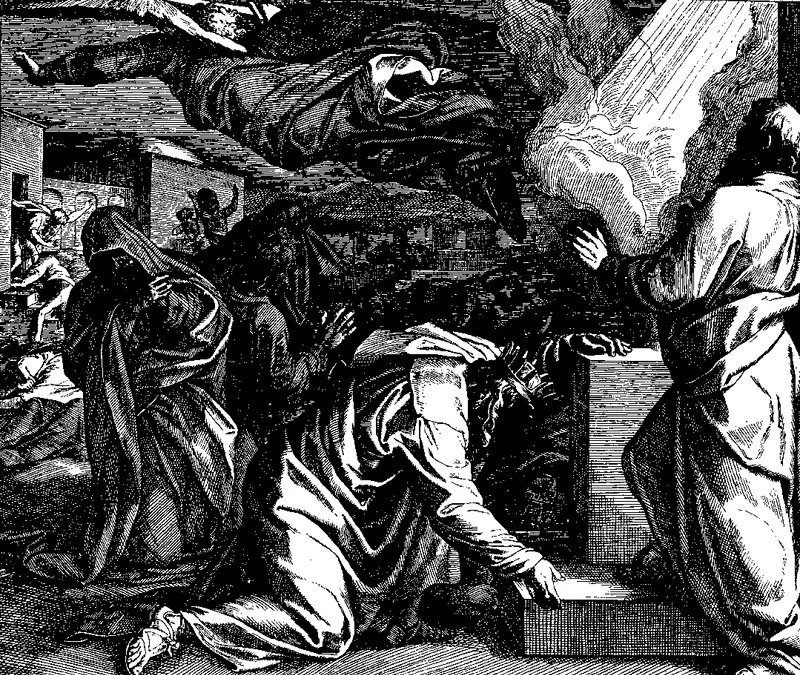
15So the LORD sent a pestilence upon Israel from the morning even to the time appointed: and there died of the people from Dan even to Beersheba seventy thousand men. 16And when the angel stretched out his hand upon Jerusalem to destroy it, the LORD repented him of the evil, and said to the angel that destroyed the people, It is enough: stay now thine hand. And the angel of the LORD was by the threshingplace of Araunah the Jebusite. 17And David spake unto the LORD when he saw the angel that smote the people, and said, Lo, I have sinned, and I have done wickedly: but these sheep, what have they done? let thine hand, I pray thee, be against me, and against my father’s house.
The plague is swift and terrible. Seventy thousand die. The pestilence that David chose has come, and in three days the death toll is immense. And yet at the moment the angel stretches out his hand toward Jerusalem to complete the destruction, the Lord stays his hand. "It is enough." Mercy intervenes. The Lord sees the angel at the threshing floor - the site where David will later purchase ground for an altar. The judgment is arrested at a place that will become sacred.
David's response turns outward. He asks for the people. "These sheep, what have they done?" The metaphor is striking - David calls the people "sheep," a word that speaks both of the innocence of those who have died and of their dependence on a shepherd. Seventy thousand people have died because of David's sin. And David sees this. He does not hide from it. He asks that the judgment fall upon him and his house, sparing the people who bore it.
2 Samuel 24:18-25"I Will Not Offer That Which Costs Me Nothing"
18And Gad came that day to David, and said unto him, Go up, rear an altar unto the LORD in the threshingfloor of Araunah the Jebusite. 19And David, according to the saying of Gad, went up as the LORD commanded. 20And Araunah looked, and saw the king and his servants coming on toward him: and Araunah went out, and bowed himself before the king on his face upon the ground. 21And Araunah said, Wherefore is my lord the king come to his servant? And David said, To buy the threshingfloor of thee, to build an altar unto the LORD, that the plague may be stayed from the people. 22And Araunah said unto David, Let my lord the king take and offer up what seemeth good unto him: behold, here be oxen for burnt sacrifice, and threshing instruments and other instruments of the oxen for wood.
Araunah is a Jebusite - a native of Jerusalem from the time before David conquered the city. His willingness to offer David the threshing floor freely, to provide oxen and wood for the sacrifice, is an act of generosity and respect. Araunah sees before him the Lord's anointed and offers everything freely, as "a king" giving to a king.
David's stated purpose is clear: to build an altar so that the plague may be stayed. But the altar is more than functional. The altar is an act of atonement, a place where David acknowledges the sovereignty of God and seeks His favor. The sacrifice offered here is meant to repair the relationship between David and the Lord.
23All these things did Araunah, as a king, give unto the king. And Araunah said unto the king, The LORD thy God accept thee.
Araunah offers everything for free, and David refuses with a king's firmness. He insists on paying full price. The refusal is not stubbornness or pride about money; it is the recognition that an offering pulled from someone else's pocket is not his to give. What goes on this altar has to come out of his own substance - his silver, his loss - or it means nothing.
Here is the beating heart of the chapter, and it cuts at every cheap religion ever invented. A gift that costs you nothing buys you nothing before God. The Hebrew word for offering, "korban," comes from a root meaning to draw near - and the drawing near happens through the cost. You move toward God by handing over something your hands were closed around. Free worship, surplus worship, leftover worship: it never crosses the distance. Only what is given up arrives.
24And the king said unto Araunah, Nay; but I will surely buy it of thee at a price: neither will I offer burnt offerings unto the LORD my God of that which doth cost me nothing. So David bought the threshingfloor and the oxen for fifty shekels of silver. 25And David built there an altar unto the LORD, and offered burnt offerings and peace offerings. So the LORD was intreated for the land, and the plague was stayed from Israel.
David pays fifty shekels of silver (though 1 Chronicles 21:25 mentions six hundred shekels for the entire site - either different accounts or different phases of purchase). He builds an altar. He offers burnt offerings - gifts that are entirely consumed - and peace offerings - meals shared with the Lord. And the result: "the Lord was intreated." God accepts the offering. The plague is stayed. The relationship is restored.
Research trail
Sources & further study
These references support the historical, linguistic, manuscript, and contextual notes in this chapter. Scripture remains the primary text; external sources are provided so readers can inspect the research directly.
- David as King of IsraelDavid's consolidation of power and establishment of monarchy over united Israel.
- City of David ExcavationsContinuous excavation revealing David-era structures and urban development in Jerusalem.
- Jerusalem CapturedDavid's capture of the Jebusite city and establishment as Israel's capital.
Where this echoes in Scripture
"I Will Not Offer That Which Costs Me Nothing"
- 2 Chronicles 3:1Then Solomon began to build the house of the LORD at Jerusalem in mount Moriah… in the place that David had prepared in the threshingfloor of Ornan the Jebusite.The floor David bought here is named as the exact ground the temple is later raised on.
- John 1:29Behold the Lamb of God, which taketh away the sin of the world.The offering that stays the far greater plague - sin and death over the whole race.
- Philippians 2:7-8But made himself of no reputation… and became obedient unto death, even the death of the cross.A life not held back - the refusal to offer what costs nothing, carried to its end.
- Mark 12:43-44This poor widow hath cast more in… for she… did cast in all that she had, even all her living.The widow's two coins outweigh the rich because, like David, she keeps nothing back.
- 1 Chronicles 21:26And David built there an altar unto the LORD… and the LORD… answered him from heaven by fire upon the altar.The parallel account - fire from heaven confirms the offering that halts the angel.