2 Chronicles 3
People in this chapter
Solomon does not pick a hill. The hill was chosen generations ago. He builds the house of the LORD on Mount Moriah, where Abraham once raised the knife over Isaac and God provided a ram instead, on the threshingfloor where a destroying angel was stayed the moment David built an altar. The house of sacrifice rises on the mountain of the substitute. The ground was preaching before the first stone went down.1
Tap any highlighted phrase to jump to the commentary that unpacks it.
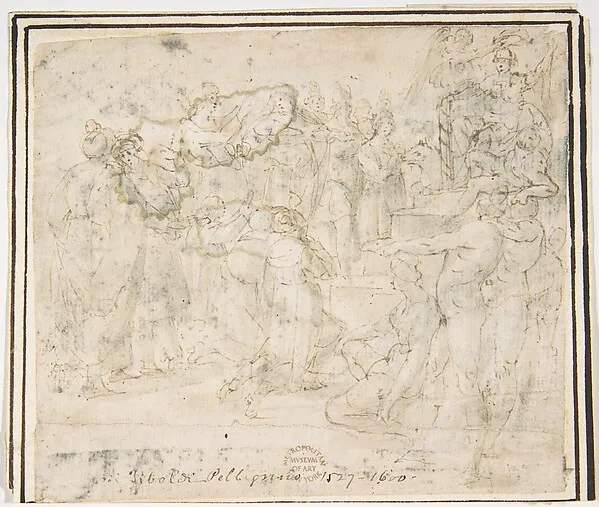
2 Chronicles 3:1-2The Place: Mount Moriah, the Mount of the Substitute
1Then Solomon began to build the house of the LORD at Jerusalem in mount Moriah, where the Lord appeared unto David his father, in the place that David had prepared in the threshingfloor of Ornan the Jebusite. 2And he began to build in the second day of the second month, in the fourth year of his reign.
A place-name is doing more work here than any measurement in the chapter. Of all the hills in Israel, Moriah is the only one Scripture had ever named before - and it had named it once, in a story no Israelite could forget. This is where Abraham was sent to offer Isaac, thine only son Isaac, whom thou lovest (Gen. 22:2); where he bound the boy, laid him on the wood, and stretched out his hand with the knife; and where the voice from heaven stopped him and showed him a ram caught in a thicket to die in his son's place.
Solomon begins with that mountain, and you are meant to feel the ground shift under the word. The house of the LORD is going up on the mount where a father once raised the knife and God provided the substitute.1
The verse keeps layering memory. It is not only Moriah; it is also the place that David had prepared in the threshingfloor of Ornan the Jebusite - and that, too, is a story about sacrifice answering judgment. When David sinned in numbering the people, a destroying angel stood over Jerusalem with a drawn sword, and the plague was stayed only when David bought this threshingfloor, built an altar, and offered burnt offerings upon it (1 Chr. 21).
On the very ground where the angel of death was halted by an offering, Solomon now builds. Notice too the quiet word prepared. Solomon is the heir: David bought the site, marked the altar, gathered the materials, and was told This is the house of the LORD God (1 Chr. 22:1). The son builds what the father prepared - on ground already sanctified twice over by sacrifice.
2 Chronicles 3:3-5The Porch and the Greater House, Overlaid with Gold
3Now these are the things wherein Solomon was instructed for the building of the house of God. The length by cubits after the first measure was threescore cubits, and the breadth twenty cubits. 4And the porch that was in the front of the house, the length of it was according to the breadth of the house, twenty cubits, and the height was an hundred and twenty: and he overlaid it within with pure gold. 5And the greater house he cieled with fir tree, which he overlaid with fine gold, and set thereon palm trees and chains.
Notice the careful, almost legal word the section leans on: Solomon was instructed. He is following a pattern that came to David - David had given him the plans by the spirit… the pattern of all that he had by the spirit (1 Chr. 28:12), and had told him, All this… the LORD made me understand in writing by his hand upon me (1 Chr. 28:19). The dimensions that follow are received from God, Solomon's preferences set aside.
The house is holy because it is built to the measure God gave. Reverence here is obedience to a pattern handed down.
2 Chronicles 3:6-9The Most Holy House and the Gold of Parvaim
6And he garnished the house with precious stones for beauty: and the gold was gold of Parvaim. 7He overlaid also the house, the beams, the posts, and the walls thereof, and the doors thereof, with gold; and graved cherubims on the walls. 8And he made the most holy house, the length whereof was according to the breadth of the house, twenty cubits, and the breadth thereof twenty cubits: and he overlaid it with fine gold, amounting to six hundred talents. 9And the weight of the nails was fifty shekels of gold. And he overlaid the upper chambers with gold.
And then the gold. It is almost relentless: the porch overlaid within with pure gold, the greater house with fine gold, the beams and posts and walls and doors all with gold, the most holy house with fine gold, amounting to six hundred talents, the very nails weighing fifty shekels of gold, the upper chambers gold. The Chronicler even tells us the source - the gold was gold of Parvaim, a far-off place famed for the finest metal, as if the ordinary gold of the land were not enough.1 What is all of it for?
Gold is the one material that does not rust, does not corrupt, does not tarnish - the nearest thing the ancient world had to permanence and purity made visible. To wrap a room in gold is to say, in the only language stone and metal can speak, that what happens here is unlike everything outside; that this is set apart, incorruptible, belonging to another order entirely. The deeper you walk into the house, the more the gold takes over, until the most holy place is nothing but light.
There is a deliberate architecture of nearness in these verses, and it is easy to miss under the numbers. The house moves inward by degrees - the porch, then the greater house (the holy place), then the most holy house at the center - and the closer a space lies to the room of God's presence, the more it is covered in gold and the more restricted its access. This is a map of holiness drawn in walls and thresholds, teaching that the presence of God is not common and not approached however one pleases.
Each step inward is a step into greater glory and greater carefulness. Walk it slowly and you feel the lesson before a word is spoken: to draw near to God is the most serious thing a human being can do, and nearness is a gift granted by degrees, not seized at will.
2 Chronicles 3:10-14The Cherubim and the Vail
10And in the most holy house he made two cherubims of image work, and overlaid them with gold. 11And the wings of the cherubims were twenty cubits long: one wing of the one cherub was five cubits, reaching to the wall of the house: and the other wing was likewise five cubits, reaching to the wing of the other cherub. 12And one wing of the other cherub was five cubits, reaching to the wall of the house: and the other wing was five cubits also, joining to the wing of the other cherub. 13The wings of these cherubims spread themselves forth twenty cubits: and they stood on their feet, and their faces were inward. 14And he made the vail of blue, and purple, and crimson, and fine linen, and wrought cherubims thereon.
Two great figures fill the most holy place - two cherubims of image work, overlaid in gold, their wings stretching the full twenty-cubit breadth of the room, wingtip touching wall on either side and meeting in the middle. The winged, composite guardian-creatures of the ancient Near East are the right picture - not the soft, infant figures of later art.2 In Scripture cherubim are awesome, formidable beings bound up with the holiness and the throne of God: they are set at the east of the garden of Eden… and a flaming sword to guard the way to the tree of life (Gen. 3:24); they overshadow the mercy seat on the ark; the LORD is enthroned between the cherubims (Ps. 80:1).
Their presence here, wings spread over the innermost room, marks this as the place of God's throne on earth. And their posture in verse 13 is striking - they stood on their feet, and their faces were inward, turned entirely toward the center, toward the place of the presence. Even the mightiest beings in the house are oriented entirely Godward.
It is worth holding together the two places Scripture sets cherubim, because the pairing tells a story. At the gate of Eden, cherubim guarded the way back to the tree of life - their wings and the flaming sword said no entrance, the way to life closed by sin. Here in the most holy house, cherubim again stand at the place of God's presence - but now their wings spread over the room where, once a year, blood would be carried in.
The same figures that once barred the way now overshadow the place where the way is reopened by sacrifice. The cherubim are a reminder written in gold that humanity was shut out of God's immediate presence, and that any return would have to be made on God's terms, through an appointed and costly way. The whole inner room holds that tension: the presence is here, and the presence is guarded.
And across the entrance to that room hangs the vail - a heavy woven barrier of blue, and purple, and crimson, and fine linen, and wrought cherubims thereon. Blue, purple, and crimson are the colors of heaven and royalty and blood, the costliest dyes of the ancient world, the palette of a king's house. And woven into the very fabric are cherubim - the guardian figures carried right into the threads of the curtain, so that the vail itself stands as a sentry.
Its message is unmistakable. Beyond this point lies the presence of God, and it is shut. The most holy place had no window and no second door; this curtain was the only way in, and it stayed closed. Only the high priest passed it, and only once a year, on the Day of Atonement, and never without blood (Heb. 9:7). The vail was mercy and barrier at once: it shielded a sinful people from a holiness they could not survive uninvited, and it announced, every day it hung there, that the way into the presence was not yet open.
2 Chronicles 3:15-17The Two Pillars: Jachin and Boaz
15Also he made before the house two pillars of thirty and five cubits high, and the chapiter that was on the top of each of them was five cubits. 16And he made chains, as in the oracle, and put them on the heads of the pillars; and made an hundred pomegranates, and put them on the chains. 17And he reared up the pillars before the temple, one on the right hand, and the other on the left; and called the name of that on the right hand Jachin, and the name of that on the left Boaz.
The chapter ends at the threshold, with two pillars reared up before the house - freestanding columns, towering, crowned with elaborate capitals (chapiters), wreathed with chains and a hundred pomegranates. They hold up no roof; structurally they carry nothing. Their purpose is to be seen and to mean something. They stand at the entrance like two great witnesses flanking the door, the first thing anyone approaching the house would pass between. And the most important fact about them is the last thing the chapter records: they were not merely built, they were named. To give a pillar a name is to make it speak.
These two columns were set there to declare a truth over everyone who came to worship - a truth caught in the two names themselves.
The pillar on the right hand was called Jachin - from a Hebrew root meaning “he shall establish,” “he will make firm.” It is the same kind of word God used in His promise to David: I will establish his kingdom… I will stablish the throne of his kingdom for ever (1 Chr. 17:11-12). The name is a confession: God establishes. The house stands, the kingdom stands, the covenant stands, because the LORD makes them firm. To pass this pillar on the way in was to be reminded that everything here rests on a foundation God Himself secures.
The pillar on the left hand was called Boaz - understood to carry the sense “in him is strength.” Where Jachin spoke of God establishing, Boaz spoke of the strength by which He does it. Together the two names form a single sentence over the doorway: he shall establish - in him is strength. The worshipper walked in between them as between two declarations of who holds the house up. There is a quiet wisdom in the placement.
Before a person ever reaches the gold, the cherubim, the vail, the two pillars have already told them where stability and power are found: in the God whose house it is, the One who built what is in it and placed the king who raised the walls.
Research trail
Sources & further study
These references support the historical, linguistic, manuscript, and contextual notes in this chapter. Scripture remains the primary text; external sources are provided so readers can inspect the research directly.
- 2 Chronicles 3 - Translators' NotesThe NET Bible's detailed footnotes on 2 Chronicles 3 - the identification of Mount Moriah and the threshingfloor of Ornan in verse 1, the textual questions around the porch's great height, the gold of Parvaim, and the disputed height of the two pillars in verse 15.
- Winged sphinx (cherub) ivory · Nimrud, ancient Near EastA carved ivory of a winged composite creature from the world of the Israelite kingdoms - the same iconography behind the “cherubims of image work” overlaid with gold in the most holy place (vv. 10-13) and the cherubim woven into the vail (v. 14), guardian-figures marking the boundary of the sacred.
- 2 Chronicles 3 · Hebrew + classical Jewish commentaryThe Hebrew text of 2 Chronicles 3 with Rashi, Radak, and other classical commentators side by side - useful for the place-name Moriyyah in verse 1, for the “most holy house” (qodesh haqodashim), and for the long discussion of the two named pillars Jachin and Boaz in verses 15-17.
- 2 Chronicles 3 ↔ Genesis 22 · Matthew 27 · Hebrews 10 · John 2Traces the threads tying Mount Moriah (v. 1) back to Abraham's offering and In the mount of the LORD it shall be seen (Gen. 22:14), and the woven vail (v. 14) forward to the curtain torn at the cross (Matt. 27:51) and the new and living way… through the vail, that is to say, his flesh (Heb. 10:20).
Where this echoes in Scripture
The Place: Mount Moriah, the Mount of the Substitute
- Genesis 22:14And Abraham called the name of that place Jehovahjireh: as it is said to this day, In the mount of the LORD it shall be seen.The mountain's older name - where God provided the ram for Isaac, the ground the temple of sacrifice would later stand on.
- 1 Chronicles 21:26And David built there an altar unto the LORD… and the LORD… answered him from heaven by fire upon the altar.The threshingfloor of Ornan - where David's offering stayed the destroying angel and the temple site was bought.
- John 1:29Behold the Lamb of God, which taketh away the sin of the world.The Lamb God promised to provide on Moriah - the offering every sacrifice carried to this house pointed toward.
- 1 Chronicles 22:1Then David said, This is the house of the LORD God, and this is the altar of the burnt offering for Israel.The place David “prepared” - the site named and set apart before Solomon laid a single stone.
The Most Holy House and the Gold of Parvaim
- 1 Chronicles 28:19All this, said David, the LORD made me understand in writing by his hand upon me, even all the works of this pattern.The pattern Solomon was “instructed” to follow - the house built to a measure received, not invented.
- 1 Kings 6:20And the oracle in the forepart was twenty cubits in length, and twenty cubits in breadth, and twenty cubits in the height… and overlaid it with pure gold.The parallel account - the most holy place as a perfect gold-covered cube.
- Haggai 2:9The glory of this latter house shall be greater than of the former, saith the LORD of hosts.The gold of the first house pointed beyond itself - a greater glory was promised to come.
- 1 Peter 1:18-19Ye were not redeemed with corruptible things, as silver and gold… but with the precious blood of Christ.Even gold is “corruptible” beside the offering that gives the true house its glory.
The Cherubim and the Vail
- Matthew 27:51And, behold, the vail of the temple was rent in twain from the top to the bottom.The very curtain of verse 14, torn at the death of Christ - the barrier into the presence finished from heaven's side.
- Hebrews 10:19-20Having therefore, brethren, boldness to enter into the holiest by the blood of Jesus… through the vail, that is to say, his flesh.The vail interpreted - His flesh the new and living way through which the holiest is opened to all.
- Genesis 3:24He placed at the east of the garden of Eden Cherubims, and a flaming sword… to keep the way of the tree of life.The cherubim that first guarded the way to life - the same figures now overshadowing the place where the way reopens.
- Hebrews 9:7But into the second went the high priest alone once every year, not without blood.How rationed access was behind the vail - one man, one day, never without blood - until the curtain was torn.
The Two Pillars: Jachin and Boaz
- 1 Chronicles 17:12He shall build me an house, and I will stablish his throne for ever.The promise behind Jachin - God establishing the throne, a word reaching past Solomon to the everlasting Son.
- Luke 1:32-33The Lord God shall give unto him the throne of his father David… and of his kingdom there shall be no end.The throne “established for ever” given at last to the Son of David whose kingdom never ends.
- Philippians 4:13I can do all things through Christ which strengtheneth me.Boaz fulfilled - the strength found in Him, placed at our disposal.
- Hebrews 1:3Who being the brightness of his glory… and upholding all things by the word of his power.Boaz answered - the Son in whom strength lies, holding all things up.
- Revelation 3:12Him that overcometh will I make a pillar in the temple of my God, and he shall go no more out.The pillars before the house pointing forward - God's people themselves made firm pillars in His temple.