
Acts 24
People in this chapter
A hired orator named Tertullus opens with flattery for the governor, then calls Paul a plague, a ringleader, a man who tried to profane the temple. Paul answers with no soft word for the judge. He has broken no law. He worships the God of his fathers in the very way his accusers call heresy, and he keeps a conscience clear before God and men. The man in chains is the calmest person in the room.1
Tap any highlighted phrase to jump to the commentary that unpacks it.
Acts 24:1-4Tertullus the Orator
1And after five days Ananias the high priest descended with the elders, and with a certain orator named Tertullus, who informed the governor against Paul. 2And when he was called forth, Tertullus began to accuse him, saying, Seeing that by thee we enjoy great quietness, and that very worthy deeds are done unto this nation by thy providence, 3We accept it always, and in all places, most noble Felix, with all thankfulness. 4Notwithstanding, that I be not further tedious unto thee, I pray thee that thou wouldest hear us of thy clemency a few words.
Tertullus is a professional speaker hired to present the Jewish council's case to Felix. He is not a believer; he does not care about the real charge. He is skilled at making whatever case he is paid to make. His appearance here signals that the Jewish leaders are taking Paul seriously enough to employ costly rhetoric.
Notice where Tertullus begins - with Felix. He flatters the governor, tells him how well the province runs, how thankful the Jews are for his clemency. This is the classical orator's opening move: establish rapport with the judge before you make your case. It is cynical and effective.
Acts 24:5-9A Pestilent Fellow
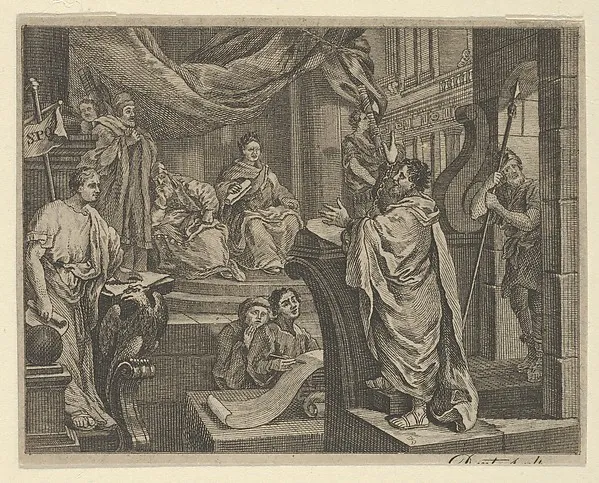
5For we have found this man a pestilent fellow, and a mover of sedition among all the Jews throughout the world, and a ringleader of the sect of the Nazarenes: 6Who also hath gone about to profane the temple: whom we took, and would have judged according to our law. 7But the chief captain Lysias came upon us, and with great violence took him away out of our hands, 8Commanding his accusers to come unto thee: by examining of whom thyself mayest take knowledge of all these things, whereof we accuse him. 9And the Jews also assented, saying that these things were so.
The three accusations are stacked: Paul is a troublemaker, he stirs up sedition among Jews everywhere, he leads the heretical sect of the Nazarenes. Tertullus uses words calculated to frighten a Roman governor. A man who causes unrest throughout the empire is a threat to Rome. The charge frames Paul as an agitator and a threat to order. The procurator Felix himself would have wielded considerable power over such matters1, and Caesarea2 was the seat of that authority.
Tertullus lets one detail slip that gives the game away. The council wanted Paul condemned under their own law, and Roman law stepped in. The commander Lysias stopped them. So now they stand before a Roman governor, asking him to finish what their own authority could not. The case is weaker than the eloquence makes it sound.
Acts 24:10-13Paul Answers for Himself
10Then Paul, after that the governor had beckoned unto him to speak, answered, Forasmuch as I know that thou hast been of many years a judge unto this nation, I do the more cheerfully answer for myself: 11Because that thou mayest understand, that there are yet but twelve days since I went up to Jerusalem for to worship. 12And they neither found me in the temple disputing with any man, neither raising up the people, neither in the synagogues, nor in the city: 13Neither can they prove the things whereof they now accuse me.
Paul begins where Tertullus began - with respect for the judge. But Paul's respect is genuine acknowledgment that Felix has years of experience discerning truth. Paul appeals to Felix's wisdom and judgment.
Acts 24:14-16After the Way Which They Call Heresy
14But this I confess unto thee, that after the way which they call heresy, so worship I the God of my fathers, believing all things which are written in the law and in the prophets: 15And have hope toward God, which they themselves also allow, that there shall be a resurrection of the dead, both of the just and unjust. 16And herein do I exercise myself, to have always a conscience void of offence toward God, and toward men.
This is one of the most striking moments in Acts. Paul takes the very word his enemies throw at him and wears it. They call it "heresy" - a strange sect, a dangerous deviation. Paul says yes, that is what I am, and then he redefines it. This Way worships the God of Abraham, Isaac, and Jacob. It believes everything the law and prophets say. It is Israel's own faith, now opened to see that Jesus is the One the prophets promised. The slur loses its sting the moment he owns it.
Paul exercises himself - he practices, he trains, he disciplines himself - to have a conscience void of offence. This is active work. A conscience void of offence is a commitment to live with awareness, to check yourself against your own measure of right and wrong, to keep your conscience clear before God and before the people around you.
Acts 24:17-21Hope of Resurrection
17Now after many years I came to bring alms to my nation, and offerings. 18Whereupon certain Jews from Asia found me purified in the temple, neither with multitude, nor with tumult. 19Who ought to have been here before thee, and object, if they had ought against me. 20Or else let these same here say, if they have found any evil doing in me, while I stood before the council, 21Except it be for this one voice, that I cried standing among them, Touching the resurrection of the dead I am called in question by you this day.
Paul brings the charge down to its real center: the resurrection of the dead. The Sadducees deny resurrection. Paul affirms it. This is what divides them, a theological disagreement. And for that, Paul is imprisoned.
Acts 24:22-25Felix Trembles
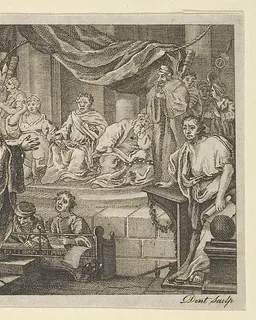
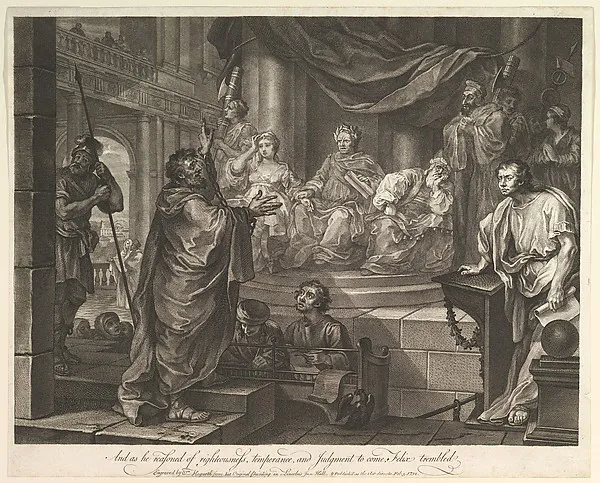
22And when Felix heard these things, having more perfect knowledge of that way, he deferred them, and said, When Lysias the chief captain shall come down, I will know the uttermost of your matter. 23And he commanded a centurion to keep Paul, and to let him have liberty, and that he should forbid none of his acquaintance to minister or come unto him. 24And after certain days, when Felix came with his wife Drusilla, which was a Jewess, he sent for Paul, and heard him concerning the faith in Christ. 25And as he reasoned of righteousness, temperance, and judgment to come, Felix trembled, and answered, Go thy way for this time; when I have a convenient season, I will call for thee.
Felix does not condemn Paul, but he does not release him either. He defers. This is the posture of a man who senses Paul is not guilty but is not willing to face the consequences of saying so. To release Paul would mean admitting that the Jewish council brought false charges. To condemn him would be unjust. So Felix does what the powerful often do: he delays.
Something shifts in this verse. Felix, with his wife Drusilla3, asks to hear about faith in Christ. This is two people, seemingly curious, wanting to hear Paul explain what he actually believes - no council, no formal proceeding. The private hearing becomes a moment of vulnerability.
Paul does not soften his message for a governor. He speaks of righteousness - right living, justice, moral order. He speaks of temperance - self-control, the mastery of passion and appetite. And he speaks of judgment to come, a day when all will be answered for. As Paul speaks, Felix trembles at his own conscience finally catching up with him. His wealth and his office do not exempt him. He is mortal. He will answer. And he is not ready.
If those three words landed on you just now, that flinch may be the kindest thing fear can do - turn you around while there is still time.
Acts 24:26-27Postponement and the Passing Years
26He hoped also that money should have been given him of Paul, that he might loose him: wherefore he sent for him the oftener, and communed with him. 27But after two years Porcius Festus came into Felix’ room: and Felix, willing to shew the Jews a pleasure, left Paul bound.
Felix calls Paul again and again, hoping for money - a bribe to release Paul. This is the posture of a man at war with himself. He is drawn to what Paul says. His conscience has been stirred. But he will not repent, will not renounce his power or his love of money, will not make the hard choices. So he postpones. He delays. He "communes" with Paul to feel the stirring of conscience without ever following it. How many of us do the same?
Two years pass. Paul remains in prison. Felix, newly aware that his soul is in question, cannot face it. When Festus arrives to replace him, Felix chooses the easier path: he leaves Paul in chains. To release him would mean admitting something to himself. To face Festus with a decision would mean stepping into the light. So he leaves the matter unresolved. He walks away from the question he trembled at.
The Free Man and the Bound Governor
Acts 24 ends with Paul in chains, but with liberty in his spirit. It ends with Felix free to go, but bound by his own fear and love of money. The irony is complete. The wrongfully imprisoned apostle is the truly free one. The governor with absolute power is the prisoner. Paul has been willing to lose everything - reputation, comfort, liberty - for the sake of Christ. Felix cannot even lose the hope of a bribe. What we are willing to lose is what we are free from. What we cannot bear to lose is what imprisons us.
Research trail
Sources & further study
These references support the historical, linguistic, manuscript, and contextual notes in this chapter. Scripture remains the primary text; external sources are provided so readers can inspect the research directly.
- Antonius FelixOpen-access SBL entry on the Roman procurator of Judaea whose portrait emerges through Josephus and Acts.
- CaesareaSBL guide to the coastal city and Herod's praetorium where Paul stood trial before Felix.
- DrusillaOpen-access entry on Felix's wife, daughter of Herod Agrippa I, who heard Paul speak at Caesarea.
Where this echoes in Scripture
Hope of Resurrection
- John 11:25I am the resurrection, and the life: he that believeth in me, though he were dead, yet shall he live.Jesus makes resurrection His own name, not just a future event Paul defends.
- 1 Corinthians 15:13-14If there be no resurrection of the dead, then is Christ not risen: And if Christ be not risen, then is our preaching vain.Paul stakes the entire gospel on the same hope he is jailed for here.
- Acts 23:6Of the hope and resurrection of the dead I am called in question.The day before, Paul named resurrection as the true charge against him.
- Daniel 12:2Many of them that sleep in the dust of the earth shall awake, some to everlasting life, and some to shame.The resurrection of just and unjust that Paul says Scripture already taught.
Felix Trembles
- John 5:22, 28-29The Father judgeth no man, but hath committed all judgment unto the Son... all that are in the graves shall hear his voice.The judgment to come that made Felix tremble is placed in the hands of the Son.
- 2 Corinthians 6:2Behold, now is the accepted time; behold, now is the day of salvation.The answer to Felix's “convenient season” - the open door is today, not someday.
- Hebrews 9:27It is appointed unto men once to die, but after this the judgment.Wealth and office did not exempt Felix from the reckoning he sensed coming.