Amos 6
People in this chapter
A second woe falls, and this time it does not land on the slave-traders or the killers next door. Woe to them that are at ease in Zion, and trust in the mountain of Samaria (v. 1). The target is the comfortable insider - the notable men on the fortified hills, pleased with themselves, sure nothing can reach them. Amos lingers over their luxury in slow motion: ivory beds, the choicest lambs, music improvised like David, wine drunk by the bowlful, the finest ointments.1
Tap any highlighted phrase to jump to the commentary that unpacks it.
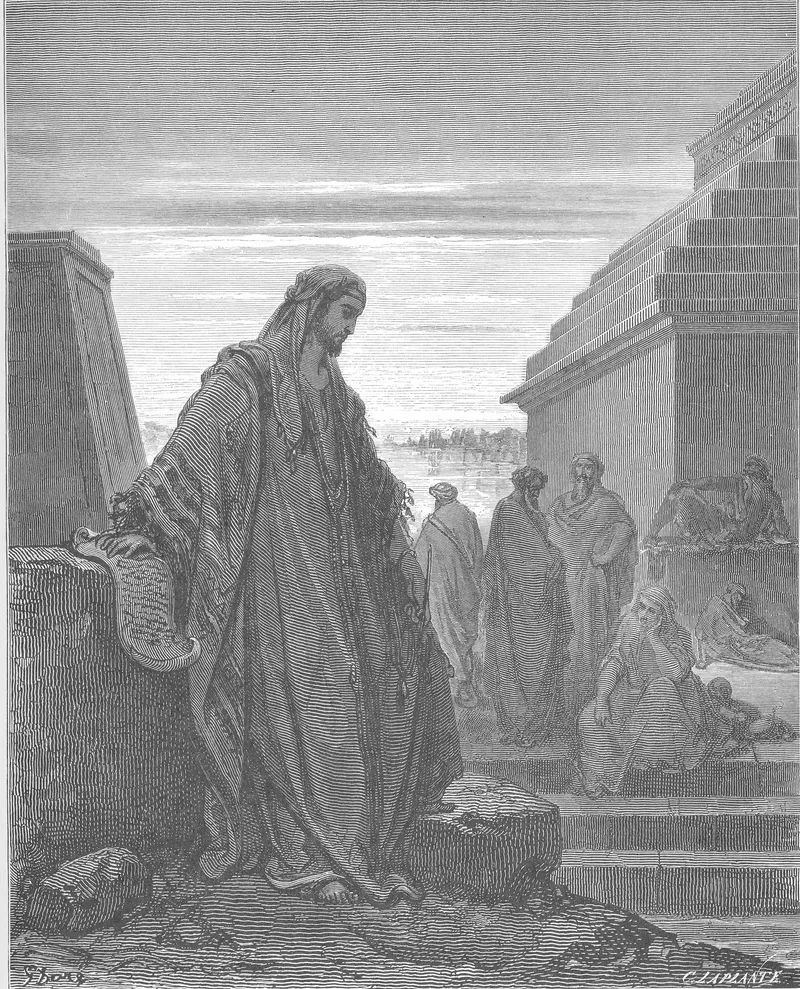
Amos 6:1-3Woe to Them That Are at Ease in Zion
1Woe to them that are at ease in Zion, and trust in the mountain of Samaria, which are named chief of the nations, to whom the house of Israel came! 2Pass ye unto Calneh, and see; and from thence go ye to Hamath the great: then go down to Gath of the Philistines: be they better than these kingdoms? or their border greater than your border? 3Ye that put far away the evil day, and cause the seat of violence to come near;
The woe lands with deliberate shock. After arraigning the brutal nations of the surrounding world - the slave-traders, the killers of the unborn - Amos turns the same word against the leaders of God's own people: Woe to them that are at ease in Zion, and trust in the mountain of Samaria (v. 1). Zion is the holy hill of Jerusalem; Samaria is the fortified capital of the northern kingdom. Together they name the security of those at the top - the notable men, the ones named chief of the nations, to whom ordinary people came for help and judgment.
They are the comfortable, the established, the self-assured. And their fault is doubled in a single line: they are at ease, and they trust in the mountain - that is, they rest their confidence in their fortifications, their status, their untroubled position, while the God whose name their city bears goes unheeded. The peril Amos exposes is the false sense of safety that luxury breeds. People perched on a strong hill come to believe the hill will hold; people surrounded by plenty come to believe nothing can touch them.
Misplaced trust is the quiet root of everything the chapter will go on to condemn.1
Then Amos sends the leaders on a tour they would rather not take. Pass ye unto Calneh… go ye to Hamath the great… go down to Gath of the Philistines: be they better than these kingdoms? or their border greater than your border? (v. 2). Calneh, Hamath, and Gath were cities of real standing - and every one of them had already fallen or been humbled. The question is sobering precisely because the answer is no. Israel is no larger, no stronger, no more deserving of permanence than the wreckage Amos is pointing at.
This is the lie the comfortable cling to hardest: it happened to them, but it cannot happen to us. You assume some invisible exemption, some merit that will hold the disaster back. Amos strips it away with a single gesture toward the ruins of cities that assumed the very same thing.
Now the inner mechanism gets named. To put far away the evil day (v. 3) is to push the thought of reckoning out of mind - to live as though the day of accounting will never arrive, or at least never arrive for you. It is not that they weighed the warning and rejected it. They simply refused to let it near, the way a person refuses to think about a debt coming due. And Amos draws the piercing connection: shoving the evil day away does not delay it - it causes the seat of violence to come near. By living as if no reckoning were coming, they fill the present with injustice and so hurry along the very judgment they will not look at.
The logic is terrible and exact. Refusing to face the consequences of your conduct does not cancel them; it only removes the one restraint that might have changed your course. Pushing the evil day out of sight is how the evil day is brought closer.
Amos 6:4-7Not Grieved for the Affliction of Joseph
4That lie upon beds of ivory, and stretch themselves upon their couches, and eat the lambs out of the flock, and the calves out of the midst of the stall; 5That chant to the sound of the viol, and invent to themselves instruments of musick, like David; 6That drink wine in bowls, and anoint themselves with the chief ointments: but they are not grieved for the affliction of Joseph. 7Therefore now shall they go captive with the first that go captive, and the banquet of them that stretched themselves shall be removed.
Amos now slows the camera and lingers over the luxury of the careless, detail by detail, until the picture is almost decadent in its fullness. They lie upon beds of ivory, and stretch themselves upon their couches (v. 4) - reclining not merely to rest but to sprawl, indolent and unbothered, on furniture inlaid with imported ivory. They eat the very best the flock and stall can offer, the tender lambs and fatted calves, the choicest meat.
They are connoisseurs of music too, idly improvising songs to the sound of the viol and inventing new instruments like David (v. 5) - a pointed comparison, since David made music for the worship of God while these men make it only for their own amusement. They drink wine in bowls (v. 6) - not measured cups but bowls, the language of excess - and finish by anointing themselves with the chief ointments, the finest and costliest perfumes.
Amos is painting, with patient care, a life so thoroughly cushioned, so devoted to its own sensual ease, that it has room for nothing beyond itself. Every appetite is indulged; every refinement is pursued. The portrait is complete - and then one clause shatters it.
The shattering clause comes at the end of verse 6: but they are not grieved for the affliction of Joseph. Here is the heart of the whole chapter. Joseph stands for the people of the northern kingdom - their own brothers, their own nation - who are suffering and on the brink of catastrophe. And the leaders feasting on ivory beds are not grieved. The Hebrew word means more than passing sadness; it means to be made sick, to be wounded inwardly.
They feel nothing. The affliction of their own people simply does not reach them through the cushion of their comfort. This is the precise sin Amos exposes - what the wealth has done to them. It has anaesthetized them. It has made them numb to suffering at their own door, deaf to a need they are perfectly positioned to relieve. A person can be surrounded by every refinement and have a heart that has gone cold; indeed, the refinements can be exactly what cools it.
The terrible thing is that they could feast through Joseph's affliction untroubled. Comfort had made them indifferent - and before God that indifference is itself the indictment.
The sentence answers the crime with bitter precision. They were first in luxury, foremost at every feast - therefore now shall they go captive with the first that go captive (v. 7), at the head of the column into exile. The leaders who reclined at the front of the banquet will lead the procession into chains, and the banquet of them that stretched themselves shall be removed. The revelry that defined them simply ends. There is a hard symmetry in prophetic judgment: the thing a person has made his idol becomes the very point of his loss.
Those who trusted their ease lose precisely their ease. A life built on sensual security has built on sand, and when the reckoning comes, what felt most solid is the first thing to vanish.
Amos 6:8-14I Abhor the Excellency of Jacob
8The Lord GOD hath sworn by himself, saith the LORD the God of hosts, I abhor the excellency of Jacob, and hate his palaces: therefore will I deliver up the city with all that is therein. 9And it shall come to pass, if there remain ten men in one house, that they shall die. 10And a man’s uncle shall take him up, and he that burneth him, to bring out the bones out of the house, and shall say unto him that is by the sides of the house, Is there yet any with thee? and he shall say, No. Then shall he say, Hold thy tongue: for we may not make mention of the name of the LORD. 11For, behold, the LORD commandeth, and he will smite the great house with breaches, and the little house with clefts.
The chapter rises now to its most solemn pitch - an oath sworn by God upon Himself: The Lord GOD hath sworn by himself, saith the LORD the God of hosts, I abhor the excellency of Jacob, and hate his palaces (v. 8). When God swears by himself, there is nothing greater by which to swear; the word is fixed and final. And what He swears is startling for its intensity: He abhors the very thing Israel is proudest of.
The excellency of Jacob is the nation's self-glory - her wealth, her grandeur, the swagger of her success - and the palaces are its monuments, the fine houses where the at-ease recline on ivory. God does not merely disapprove of these; He abhors and hates them. It is jarring, until we see why. This is the same pride that put far away the evil day, the same luxury that fed on the affliction of Joseph.
The grandeur God hates is grandeur built on indifference and injustice, glory that has displaced Him and crushed the neighbor. So the sentence follows: therefore will I deliver up the city with all that is therein. The fortified hill they trusted, the city they thought secure, will be handed over - all of it. What the nation exalted, God has resolved to bring down.
Amos sketches the aftermath in a scene of chilling quiet: if there remain ten men in one house, that they shall die (v. 9). A full household - ten men - will not survive. Then comes one of the eeriest pictures in the prophets: a relative comes to carry out the dead, to bring out the bones out of the house, and calls to whoever is left huddled by the sides of the house, Is there yet any with thee? The answer is a single bleak word: No. And then: Hold thy tongue: for we may not make mention of the name of the LORD (v. 10).
The hush at the end is the heart of it. In the wreckage, the survivors are afraid even to speak God's name - whether out of dread that any further notice from Him will bring more ruin, or out of a numbed despair that has stopped expecting anything from Him at all. Either way it is a terrible reversal. The people who once felt so secure that they never gave God a thought are reduced to a silence too frightened even to name Him.
And the LORD seals the picture: he will smite the great house with breaches, and the little house with clefts (v. 11). Great house and small alike are cracked open. The judgment does not sort by size; it reaches the mansion and the cottage together.
12Shall horses run upon the rock? will one plow there with oxen? for ye have turned judgment into gall, and the fruit of righteousness into hemlock: 13Ye which rejoice in a thing of nought, which say, Have we not taken to us horns by our own strength? 14But, behold, I will raise up against you a nation, O house of Israel, saith the LORD the God of hosts; and they shall afflict you from the entering in of Hemath unto the river of the wilderness.
Amos drives the absurdity of their conduct home with two questions every farmer knew the answer to: Shall horses run upon the rock? will one plow there with oxen? (v. 12). Of course not. No one gallops horses over bare cliffs or drives a plow team across solid stone; the ground will not bear it, and only ruin comes of trying. The questions expose how unnatural and self-defeating Israel's behavior is - for ye have turned judgment into gall, and the fruit of righteousness into hemlock. Here is the charge beneath all the luxury and pride: they have taken the two things meant to be sweet and life-giving in a society - judgment (justice) and righteousness - and turned them bitter and poisonous.
Gall and hemlock are bitter, toxic plants. Justice, which should nourish and protect, they have made into something that sickens; the fruit of righteousness, which should sustain the weak, they have made into poison. It is as perverse as plowing the sea or racing horses up a cliff - a flat reversal of how things are meant to work, and just as certain to end in disaster. The complacency Amos has exposed throughout is not harmless after all.
It has corrupted the very wellsprings of communal life, turning what should heal into what destroys.
The chapter ends where complacency always ends - in a confrontation with the God who is not impressed by it. But, behold, I will raise up against you a nation, O house of Israel, saith the LORD the God of hosts; and they shall afflict you from the entering in of Hemath unto the river of the wilderness (v. 14). The boast of verse 13 is answered point for point. They claimed to have taken their power by our own strength; God replies that He will raise up the nation that overturns it.
The two place names mark the full reach of the kingdom - from its northern border at the pass of Hamath to its southern edge at the desert stream - so the affliction will run the whole length of the land they were so proud to hold. There is no corner the judgment will not touch. And the title at the center is the key to it all: the LORD the God of hosts. The God of armies, of all the powers of heaven and earth, is the One who raises nations up and brings them down.
Against such a God, the swagger of our own strength is not merely wrong; it is pitiable. The complacent trusted their hill, their wealth, their muscle - and the One who commands the hosts of heaven has only to lift His hand and raise up a nation, and the whole proud structure comes down.
Research trail
Sources & further study
These references support the historical, linguistic, manuscript, and contextual notes in this chapter. Scripture remains the primary text; external sources are provided so readers can inspect the research directly.
- Amos 6 - Translators' NotesThe NET Bible's detailed footnotes on Amos 6 - the complacency of those at ease in verse 1, the difficult tour of cities in verse 2, the catalogue of luxury in verses 4-6, the grim funeral scene of verse 10, and the much-discussed proverb of horses on the rock in verse 12.
- Amos 6 · Hebrew + classical Jewish commentaryThe Hebrew text of Amos 6 with Rashi, Ibn Ezra, and other classical commentators side by side - useful for sha'anan (v. 1, the “at ease” that means careless, complacent security), for ge'on Ya'aqov (v. 8, “the excellency of Jacob”), and for the bitter wordplay of verse 12, where justice is turned to gall and righteousness to hemlock.
- Amos 6 ↔ Luke 12 & 16 · Romans 12 · Revelation 3Traces the threads tying Amos 6 to the rest of Scripture - the feasting that ignores the afflicted (vv. 4-6) read beside the rich man and Lazarus (Luke 16:19-25) and the rich fool who said take thine ease (Luke 12:19-20), and the boast of our own strength (v. 13) read beside the lukewarm who say I have need of nothing (Rev. 3:17).
Where this echoes in Scripture
Woe to Them That Are at Ease in Zion
- Isaiah 32:9-11Rise up, ye women that are at ease; hear my voice, ye careless daughters... ye that are at ease.The same complacency as verse 1 - a settled ease rebuked because it feels no danger.
- Luke 12:19-20Soul... take thine ease, eat, drink, and be merry. But God said unto him, Thou fool, this night thy soul shall be required of thee.The rich fool who put far away the evil day (v. 3) - and met it the very night he felt most secure.
- Zephaniah 1:12I will punish the men that are settled on their lees: that say in their heart, The LORD will not do good, neither will he do evil.The inner thought of the at-ease (v. 1) laid bare - the quiet assumption that God will neither act nor judge.
- Luke 12:35-36Let your loins be girded about, and your lights burning; ... that when he cometh and knocketh, they may open unto him immediately.The posture the at-ease (v. 3) have abandoned - awake, lamps lit, ready for the knock.
- Luke 12:40Be ye therefore ready also: for the Son of man cometh at an hour when ye think not.The answer to those who put far away the evil day (v. 3) - watchfulness where those at ease chose complacency.
- Proverbs 1:32the prosperity of fools shall destroy them.The danger the whole woe exposes - the very ease and prosperity of verses 1-3 becoming the instrument of ruin.
Not Grieved for the Affliction of Joseph
- Luke 16:19-25There was a certain rich man, which was clothed in purple and fine linen, and fared sumptuously every day: and there was a certain beggar named Lazarus, which was laid at his gate.A living portrait of verses 4-6 - the man who feasts untroubled above the affliction at his own gate.
- Romans 12:15Rejoice with them that do rejoice, and weep with them that weep.The opposite of being “not grieved for the affliction of Joseph” (v. 6) - a heart kept open to others' pain.
- 1 John 3:17whoso hath this world's good, and seeth his brother have need, and shutteth up his bowels of compassion from him, how dwelleth the love of God in him?The very failure of verse 6 named in the Gospel - comfort that shuts up compassion toward a brother in need.
- Ezekiel 16:49this was the iniquity of thy sister Sodom, pride, fulness of bread, and abundance of idleness... neither did she strengthen the hand of the poor and needy.The same indictment as verses 4-6 - fullness and ease that left the needy unhelped.
- James 5:5Ye have lived in pleasure on the earth, and been wanton; ye have nourished your hearts, as in a day of slaughter.The luxury of verses 4-6 echoed - self-indulgent feasting that fattens for a coming reckoning.
- Isaiah 53:3He is despised and rejected of men; a man of sorrows, and acquainted with grief.The contrast to the unmoved at-ease (v. 6) - the One who entered the affliction of His people and carried it as His own.
I Abhor the Excellency of Jacob
- Revelation 3:17thou sayest, I am rich, and increased with goods, and have need of nothing; and knowest not that thou art wretched, and miserable, and poor, and blind, and naked.The boast of verse 13 named in the Gospel - the self-confidence that mistakes emptiness for wealth.
- Proverbs 16:18Pride goeth before destruction, and an haughty spirit before a fall.The pattern of verses 8 and 13 - the excellency God abhors, and the fall that follows the boast.
- Deuteronomy 8:17-18thou say in thine heart, My power and the might of mine hand hath gotten me this wealth. But thou shalt remember the LORD thy God: for it is he that giveth thee power to get wealth.The exact boast of verse 13 forbidden - strength and wealth are received from God.
- John 15:5I am the vine, ye are the branches... for without me ye can do nothing.The undoing of “our own strength” (v. 13) - every real power is received.
- 1 Corinthians 4:7For who maketh thee to differ from another? and what hast thou that thou didst not receive?The boast of verse 13 answered with a question - everything claimed as “our own” was first received.
- Galatians 6:7Be not deceived; God is not mocked: for whatsoever a man soweth, that shall he also reap.The certainty behind verse 14 - the self-assured reaping comes due however far the evil day is pushed off.
- Amos 5:24But let judgment run down as waters, and righteousness as a mighty stream.The reverse of verse 12 - the justice and righteousness they turned to poison, as God meant them to flow.