Joshua 10
People in this chapter
Joshua 10 opens with five Amorite kings - Adoni-zedek of Jerusalem, plus the kings of Hebron, Jarmuth, Lachish1, and Eglon - joining forces against Gibeon because Gibeon made peace with Joshua. They are terrified. Gibeon is a great city, a royal city, and its men are mighty. If Gibeon allies with Israel, the southern highlands will crumble under Israelite control. They attack to break the alliance.
Tap any highlighted phrase to jump to the commentary that unpacks it.
Joshua 10:1-5Five Kings Afraid
1Now it came to pass, when Adonizedec king of Jerusalem had heard how Joshua had taken Ai, and had utterly destroyed it; as he had done to Jericho and her king, so he had done to Ai and her king; and how the inhabitants of Gibeon had made peace with Israel, and were among them; 2That they feared greatly, because Gibeon was a great city, as one of the royal cities, and because it was greater than Ai, and all the men thereof were mighty.
Gibeon made peace with Joshua without consulting the other city-states. That decision - rational, self-preserving, and motivated by fear of Israel - breaks the southern alliance's unity. Adoni-zedek sees a crack: if Gibeon stands with Israel, the whole highland network of five kings is surrounded.
3Wherefore Adonizedec king of Jerusalem sent unto Hoham king of Hebron, and unto Piram king of Jarmuth, and unto Japhia king of Lachish, and unto Debir king of Eglon, saying, 4Come up unto me, and help me, that we may smite Gibeon: for it hath made peace with Joshua and with the children of Israel. 5Therefore the five kings of the Amorites, the king of Jerusalem, the king of Hebron, the king of Jarmuth, the king of Lachish, the king of Eglon, gathered themselves together, and went up, they and all their hosts, and encamped before Gibeon, and made war against it.
Five kings moving as one. This is the largest unified resistance to Israel so far. The Amorites understand that divided, they fall; together, they might withstand the Hebrew advance. It is a rational calculation - and it will not matter. Fear of Israel is driving their military strategy, but they have no concept of who they are actually fighting against.
Joshua 10:6-10All Night, No Fear
6And the men of Gibeon sent unto Joshua to the camp to Gilgal, saying, Slack not thy hand from thy servants; come up to us quickly, and save us, and help us: for all the kings of the Amorites that dwell in the mountains are gathered together against us.
Gibeon made a covenant with Israel; now it calls Israel to honor it. There is no ambiguity in the cry: “Slack not thy hand.” Don't stop. Don't hesitate. Come quickly. The plea is to a God-sworn obligation - and Joshua hears it as such.
7So Joshua ascended from Gilgal, he, and all the people of war with him, and all the mighty men of valour. 8And the LORD said unto Joshua, Fear them not: for I have delivered them into thine hand; there shall not a man of them stand before thee.
Joshua does not hesitate. He marches. And before the battle even begins, the Lord speaks to him in the night: "Fear them not." The outcome is already settled. Israel will not face an ambiguous battle; Israel will face a delivered enemy. Joshua's only call is to show up and trust.
9Joshua therefore came unto them suddenly, and went up from Gilgal all night. 10And the LORD discomfited them before Israel, and slew them with a great slaughter at Gibeon, and chased them along the way that goeth up to Bethhoron, and smote them to Azekah, and unto Makkedah.
The Hebrew word here is hamam - to put in disorder, to terrify. The Lord does not give Joshua victory by military cleverness; He breaks the enemy's cohesion. Fear ripples through their ranks. Where moments before five kings moved as one, now panic scatters them. God is not interested in a close fight.
Joshua 10:11God's Hailstones
11And it came to pass, as they fled from before Israel, and were in the going down to Bethhoron, that the LORD cast down great stones from heaven upon them unto Azekah, and they died: they were more which died with hailstones than they whom the children of Israel slew with the sword.
This detail cuts to the heart of the chapter's message. More enemies die from hailstones than from the sword. The battle is God's. Israel is the instrument He wields. When you read "the Lord fought for Israel," this is what that means: the outcome depends on His power, not on military skill.
Joshua 10:12-14The Sun Stands Still
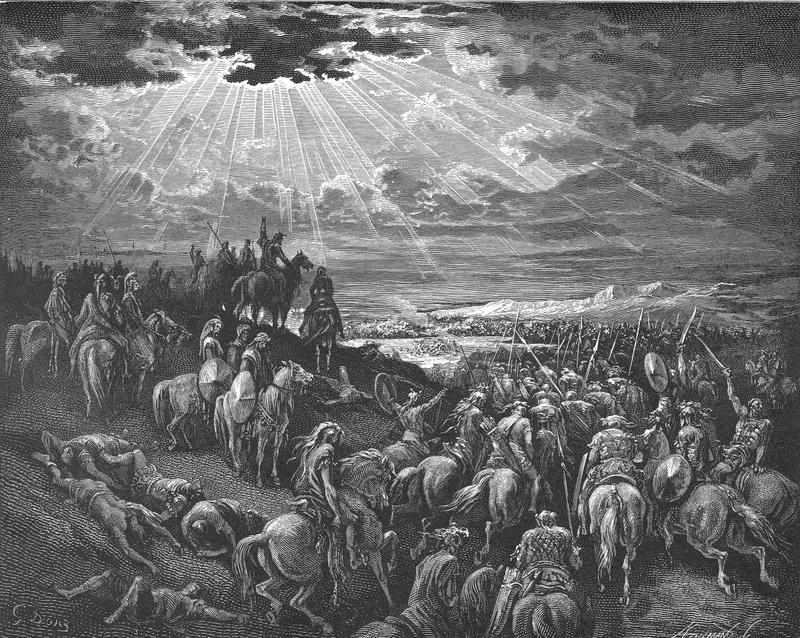
12Then spake Joshua to the LORD in the day when the LORD delivered up the Amorites before the children of Israel, and he said in the sight of Israel, Sun, stand thou still upon Gibeon; and thou, Moon, in the valley of Ajalon.
Joshua is commanding the sun and the moon - as instruments of God - to obey. The text says he "sang" this, or spoke it aloud "in the sight of all Israel." It is a public act. He speaks the command as if the heavens themselves are part of the Lord's army.
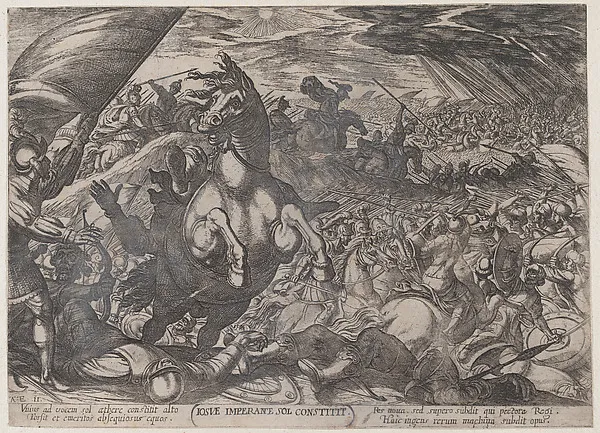
13And the sun stood still, and the moon stayed, until the people had avenged themselves upon their enemies. Is not this written in the book of Jasher? So the sun stood still in the midst of heaven, and hasted not to go down about a whole day.
The text does not explain the mechanism. It simply states the fact: the day lasted about a whole day longer than normal. Skeptics have struggled with this verse for centuries. Ancient pagan explanations. Astronomical theories. But the text is straightforward: God extended the day for the battle. Whether by a slowing of rotation, a bending of light, or means we have no name for, the work was accomplished. What matters is that He did it because a man asked.
14And there was no day like that before it or after it, that the LORD hearkened unto the voice of a man: for the LORD fought for Israel.
This verse is the keystone of the whole chapter. "The Lord hearkened unto the voice of a man." God listened to Joshua's prayer with cosmic consequences. The sun and moon obeyed. Creation bent to the word of a faithful man who spoke in faith. There has been no day before or after like it - a moment when the prayer of one man moved the heavens.
Joshua 10:15-27Feet on Enemies' Necks
15And Joshua returned, and all Israel with him, unto the camp to Gilgal.
16But these five kings fled, and hid themselves in a cave at Makkedah. 17And it was told Joshua, saying, The five kings are found hid in a cave at Makkedah. 18And Joshua said, Roll great stones upon the mouth of the cave, and set men by it for to keep them: 19And stay ye not, but pursue after your enemies, and smite the hindmost of them; suffer them not to enter into their cities: for the LORD your God hath delivered them into your hand.
The five kings, in their terror, flee and hide in a cave like frightened children. Joshua leaves a watch on the cave and tells his army to continue pursuing the rest of the enemy army. The kings will wait. The battle is not over until the whole enemy force is scattered.
20And it came to pass, when Joshua and the children of Israel had made an end of slaying them with a very great slaughter, till they were consumed, that the rest which remained of them entered into fenced cities. 21And all the people returned to the camp to Joshua at Makkedah in peace: none moved his tongue against any of the children of Israel.
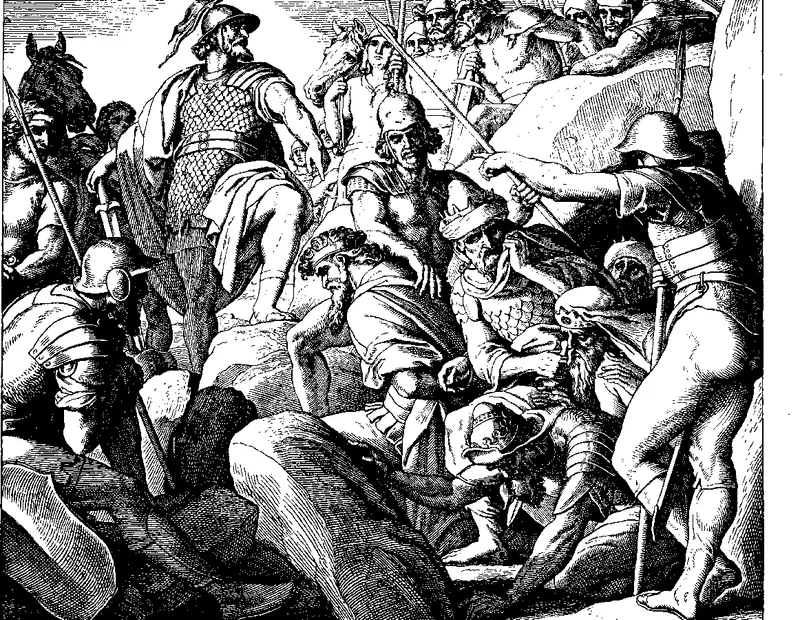
22Then said Joshua, Open the mouth of the cave, and bring out those five kings unto me out of the cave. 23And they did so, and brought forth those five kings unto him out of the cave, the king of Jerusalem, the king of Hebron, the king of Jarmuth, the king of Lachish, and the king of Eglon. 24And it came to pass, when they brought out those kings unto Joshua, that Joshua called for all the men of Israel, and said unto the captains of the men of war which went with him, Come near, put your feet upon the necks of these kings. And they came near, and put their feet upon the necks of them.
This is ritual, deliberate and public. In the ancient world, putting your foot on an enemy's neck is the ultimate symbol of vassalage - the conquered king is completely subject, completely stripped of dignity. Joshua commands the captains of Israel to do this publicly. Every soldier sees it. The five kings who united to resist Israel are now beneath the feet of Israel's warriors.
25And Joshua said unto them, Fear not, nor be dismayed, be strong and of good courage: for thus shall the LORD do to all your enemies against whom ye fight. 26And afterward Joshua smote them, and slew them, and hanged them on five trees: and they were hanging upon the trees until the evening. 27And it came to pass at the time of the going down of the sun, that Joshua commanded, and they took them down off the trees, and cast them into the cave wherein they had been hid, and laid great stones in the cave’s mouth, which remain until this very day.
Joshua speaks the promise aloud to all the soldiers. "Thus shall the Lord do to all your enemies." This is not arrogance; it is assurance from the Lord. And then the kings are hanged on trees. That evening, before sunset, they are taken down - a gesture of respect for the dead that aligns with Deuteronomy 21:23. Even in judgment, the law is honored. The bodies are cast into the cave, sealed with great stones. The cave becomes their tomb - the hiding place becomes their grave.
Joshua 10:28-43From Makkedah to Gaza
28And that day Joshua took Makkedah, and smote it with the edge of the sword, and the king thereof he utterly destroyed, them, and all the souls that were therein; he let none remain: and he did to the king of Makkedah as he did unto the king of Jericho.
29Then Joshua passed from Makkedah, and all Israel with him, unto Libnah, and fought against Libnah: 30And the LORD delivered it also, and the king thereof, into the hand of Israel; and he smote it with the edge of the sword, and all the souls that were therein; he let none remain in it; but did unto the king thereof as he did unto the king of Jericho.
31And Joshua passed from Libnah, and all Israel with him, unto Lachish, and encamped against it, and fought against it: 32And the LORD delivered Lachish into the hand of Israel, which took it on the second day, and smote it with the edge of the sword, and all the souls that were therein, according to all that he had done to Libnah. 33Then Horam king of Gezer came up to help Lachish; and Joshua smote him and his people, until he had left him none remaining.
34And from Lachish Joshua passed unto Eglon, and all Israel with him; and they encamped against it, and fought against it: 35And they took it on that day, and smote it with the edge of the sword, and all the souls that were therein he utterly destroyed that day, according to all that he had done to Lachish.
36And Joshua went up from Eglon, and all Israel with him, unto Hebron; and they fought against it: 37And they took it, and smote it with the edge of the sword, and the king thereof, and all the cities thereof, and all the souls that were therein; he left none remaining, according to all that he had done to Eglon; but destroyed it utterly, and all the souls that were therein.
38And Joshua returned, and all Israel with him, to Debir; and fought against it: 39And he took it, and the king thereof, and all the cities thereof; and they smote them with the edge of the sword, and utterly destroyed all the souls that were therein; he left none remaining: as he had done to Hebron, so he did to Debir, and to the king thereof; as he had done also to Libnah, and to her king.
The narrative marches forward with relentless pace. Makkedah, Libnah, Lachish, Eglon, Hebron, Debir - each city falls in turn. Each king is captured or killed. Each city is "utterly destroyed." The phrase "the Lord delivered it" repeats like a refrain. Israel is not conquering by cleverness or military might. Each city falls because the Lord gives it into Israel's hand. The rhythm of the conquest is the rhythm of obedience meeting God's promise.
40So Joshua smote all the country of the hills, and of the south, and of the vale, and of the springs, and all their kings: he left none remaining, but utterly destroyed all that breathed, as the LORD God of Israel commanded.
The conquest follows the pattern laid out in Joshua 1. The Lord commanded it; Joshua does it. The language "all that breathed" is absolute, total. There is no negotiation, no parley, no mercy except as the Lord commands (as with Rahab in Jericho, or the Gibeonites). This is the ancient world's complete military victory - the total elimination of rival power.
41And Joshua smote them from Kadeshbarnea even unto Gaza, and all the country of Goshen, even unto Gibeon. 42And all these kings and their land did Joshua take at one time, because the LORD God of Israel fought for Israel.
The summary is surgical. From south to north, from Kadesh-barnea to Gaza, the entire southern region falls "at one time." One moment of decision, one night march, one prayer, one day of battle - and a whole kingdom is subdued. It happens because "the Lord God of Israel fought for Israel." That sentence is the whole theology of the chapter.
43And Joshua returned, and all Israel with him, unto the camp to Gilgal.
Joshua returns to Gilgal, the place where he began. The conquest of the south is complete. And the next phase of the campaign will begin from the same base. But what has changed is everything: the southern highlands are Israel's. The promise is being kept.
Research trail
Sources & further study
These references support the historical, linguistic, manuscript, and contextual notes in this chapter. Scripture remains the primary text; external sources are provided so readers can inspect the research directly.
- Lachish and the Southern Cities ConquestArchaeological evidence of Lachish and other southern Canaanite cities conquered during Joshua's southern campaign.
- All Enemies Under Feet (Joshua to Paul)The pattern of conquest and subjection that flows from Joshua through Psalms and into Paul's epistles, culminating in Christ's final victory.