Joshua 22
People in this chapter
Joshua 22 is a story about the power of physical memory and the fragility of unity across separation. After years of conquest, Joshua releases the eastern tribes - Reuben, Gad, and half of Manasseh - to return to their lands east of the Jordan. But before they depart, Joshua reinforces one crucial command: do not forget the Lord your God.
Tap any highlighted phrase to jump to the commentary that unpacks it.
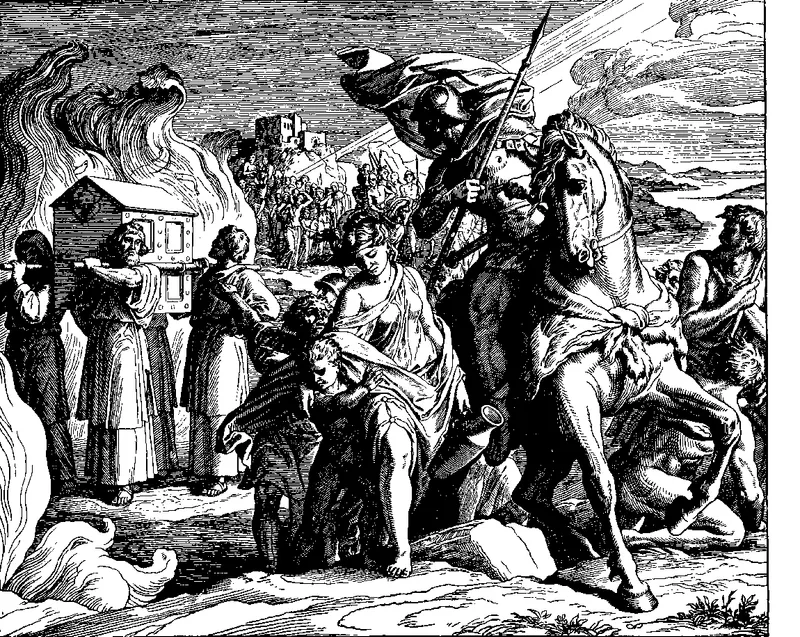
Joshua 22:1-8The Eastern Tribes Blessed and Sent Home
1Then Joshua called the Reubenites, and the Gadites, and the half tribe of Manasseh, 2And said unto them, Ye have kept all that Moses the servant of the LORD commanded you, and have obeyed my voice in all that I commanded you:
Joshua opens with affirmation. The eastern tribes have been faithful - they fought beside the western tribes for years without complaint or divided loyalty. This praise is not ceremonial; it is earned. Joshua is not releasing them as second-class partners; he is honoring their covenant-keeping. The word "kept" (Hebrew shamar) will echo through the chapter1.
The eastern tribes have kept the mishmereth - the charge, the responsibility, the guarding - of God's commandment. This was the same word used in Genesis 2:15 when Adam was told to "keep" the garden. Responsibility and faithfulness are woven together. That this fidelity is what Joshua emphasizes first will matter enormously when the misunderstanding unfolds2.
3Ye have not left your brethren these many days unto this day, but have kept the charge of the commandment of the LORD your God. 6So Joshua blessed them, and sent them away: and they went unto their tents.
Joshua 22:4-9The Promise of Rest and the Jordan Boundary
4And now the LORD your God hath given rest unto your brethren, as he promised them: therefore now return ye, and get you unto your tents, and unto the land of your possession, which Moses the servant of the LORD gave you on the other side Jordan.
Before releasing them, Joshua gives them a final charge: a covenant reminder. He echoes Moses, echoes Deuteronomy, echoes the Shema. The pattern is love, walk, keep, cleave, serve - concentric circles of devotion. Joshua knows that the Jordan is about to become a physical dividing line. He is trying to ensure it does not become a spiritual one.
8And he spake unto them, saying, Return with much riches unto your tents, and with very much cattle, with silver, and with gold, and with brass, and with iron, and with very much raiment: divide the spoil of your enemies with your brethren. 9And the children of Reuben and the children of Gad and the half tribe of Manasseh returned, and departed from the children of Israel out of Shiloh, which is in the land of Canaan, to go unto the country of Gilead, to the land of their possession, whereof they were possessed, according to the word of the LORD by the hand of Moses.
The eastern tribes leave in abundance - gold, silver, cattle, raiment, an affirmation of their partnership. Joshua ensures that the whole congregation knows they depart blessed.
Joshua 22:10-14The Western Tribes' Alarm and Investigation
10And when they came unto the borders of Jordan, that are in the land of Canaan, the children of Reuben and the children of Gad and the half tribe of Manasseh built there an altar by Jordan, a great altar to see to.
The moment the eastern tribes reach the Jordan, they build an altar. It is intentionally prominent - "a great altar to see to." They want it visible, witnessed, remembered. Yet the same action that was meant to cement unity will nearly destroy it.
11And the children of Israel heard say, Behold, the children of Reuben and the children of Gad and the half tribe of Manasseh have built an altar over against the land of Canaan, in the borders of Jordan, at the passage of the children of Israel. 12And when the children of Israel heard of it, the whole congregation of the children of Israel gathered themselves together at Shiloh, to go up to war against them.
The news travels fast. "Built an altar over against the land of Canaan" - positioned as if in defiance, at the border. The narrative moves quickly from fact to fear. The phrase "the passage of the children of Israel" suggests a strategic location, feeding the interpretation that this is a challenge.
The western tribes assume the worst immediately. They do not ask; they gather for war. This is not malice - it is zealousness for God's law. In their memory is the sin at Peor, when a single tribe's idolatry brought plague on the entire nation. To them, the altar at Jordan looks like history about to repeat. The assumption is reasonable; the process will be the problem.
13And the children of Israel sent unto the children of Reuben, and to the children of Gad, and to the half tribe of Manasseh, into the land of Gilead, Phinehas the son of Eleazar the priest,
Before the war begins, something better happens. Phinehas is sent - the same priest who, in Numbers 25, stopped a plague by taking decisive action against idolatry. He is zealous for the Lord, but he is also wise. He brings one prince from each of the ten western tribes - a delegation representing the whole congregation, not just its anger.
Joshua 22:15-20"What Trespass Is This?"
15And they came unto the children of Reuben, and to the children of Gad, and to the half tribe of Manasseh, unto the land of Gilead, and they spake with them, saying,
Even in the accusation, the tone is almost mournful. "What trespass" - the word ma'al means to act treacherously, to betray a covenant. Phinehas speaks as if the heart has already broken. Yet he does not pronounce judgment; he asks the question and waits for the answer. The investigation is real, not a formality.
16Thus saith the whole congregation of the LORD, What trespass is this that ye have committed against the God of Israel, to turn away this day from following the LORD, in that ye have builded you an altar, that ye might rebel this day against the LORD?
Phinehas invokes Numbers 25 - the sin at Peor, where Israelite men engaged in idolatry with Moabite women, and God sent a plague that killed 24,000. That sin is still fresh in memory, still unhealed. "Are we not cleansed until this day" - the wound is ongoing. And now, to them, the altar looks like the wound opening again.
Joshua 22:21-29“Ed” - A Witness Between Us
21Then the children of Reuben and the children of Gad and the half tribe of Manasseh answered, and said unto the heads of the thousands of Israel, 22The LORD God of gods, the LORD God of gods, he knoweth, and Israel he shall know; if it be in rebellion, or if in transgression against the LORD, (save us not this day,)
The eastern tribes answer with an oath of terrible consequence. "The Lord God of gods, the Lord God of gods" - the repetition is emphatic, almost desperate. They invoke divine judgment on themselves if they are lying. The triple invocation echoes the Shema's insistence: the Lord is one, and He alone knows the heart. This is a covenant vow.
24And if we have not rather done it for fear of this thing, saying, In time to come your children might speak unto our children, saying, What have ye to do with the LORD God of Israel? 25For the LORD hath made Jordan a border between us and you, ye children of Reuben and children of Gad; ye have no part in the LORD: so shall your children make our children cease from fearing the LORD.
The eastern tribes reveal their true motive: preservation. They fear that in a generation or two, the Jordan will become more than a geographical boundary. It will become a spiritual boundary. Their children will be strangers. The gesture rises from anxiety about being forgotten.
The phrase "What have ye to do with the Lord God of Israel?" is the cry of the excluded, the strangers left outside. The eastern tribes are saying: our children will hear this question and will have no answer. They will feel severed from the covenant. To prevent that rupture, we build this altar now.
26Therefore we said, Let us now prepare to build us an altar, not for burnt offering, nor for sacrifice: 27But that it may be a witness between us, and you, and our generations after us, that we might do the service of the LORD before him with our burnt offerings, and with our sacrifices, and with our peace offerings; that your children may not say to our children in time to come, Ye have no part in the LORD.
The altar is a witness stone, built for memory. In verse 34, they will name it "Ed" - the Hebrew word for witness. The altar is a physical document, a sign, a message in stone to future generations: "We belonged. We served. We kept covenant. The Jordan divides our land, but not our God."
Joshua 22:30-34Phinehas Understands; Peace Is Restored
30And when Phinehas the priest, and the princes of the congregation and heads of the thousands of Israel which were with him, heard the words that the children of Reuben and the children of Gad and the children of Manasseh spake, it pleased them. 31And Phinehas the son of Eleazar the priest said unto the children of Reuben, and to the children of Gad, and to the children of Manasseh, This day we perceive that the LORD is among us, because ye have not committed this trespass against the LORD: now ye have delivered the children of Israel out of the hand of the LORD.
The word "pleased" (Hebrew yatab) means it was good in their sight. The misunderstanding dissolves the moment the truth is spoken and heard. This is a genuine reversal. Phinehas and the delegation were wrong, and now they know it.
Phinehas shifts from accusation to affirmation. "This day we perceive" - they see with new eyes. The eastern tribes have not betrayed God; they have honored Him. They have kept covenant. In Phinehas's eyes, their faithfulness shines.
34And the children of Reuben and the children of Gad called the altar Ed: for it shall be a witness between us that the LORD is God.
The conflict ends in naming. The altar is called "Ed" - a witness, a permanent sign of their belonging. Future generations will see it and remember: we are one people, east and west of Jordan. We serve one God.
Research trail
Sources & further study
These references support the historical, linguistic, manuscript, and contextual notes in this chapter. Scripture remains the primary text; external sources are provided so readers can inspect the research directly.