Psalms 150
Psalm 150 is the final psalm of the Psalter - the last of five great Hallelujah psalms (146-150) that each open and close with the same shout, Praise ye the LORD, and together bring the whole book to its climax. The book of Psalms is, in Hebrew, called Tehillim - “Praises” - and here, at the very end, the book becomes its own name. After a hundred and forty-nine chapters that have carried every cry the human heart can make - sorrow, fear, repentance, longing, thanksgiving - the Psalter resolves, at the last, into unmixed praise.
There is no lament here, no petition, no question. Only the single command, repeated and amplified until it fills the whole of things.1
Tap any highlighted phrase to jump to the commentary that unpacks it.
Psalm 150:1-2Praise God in His Sanctuary
1Praise ye the LORD. Praise God in his sanctuary: praise him in the firmament of his power. 2Praise him for his mighty acts: praise him according to his excellent greatness.
The psalm opens without preamble, on the same word it will repeat to the end: Praise ye the LORD. Praise God in his sanctuary. There is no working-up to it, no setting of the scene; the summons simply begins, as though the praise has been going on already and the poet has merely thrown open a door onto it. And notice at once where the call locates the praise: first in his sanctuary, then in the firmament of his power. The two together draw a line from the smallest holy room to the widest reach of the sky.
The sanctuary is the holy place, the dwelling God set apart, the spot on earth where heaven touches down and His people gather to worship. The firmament of his power is the great vault of the heavens overhead, where His might is openly displayed for all to see. Between those two - the inner room and the outer cosmos - the whole of creation is gathered into one act of worship. Praise is not confined to the altar, and it is not confined to the open sky; it belongs in both at once, rising from the place of worship and from the works of God together.
The last psalm begins by leaving nowhere out.
The second line lifts the eyes from the holy room to the open heavens: praise him in the firmament of his power. The word firmament reaches all the way back to the opening page of Scripture, to the great expanse God set above the earth on the second day - the vast arch of sky that the ancient eye saw stretched overhead like a canopy. To praise God in the firmament of his power is to call the heavens themselves into the chorus, the very place where, as another psalm says, the heavens declare the glory of God; and the firmament sheweth his handywork (Ps. 19:1).
And it is called the firmament of his power - not a neutral sky, but a sky that is itself a display of might, the high and shining evidence of what God can do. So the opening verse sets the two great theatres of praise side by side: the sanctuary, where God's presence is known, and the heavens, where God's power is seen. The worshipper in the holy place and the stars in their courses are summoned to the same song.
There is no altitude at which praise becomes inappropriate, and none too high for it to reach.1
Having named where praise belongs, the psalm turns to why: Praise him for his mighty acts. The word reaches for everything God has powerfully done - the great deeds of strength by which He has made Himself known. The whole memory of His people is folded into that phrase: the world brought into being, the sea split open, a captive nation set free, the dead and the desperate raised up and rescued. To praise God for his mighty acts is to praise Him for a track record, not merely for an idea - for the things He has actually accomplished in the world, the deeds that can be remembered and recounted and leaned upon.
There is something steadying in this. The praise the psalm calls for is not rooted in the worshipper's passing mood but in what God has done, which does not change with the weather of the heart. When feelings run dry, the acts remain; one can always praise Him for what He has already done, even on a day when little else feels sure. The deeds of God give the praise of God its ground - a reason outside ourselves, fixed in what He has accomplished, that no bad day can erase.
The reasons for praise come in a pair, and the second completes the first: praise him according to his excellent greatness. If His mighty acts are what He has done, His excellent greatness is who He is - not merely His deeds but His very nature, the surpassing greatness that no work can fully measure. And mark the small word according to. It sets the standard of our praise impossibly high: praise Him to the measure of His greatness, in proportion to how great He actually is.
By that standard no praise can ever be too much, because His greatness has no ceiling against which praise might finally be called excessive. The deeds and the nature of God belong together and cannot be pried apart: we praise Him for what He has done because of who He is, and we know who He is by what He has done. His acts reveal His greatness; His greatness explains His acts. So the psalm gives the worshipper both an anchor and a horizon - the solid memory of what God has done, and the boundless measure of what He is - and tells us to let our praise rise to the full height of both.
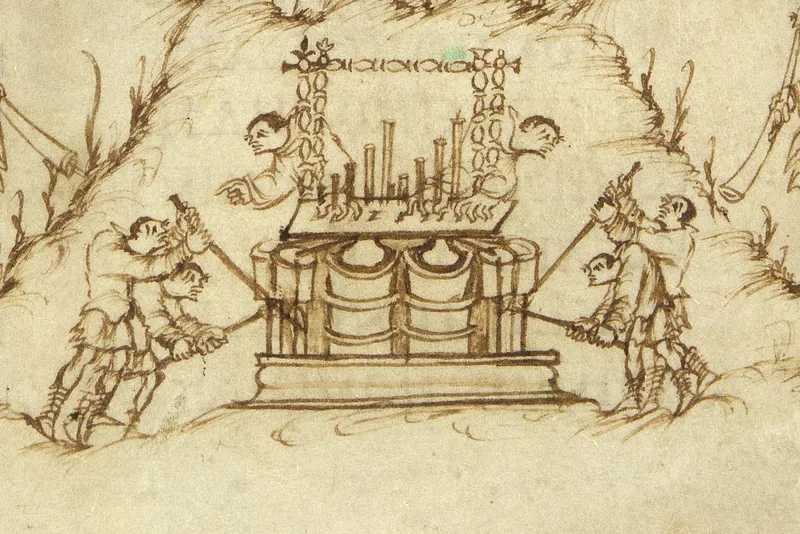
Psalm 150:3-6Let Every Thing That Hath Breath
3Praise him with the sound of the trumpet: praise him with the psaltery and harp. 4Praise him with the timbrel and dance: praise him with stringed instruments and organs. 5Praise him upon the loud cymbals: praise him upon the high sounding cymbals. 6Let every thing that hath breath praise the LORD. Praise ye the LORD.
Now the psalm opens into music, and the first instrument named is the loudest and most public of them all: Praise him with the sound of the trumpet. This was not a melodic instrument but the shofar, the ram's-horn trumpet whose single piercing blast summoned Israel to worship and to war alike. Its sound announced the new moon and the great feasts, called the assembly together, and rang out on the Day of Atonement and in the year of jubilee.
It is the sound of summons, the note that gathers a whole people and turns every head - and so it is fitting that it should open the orchestra of praise. After the trumpet come the psaltery and harp: the stringed instruments of the temple singers, the lyre and the larger harp that David himself played, the gentler voices that carried the melody of Israel's songs. So the list begins with a deliberate breadth - the blaring horn that summons the crowd and the sweet strings that accompany the song, the public call and the intimate melody, set side by side.
From its first notes the praise of Psalm 150 refuses to be only one kind of sound.1
The list quickens and broadens, gathering up the whole range of human music: the timbrel and dance… stringed instruments and organs… the loud cymbals… the high sounding cymbals (vv. 4-5). The timbrel was the hand-drum, the tambourine Miriam took up when she led the women in dancing after the sea was crossed - and here, beside it, is dance itself, the body caught up in the praise so that the worshipper is not a still spectator but a moving participant.
Then the breath instruments and the organs (a pipe), and finally the percussion brought to its peak: cymbals named twice over, the loud and the high sounding, the great crashing climax of the temple orchestra. Run your eye down the catalogue and notice what it is doing. It is not a precise inventory; it is a sweep meant to leave nothing out - strings, winds, percussion; the loud and the soft; the hands, the breath, the whole body in the dance.
Every family of instrument, every manner of making a sound, is called to the same task. The point is totality: there is no kind of music that cannot become praise, no sound humanity has learned to make that is shut out of this song.
The instruments build to their loudest at the very end of the list: Praise him upon the loud cymbals: praise him upon the high sounding cymbals (v. 5). Cymbals are named not once but twice, as if a single mention could not carry the volume - first the loud, then the high sounding, the crash and clash of bronze that was the great percussive climax of the temple orchestra. The whole catalogue has been rising toward this: it began with the summoning blast of the trumpet, moved through the strings and the dance and the pipes, and now it arrives at the crashing cymbals, the biggest and most exuberant sound the assembly could make.
There is no restraint here, no anxious throttling-back of joy. The praise of God is allowed to be loud - full-throated, unembarrassed, swelling to a crescendo. And then, the instant the cymbals reach their peak, the psalm widens past every instrument altogether. The crashing climax of the orchestra is not the summit after all; one more summons remains, larger than any sound the temple could produce - and the next verse will reach for it.
At the peak of the music the psalm leaps past all of it: Let every thing that hath breath praise the LORD (v. 6). Every instrument has been named, the orchestra has crashed to its climax - and now the summons outruns the whole temple, reaching out to take in every breathing thing. Not the musicians alone, not the assembly alone, not Israel alone, not even humankind alone, but every creature that draws breath. The single qualification is the simplest one imaginable: to have breath is to be called.
And then, in five plain words, the whole book of Psalms comes to rest: Praise ye the LORD. It is the same shout the psalm began with - the great Hallelujah - and the book ends precisely where this psalm started, on the word it was named for. Yet notice that it does not so much conclude as open outward. There is no final image to settle on, no last petition answered, no story tied off. There is only the command, hanging in the air, handed on to whoever reads it next.
The Psalter ends with a summons that has no period - an unfinished song, waiting for one more voice to take it up. The only question the last psalm leaves is whether the reader will be that voice.
Research trail
Sources & further study
These references support the historical, linguistic, manuscript, and contextual notes in this chapter. Scripture remains the primary text; external sources are provided so readers can inspect the research directly.
- Psalm 150 - Translators' NotesThe NET Bible's detailed footnotes on Psalm 150 - the structure of its three movements (the place, the reasons, the instruments), the identification of the ancient instruments named in verses 3-5, and the force of the closing universal summons to every thing that hath breath.
- Psalm 150 · Hebrew + classical Jewish commentaryThe Hebrew text of Psalm 150 with Rashi, Ibn Ezra, and other classical commentators side by side - useful for the repeated imperative hallelu (the “praise ye” that sounds thirteen times), for the great cry Hallelujah that frames the psalm, and for neshamah (v. 6, the “breath” that is called to praise).
- Psalm 150 ↔ John 1 · Hebrews 9 · Philippians 2 · Revelation 5Traces the threads tying Psalm 150 to the rest of Scripture - the breath of life given through the Word in whom was life (John 1:4), the heavenly sanctuary Christ has entered (Heb. 9:24), the day when every knee should bow (Phil. 2:10), and the praise of every creature gathered around the throne (Rev. 5:13).
Where this echoes in Scripture
Praise God in His Sanctuary
- Hebrews 9:24Christ is not entered into the holy places made with hands... but into heaven itself, now to appear in the presence of God for us.The sanctuary of verse 1 opened to its fullest meaning - the true and heavenly holy place Christ has entered.
- Psalm 19:1The heavens declare the glory of God; and the firmament sheweth his handywork.The firmament of verse 1 - the open sky itself a theatre of praise, showing the works of God.
- Psalm 145:4One generation shall praise thy works to another, and shall declare thy mighty acts.The mighty acts of verse 2 - the deeds of God handed down and praised from age to age.
- Deuteronomy 3:24for what God is there in heaven or in earth, that can do according to thy works, and according to thy might?The mighty acts and excellent greatness of verse 2 - the works and might that have no equal.
- Psalm 145:3Great is the LORD, and greatly to be praised; and his greatness is unsearchable.The excellent greatness of verse 2 - a greatness so vast that no praise can be excessive.
Let Every Thing That Hath Breath
- Revelation 5:13And every creature which is in heaven, and on the earth... Blessing, and honour, and glory, and power, be unto him that sitteth upon the throne, and unto the Lamb.The universal summons of verse 6 come true - every creature gathered into one boundless praise.
- Philippians 2:10-11That at the name of Jesus every knee should bow... and that every tongue should confess that Jesus Christ is Lord.The day every breathing thing of verse 6 joins the praise - every knee, every tongue.
- Revelation 4:8and they rest not day and night, saying, Holy, holy, holy, Lord God Almighty.The open-ended command of verse 6 kept ceaselessly - the praise that never falls silent.
- Genesis 2:7and breathed into his nostrils the breath of life; and man became a living soul.The breath of verse 6 - the same breath of life God gave, now lifted back to Him in praise.
- Psalm 148:7-13Praise the LORD from the earth... Let them praise the name of the LORD: for his name alone is excellent.The companion Hallelujah psalm that names the creation rank by rank, here gathered into “every thing that hath breath.”