Deuteronomy 3
People in this chapter
Og came out to meet them at Edrei, the last of the giants, his whole army behind him. His iron bedstead ran over thirteen feet long. Before a sword was drawn the Lord said three words: "Fear him not." Og fell. Sixty walled cities fell with him. The land east of Jordan was carved up among Reuben, Gad, and half-Manasseh1, and Moses charged Joshua to lead the rest across.
Tap any highlighted phrase to jump to the commentary that unpacks it.
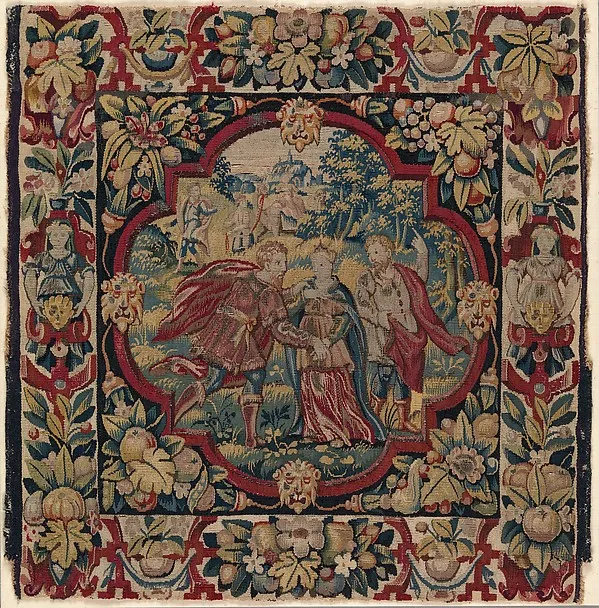
Deuteronomy 3:1-7The Defeat of Og
1Then we turned, and went up the way to Bashan: and Og the king of Bashan came out against us, he and all his people, to battle at Edrei. 2And the LORD said unto me, Fear him not: for I will deliver him, and all his people, and his land, into thy hand; and thou shalt do unto him as thou didst unto Sihon king of the Amorites, which dwelt at Heshbon.
This is the grammar of conquest in Deuteronomy. The Lord does not hand Israel a victory on the strength of their nerve or their numbers. He deals with the fear first, and He deals with it by telling them how the story ends before it starts. Almost every advance into the land of promise opens with God's word over the dread: do not be afraid2.
3So the LORD our God delivered into our hands Og also, the king of Bashan, and all his people: and we smote him until none was left to him remaining. 4And we took all his cities at that time, there was not a city which we took not from them, threescore cities, all the region of Argob, the kingdom of Og in Bashan. 5All these cities were fenced with high walls, gates, and bars; beside unwalled towns a great many.
Og is defeated completely. "None was left to him remaining." Bashan, the rich plains north of Gilead, was known for its cattle and its fertility. But it was also known as the place of the giants - and now the last of the giants has fallen.
These were not towns that could be easily taken. They were fortified - high walls, gates, bars. Unwalled towns were many as well. All of them were taken. The victory came because the Lord had delivered them.
6And we utterly destroyed them, as we did unto Sihon king of Heshbon, utterly destroying the men, women, and children, of every city. 7But all the cattle, and the spoil of the cities, we took for a prey to ourselves.
Deuteronomy 3:8-11The Last of the Giants
8And we took at that time out of the hand of the two kings of the Amorites the land that was on this side Jordan, from the river of Arnon unto mount Hermon; 9(Which Hermon the Sidonians call Sirion; and the Amorites call it Shenir;) 10All the cities of the plain, and all Gilead, and all Bashan, unto Salchah and Edrei, cities of the kingdom of Og in Bashan. 11For only Og king of Bashan remained of the remnant of giants; behold, his bedstead was a bedstead of iron; is it not in Rabbath of the children of Ammon? nine cubits was the length thereof, and four cubits the breadth of it, after the cubit of a man.
The text lingers on the measurement of Og's bedstead. Nine cubits long - roughly thirteen feet. Four cubits wide - about six feet. These are the dimensions of a man who was not like other men. He was the last of an ancient kind. Yet he fell. The bedstead itself became a monument in Rabbath of the Ammonites, a memorial to Israel's victory. What looks impossible is always smaller than the God who defeats it.
Deuteronomy 3:12-20The Land East of Jordan; Moses Charges the Eastern Tribes
12And this land, which we possessed at that time, from Aroer, which is by the river Arnon, and half mount Gilead, and the cities thereof, gave I unto the Reubenites and to the Gadites. 13And the rest of Gilead, and all Bashan, being the kingdom of Og, gave I unto the half tribe of Manasseh; all the region of Argob, with all Bashan, which was called the land of giants. 14Jair the son of Manasseh took all the country of Argob unto the coasts of Geshuri and Maachathi; and called them after his own name, Bashanhavothjair, unto this day.
Reuben, Gad, and half-Manasseh settle for the land east of Jordan. It is already conquered, already settled, already known - the safe side of the river. The choice carries a quiet cost. They will live outside the land of promise proper, always a step away from the inheritance the others receive. Good ground is not always the promised ground.
15And I gave Gilead unto Machir. 16And unto the Reubenites and unto the Gadites I gave from Gilead even unto the river Arnon half the valley, and the border even unto the river Jabbok, which is the border of the children of Ammon; 17The plain also, and Jordan, and the coast thereof, from Chinnereth even unto the sea of the plain, even the salt sea, under Ashdothpisgah eastward.
18And I commanded you at that time, saying, The LORD your God hath given you this land to possess it: ye shall pass over armed before your brethren the children of Israel, all that are meet for the war. 19But your wives, and your little ones, and your cattle, (for I know that ye have much cattle,) shall abide in your cities which I have given you; 20Until the LORD have given rest unto your brethren, as well as unto you, and until they also possess the land which the LORD your God hath given them beyond Jordan: and then shall ye return every man unto his possession, which I have given you.
Moses gives a charge: the men of war from Reuben, Gad, and Manasseh must not stay in their easy land. They must cross the Jordan armed, ahead of their brothers, until the conquest is complete. Even those who chose the lesser inheritance are still part of the people. Even those who rest must serve. The charge is clear: your rest does not come at the expense of your brothers' struggle.
Deuteronomy 3:21-22Moses Charges Joshua: "Fear Them Not"
21And I commanded Joshua at that time, saying, Thine eyes have seen all that the LORD your God hath done unto these two kings: so shall the LORD do unto all the kingdoms whither thou passest. 22Ye shall not fear them: for the LORD your God he shall fight for you.
Notice what Joshua does not inherit. He does not inherit Moses' strength, or his standing, or his forty years of hard-won nerve. He inherits one promise: the Lord your God shall fight for you. That is the whole transfer. Succession in Israel was the handing down of the same God to a new pair of hands. The leader changes. The One who wins the battles remains.
Deuteronomy 3:23-27Moses Prays; God Says "No"
23And I besought the LORD at that time, saying, 24O Lord GOD, thou hast begun to shew thy servant thy greatness, and thy mighty hand: for what God is there in heaven or in earth, that can do according to thy works, and according to thy might?
Moses prays. He has led the people for forty years through the wilderness. He has seen God work again and again. Now, at the edge of the Promise, his heart breaks with longing. "Let me go over and see the good land." This is the prayer of a man who has given everything and now asks for one thing - to enter what he has labored to make possible for others.
25I pray thee, let me go over, and see the good land that is beyond Jordan, that goodly mountain, and Lebanon. 26But the LORD was wroth with me for your sakes, and would not hear me: and the LORD said unto me, Let it suffice thee; speak no more unto me of this matter.
God does not grant the prayer. Moses prayed once; God could deny it gently. But Moses asked again, and the text says the Lord was "wroth" - angry. The moment to accept the denial had passed. Now God speaks with finality: "Speak no more unto me of this matter." Some prayers are not answered yes. Some are answered no, and the answer stands. This is one of the hardest lessons in Scripture - that even the greatest servants of God cannot have everything, and that grace sometimes means accepting a no from the One who loves us most.
27Get thee up into the top of Pisgah, and lift up thine eyes westward, and northward, and southward, and eastward, and behold it with thine eyes: for thou shalt not go over this Jordan.
God does not leave Moses without mercy. He says: go to Pisgah. You will see the land. You will see it with your eyes. You will behold it. This is a strange grace - the grace of vision without possession. The grace of seeing what you cannot yet have, and trusting that what God promised will come to pass through others. It is the grace of surrender.
Deuteronomy 3:28-29Charge Joshua; Encourage Him; Strengthen Him
28But charge Joshua, and encourage him, and strengthen him: for he shall go over before this people, and he shall cause them to inherit the land which thou shalt see. 29So we abode in the valley over against Bethpeor.
God does not let Moses grieve forever. He redirects Moses' leadership gift to Joshua. "Charge him." The work is being handed on. The conquest will happen. The Promise will be entered, by Joshua.
Three times the word comes: charge, encourage, strengthen. The repetition shows the weight of it. Joshua is young. Joshua has not yet led in conquest. Joshua will face giants and walled cities and doubt. He needs to be encouraged. He needs to be strengthened. The greatest gift a leader can give is to pass on the work with confidence, not with hesitation or fear.
The word "strengthen" means to make firm, to make strong. Not by Moses' own power, but by the work of the Lord. Joshua will be strengthened as he trusts the Lord who has already delivered Sihon and Og into Israel's hands. The formula for Joshua's strength is the same as Israel's: remembrance of past faithfulness, and trust in present promise.
Research trail
Sources & further study
These references support the historical, linguistic, manuscript, and contextual notes in this chapter. Scripture remains the primary text; external sources are provided so readers can inspect the research directly.
Where this echoes in Scripture
The Defeat of Og
- Matthew 10:28Fear not them which kill the body, but are not able to kill the soul.Jesus reorders fear the way God does at Edrei - the worst the enemy can do is not the last word.
- Matthew 26:52-53Thinkest thou that I cannot now pray to my Father, and he shall presently give me more than twelve legions of angels?The assurance Israel had over Og, Jesus had over His captors - and laid it down on purpose.
- Numbers 21:34Fear him not: for I have delivered him into thy hand, and all his people.The exact promise about Og the first time it was given, the night before the battle.
- Joshua 1:9Be strong and of a good courage; be not afraid... for the LORD thy God is with thee.The same charge handed forward to Joshua, who watched Og fall.
Moses Charges Joshua: "Fear Them Not"
- Hebrews 12:1-2let us run with patience the race that is set before us, looking unto Jesus the author and finisher of our faith.Memory of God's past work fuels the race ahead - and fixes the eyes on one face.
- Psalm 77:11I will remember the works of the LORD: surely I will remember thy wonders of old.The same discipline Joshua is handed - reaching back into what God has done when the road ahead looks impossible.
- Deuteronomy 31:8the LORD, he it is that doth go before thee... fear not, neither be dismayed.The charge to Joshua repeated near the end of Moses' life - the promise outlasts the man.
Moses Prays; God Says "No"
- Matthew 26:39O my Father, if it be possible, let this cup pass from me: nevertheless not as I will, but as thou wilt.The other servant who asked the Father to remove a hard thing, and bowed when the answer was no.
- 2 Corinthians 12:8-9For this thing I besought the Lord thrice... And he said unto me, My grace is sufficient for thee.Paul, like Moses, prays three times and is told no - and is given the grace instead of the thing.
- Deuteronomy 34:1-4And the LORD shewed him all the land... I have caused thee to see it with thine eyes, but thou shalt not go over thither.The Pisgah view itself, the day it finally came - sight given in place of entry.
- Hebrews 11:13These all died in faith, not having received the promises, but having seen them afar off.The pattern Moses joins - seeing the promise from a distance and trusting God to keep it.