Painter of the Bible
Alonso Cano
Alonso Cano was a Spanish Baroque painter, sculptor, and architect — the principal Spanish polymath artist of the seventeenth century, who worked across all three disciplines at the highest level and is widely held to be…

Their faith
Why Alonso Cano painted Christ
Alonso Cano was a deeply devout Christian whose faith was intricately woven into the fabric of his artistic endeavors. Born in Granada in 1601, he received his training in the vibrant artistic community of Seville, where he was influenced by the teachings of Francisco Pacheco and the sculptor Juan Martínez Montañés. Cano's commitment to his faith was evident in his role as a canon of the Granada Cathedral, where he dedicated his talents to enhancing the spiritual experience of worship through art. His works were primarily created for the Spanish Catholic Counter-Reformation churches, reflecting a profound reverence for scripture and the teachings of the Church. Cano's artistic practice was not merely a profession but a devotional act, as he sought to bring the divine into the visual realm, inspiring both worshippers and fellow artists alike.
Cano's faith profoundly shaped his artistic vision, leading him to create some of the most significant religious works of the Spanish Baroque period. His altarpiece for the Sacristy of Granada Cathedral and the stunning frescoes depicting the Six Mysteries of the Virgin showcase his ability to convey deep spiritual narratives through visual artistry. In works like "Christ in Limbo," Cano captures the essence of redemption and grace, inviting viewers to reflect on their own faith journeys. His polychrome wood sculpture of the Immaculate Conception stands as a testament to his dedication to portraying the beauty of the divine. Even today, Cano's art continues to resonate, drawing viewers into a deeper understanding of Christ and the rich tapestry of faith that inspired his life and work.
Life & work
Alonso Cano was a Spanish Baroque painter, sculptor, and architect — the principal Spanish polymath artist of the seventeenth century, who worked across all three disciplines at the highest level and is widely held to be one of the supreme Spanish religious painters of his generation. Born in Granada in 1601, trained in Seville in the workshops of Francisco Pacheco (the same Sevillian workshop that trained Diego Velázquez, Cano's near-contemporary and lifelong friend) and the sculptor Juan Martínez Montañés, and active in Seville, Madrid (where he worked at the royal court under the patronage of the Conde-Duque de Olivares), and finally Granada (where he was made a canon of the cathedral in 1652 and worked on the great west facade and the apsidal frescoes), he died in Granada in 1667.
His Christian religious work is concentrated in altarpieces, sculpted polychrome statues, and architectural projects for the Spanish Catholic Counter-Reformation churches. The Conception altarpiece in the Sacristy of Granada Cathedral, the Six Mysteries of the Virgin frescoes in the apse of Granada Cathedral (his late masterpiece, painted between 1652 and his death in 1667 and depicting the principal Marian feasts in a sequence of large lunette frescoes), the Christ in Limbo (Los Angeles County Museum of Art), the Saint Joseph with the Christ Child (multiple workshop variants), and the polychrome wood sculpture of the Immaculate Conception in Granada Cathedral (his sculptural masterpiece, painted in his characteristic combination of carved wood and oil-on-wood polychrome) anchor the religious output.
His personal style — combining the dramatic Caravaggesque chiaroscuro of his Sevillian training with the soft chromatic warmth and the careful figural elegance of the late Spanish Baroque — gave him a distinctive position in the Spanish seventeenth-century pictorial tradition. The Granada apse frescoes in particular are widely held to be among the supreme Spanish Baroque ceiling decorations and remain in continuous liturgical use in the cathedral.
He was famously volatile in temperament — accused (probably falsely) of murdering his second wife in 1644, fleeing to Valencia and then returning to Madrid under royal protection, and quarreling repeatedly with the Granada cathedral chapter throughout the 1650s and 1660s. He died in Granada in 1667 and was buried in the cathedral he had spent his last fifteen years decorating.
Notable works in detail
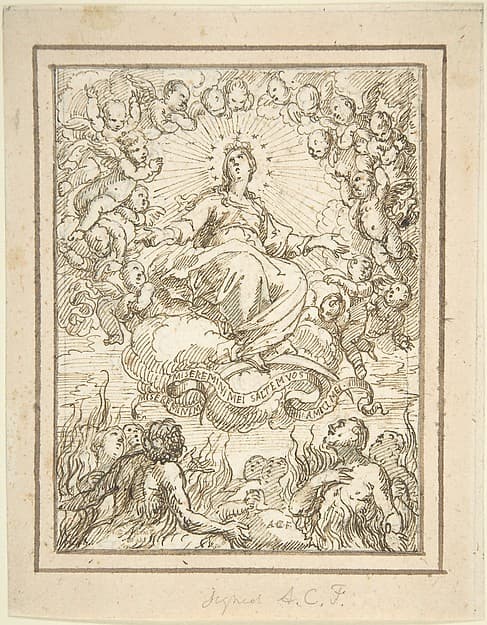
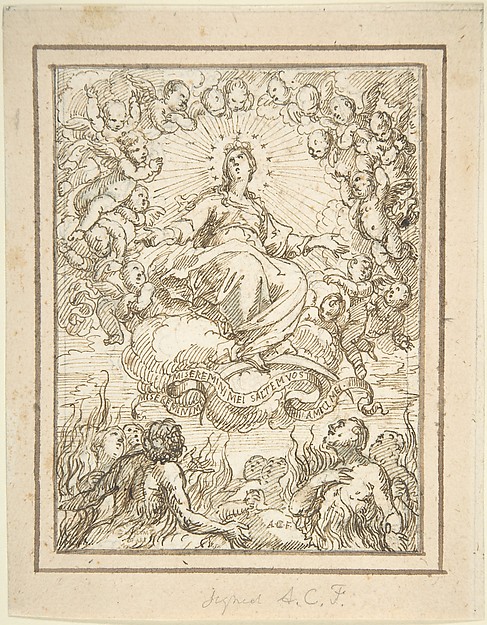
Virgin Interceding for Those in Purgatory
Virgin Interceding for Those in Purgatory, drawn by Alonso Cano around 1650 in pen and ink with wash on paper and now in the Metropolitan Museum of Art in New York, depicts the iconographic subject of the Virgin Mary interceding with Christ for the souls in Purgatory — a particular Spanish Counter-Reformation devotional preference deriving from the Catholic doctrine that Marian intercession could shorten the time the souls of the recently dead must spend in purgatorial purification before their admission to heaven. Cano composes the scene as a vertical visionary composition: the Virgin at the upper center kneeling before Christ in attitude of supplication, the souls in Purgatory rising in the lower register through the cleansing flames toward her intercession. The drawing demonstrates Cano's characteristic combination of Sevillian draughtsmanship and the Granada-Madrid courtly devotional sensibility.
met-411391
Christ on the Mount of Olives (with a study of a cypress on the verso), drawn by Alonso Cano around 1640 in pen and ink with wash on paper and now in the Metropolitan Museum of Art in New York, depicts the Agony in the Garden as recorded in the Synoptic Gospels: Christ kneels in prayer before the angel bearing the cup of the Passion, while the three sleeping disciples are gathered in the foreground and Judas with the Roman soldiers approach through the garden gate at the rear. Cano stages the scene with characteristic Spanish Baroque dramatic compositional density. The verso of the sheet — a small study of a cypress tree — demonstrates Cano's lifelong interest in the careful botanical observation that informed his many landscape backgrounds across his painted output.
![Madonna and Child [?]](/_next/image?url=https%3A%2F%2Fimages.metmuseum.org%2FCRDImages%2Fdp%2Fweb-large%2FDP800060.jpg&w=2048&q=75)
Madonna and Child, drawn by Alonso Cano around 1640 in pen and ink with wash on paper and now in the Metropolitan Museum of Art in New York, is a small preparatory drawing for one of his many painted Marian compositions across his Spanish Baroque career. The drawing shows the seated Virgin in three-quarter view holding the standing Christ Child upright on her lap. The combination of pen-and-ink with the soft wash technique demonstrates the rapid confident draughtsmanship that the Sevillian workshop tradition descending from Pacheco had refined to a high pitch and that Cano absorbed during his early Sevillian apprentice years before his move to Madrid and Granada.
![Madonna and Child [?] by Alonso Cano](https://images.metmuseum.org/CRDImages/dp/web-large/DP800060.jpg)