Painter of the Bible
Correggio (Antonio Allegri)
Correggio — born Antonio Allegri in the small Emilian town of Correggio around 1489, taking his professional name from his birthplace — was the leading painter of the Parma school in the early sixteenth century and the p…

Their faith
Why Correggio (Antonio Allegri) painted Christ
Correggio, born Antonio Allegri in the small town of Correggio, Italy, was a devout Christian whose faith deeply influenced his artistic vision. Though specific details about his religious practices are sparse, the profound spirituality evident in his works suggests a life dedicated to God. His time in Parma, where he created some of his most significant religious pieces, reflects a commitment to portraying biblical themes with reverence and beauty. The church of San Giovanni Evangelista, where he painted the Vision of Saint John on Patmos, serves as a testament to his devotion, as he sought to inspire awe and contemplation in viewers through his art.
Correggio's faith is particularly evident in his celebrated fresco cycles, which showcase his ability to convey divine narratives through innovative techniques. The Assumption of the Virgin in the cupola of Parma Cathedral, for instance, captures the moment of heavenly ascension with swirling clouds and angels, inviting viewers to experience the glory of the divine. His Madonnas, such as the Madonna of Saint Jerome, reveal a tender maternal aspect of faith, emphasizing the love and compassion inherent in Christian teachings. Through his masterful use of light and color, Correggio's works continue to resonate with audiences today, drawing them closer to the sacred stories he depicted and reminding us of the beauty of faith in art.
Life & work
Correggio — born Antonio Allegri in the small Emilian town of Correggio around 1489, taking his professional name from his birthplace — was the leading painter of the Parma school in the early sixteenth century and the principal Italian master of the soft, light-filled, sweetly proportioned manner that the seventeenth-century Bolognese Baroque painters (Annibale Carracci, Reni, Lanfranco) would treat as their direct ancestor. Trained in Modena and possibly briefly in Mantua under Andrea Mantegna's late workshop, he settled in Parma by 1520 and worked there for almost the rest of his life. He died in Correggio in 1534, in his mid-forties.
His three great Parma fresco cycles are the principal monuments of his religious career. The cupola of the church of San Giovanni Evangelista (1520–1524) shows the Vision of Saint John on Patmos, with the apostles around the rim looking up into a circular sky in which Christ ascends into glory through clouds and angels — the first great illusionistic dome of the Italian Renaissance, two generations before Pietro da Cortona and Andrea Pozzo would make di sotto in sù ceiling painting the Baroque norm. The cupola of Parma Cathedral (1526–1530) shows the Assumption of the Virgin in a similar swirling vortex of bodies and clouds. The fresco vault of the Camera di San Paolo in the convent of San Paolo (1518–1519) — a private cell for the abbess Giovanna da Piacenza — uses a trompe l'oeil pergola structure to frame allegorical and mythological figures in a private religious-humanist program of unusual sophistication.
His paintings outside Parma include the great Madonnas — the Madonna of Saint Jerome (Day, Parma, c. 1527–1528), the Madonna of Saint Sebastian (Dresden), the Madonna of Saint George (Dresden), the Madonna of the Basket (London), the Madonna and Child with Saint Jerome (Parma) — and a sequence of religious mythologies including the Loves of Jupiter cycle for Federico Gonzaga of Mantua (Io, Danaë, Leda, Ganymede), now divided between Vienna, Berlin, the Borghese, and the Wadsworth Atheneum.
His soft modeling — the famous fumato, the sweet feathered handling of skin and hair against rich crimson and dark green — was the principal Italian Renaissance achievement that the Carracci would resurrect a half-century later, and his illusionistic ceilings were the technical prelude to the entire Italian Baroque dome tradition.
Notable works in detail
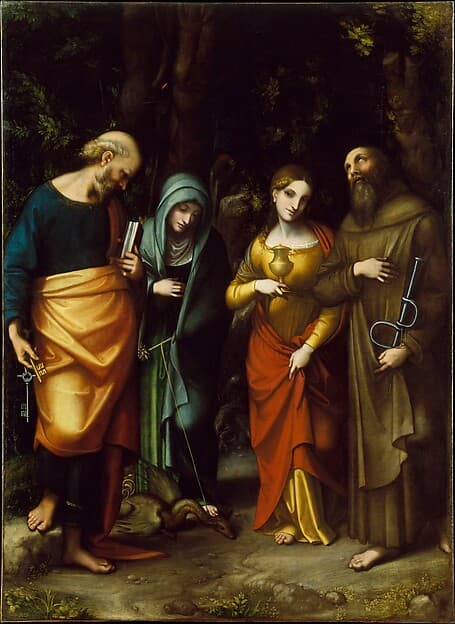
Saints Peter, Martha, Mary Magdalen, and Leonard
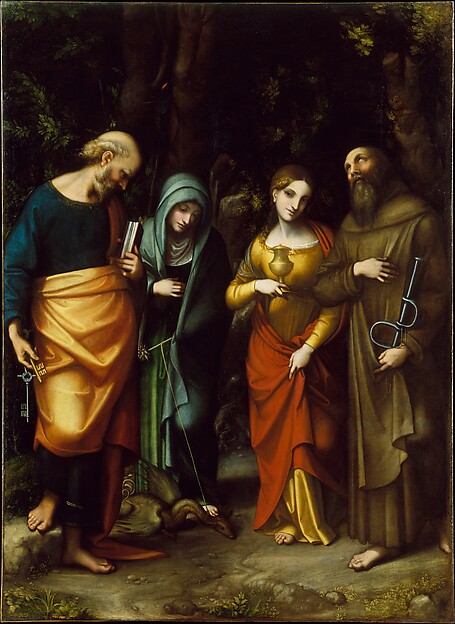
Saints Peter, Martha, Mary Magdalen, and Leonard, painted by Antonio da Correggio around 1510 in oil on canvas and now in the Metropolitan Museum of Art in New York, is among the early Correggio altarpieces that already shows the soft sfumato modeling and the warm chromatic palette that would later define the great Parma cupolas. The four saints stand in a small Renaissance interior — Peter on the left holding the keys of the kingdom, Martha with a chained dragon at her feet (the iconographic attribute of the legend in which she tamed a dragon at Tarascon), Mary Magdalen with her ointment jar, and Leonard with the broken chains he traditionally distributes to freed prisoners. The composition is built on a strict bilateral symmetry framed around an open landscape glimpsed through a colonnade behind the central group. The painting was acquired by the Metropolitan in 1912.
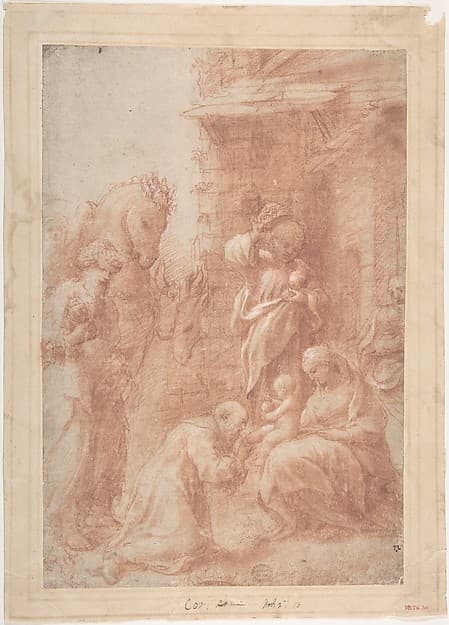
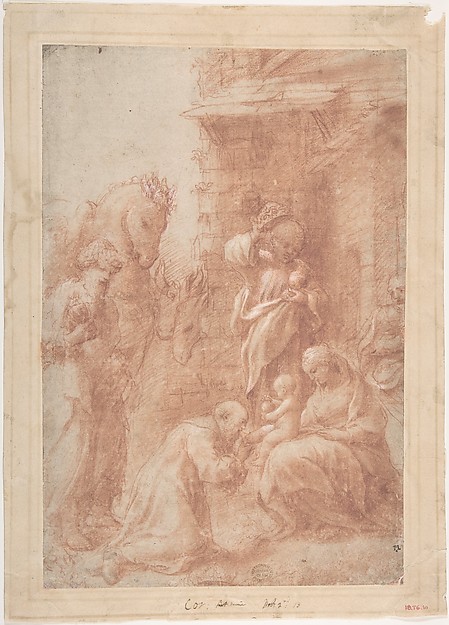
The Adoration of the Magi, painted by Antonio da Correggio around 1512 in oil on panel and now in the Metropolitan Museum of Art in New York, depicts the visit of the three kings to the infant Christ in the small dwelling at Bethlehem. Correggio organizes the figures in a tight pyramidal grouping around the seated Virgin: the eldest king kneels in profile in the foreground, the second king stands behind with his crown removed, and the third king, traditionally identified in Renaissance iconography with the African Balthazar, stands further back holding a small golden vessel. The chromatic palette of soft rose, warm ochre, and ultramarine, and the gentle smiling Christ Child reaching toward the kneeling king's offering, are the unmistakable signatures of the early-mature Correggio manner that the Carracci would resurrect almost a century later as the principal source of the Bolognese reform of Italian painting.
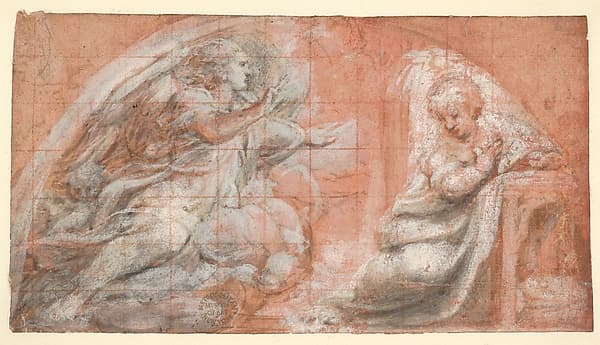
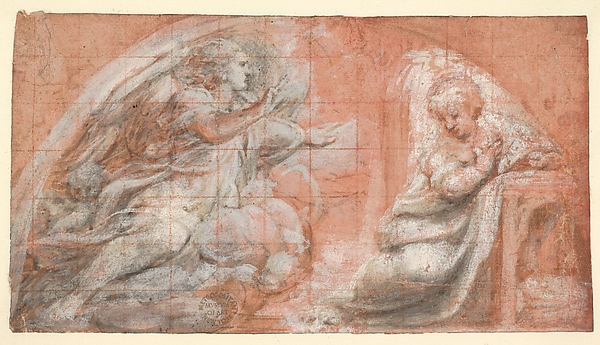
The Annunciation, drawn by Antonio da Correggio around 1517 in red chalk on paper and now in the Metropolitan Museum of Art in New York, is a small preparatory drawing from the central Parma period of his career — the years immediately before he began the great cupola frescoes of San Giovanni Evangelista and the Cathedral. The drawing shows the Virgin standing on the right, her gaze lifted toward the angel Gabriel who descends from the upper left in an attitude of greeting; the Holy Spirit appears as a small dove on a single beam of light between them. Drawings of this kind were the working currency of the Renaissance Italian workshop — quick visual notations of compositions that the painter would later work up into finished altarpieces or fresco cycles. The sheet is among the principal Correggio drawings in any American collection and entered the Metropolitan in 1962.