Painter of the Bible
Filippino Lippi
Filippino Lippi was a leading Florentine painter of the late Quattrocento and the principal heir to the workshop tradition that ran from Masaccio through Fra Filippo Lippi (his father) through Sandro Botticelli (Filippino's master after his father's death).

Their faith
Why Filippino Lippi painted Christ
Filippino Lippi, born in 1457, was deeply rooted in the Christian faith, influenced by his upbringing as the son of the renowned painter Fra Filippo Lippi and a former nun, Lucrezia Buti. Growing up in a household steeped in religious devotion, Filippino inherited not only artistic talent but also a profound reverence for scripture and the teachings of Christ. His father’s legacy and the environment of Florence, a city rich in Christian art and spirituality, shaped Filippino’s own faith journey. Throughout his career, he dedicated himself to creating works that reflected the beauty of the divine, often drawing inspiration from biblical narratives and the lives of saints. His commitment to his craft was evident in his meticulous approach to painting, which he viewed as a form of worship and devotion to God.
Filippino's faith is vividly expressed in his significant works, such as the Resurrection of the Son of Theophilus and the Crucifixion of Saint Peter, painted for the Tornabuoni Chapel. These pieces not only highlight his technical skill but also reveal his spiritual vision, as he sought to convey the transformative power of Christ’s resurrection and the steadfastness of faith in the face of persecution. His altarpiece, the Vision of Saint Bernard, further exemplifies his dedication to portraying sacred themes, capturing the mystical encounter between the saint and the divine. Through his art, Filippino Lippi invites viewers to reflect on their own faith journeys, reminding us that the beauty of devotion can transcend time, continuing to inspire and uplift hearts today.
Life & work
Filippino Lippi was a leading Florentine painter of the late Quattrocento and the principal heir to the workshop tradition that ran from Masaccio through Fra Filippo Lippi (his father) through Sandro Botticelli (Filippino's master after his father's death). Born in Prato around 1457, the son of Fra Filippo Lippi and the former nun Lucrezia Buti, brought to Spoleto as a child during his father's final fresco campaign and inherited as an apprentice into Botticelli's Florentine workshop after his father's death in 1469, he was active in Florence — with major commissions in Rome and other Tuscan cities — for the rest of his life. He died in Florence in 1504.
His Christian religious work falls in three principal groupings. First, the early Tornabuoni Chapel work (Santa Maria del Carmine, Florence, c. 1481–1485) — completing Masaccio's unfinished Brancacci Chapel cycle of the lives of Saint Peter and Saint Paul, which had stood half-painted for half a century after Masaccio's death in 1428. Filippino's contribution included the Resurrection of the Son of Theophilus, the Saint Peter Visited in Prison, and the Crucifixion of Saint Peter, all painted in a deliberate stylistic blend of his own late-Quattrocento manner with as much of Masaccio's earlier monumentality as he could recover. Second, the Strozzi Chapel frescoes in Santa Maria Novella (1487–1502) — the Stories of Saint Philip and Saint John the Evangelist, with their famously elaborate Mannerist-foretelling architectural fantasies and crowded narrative incident. Third, the Carafa Chapel in Santa Maria sopra Minerva in Rome (1488–1493), painted for Cardinal Oliviero Carafa with scenes of the life of Saint Thomas Aquinas and the Annunciation.
His altarpieces — the Vision of Saint Bernard (Badia Fiorentina, 1485, one of the most reproduced fifteenth-century Florentine altarpieces), the Madonna della Visitazione (Uffizi), the Adoration of the Magi (Uffizi, 1496), the Christ on the Cross with Saints (Berlin) — fill museums in Florence, Berlin, the Vatican, and Bologna.
His personal style is recognizable for its fluttering linear drapery, restless figural torsion, abundant antique-Roman ornament, and a kind of nervous late-Quattrocento intensity that points forward to the early Mannerists of the next generation. He was widely respected in his lifetime — at his death in 1504 the workshops of Florence reportedly closed for a day — and was buried in the church of San Michele Visdomini in Florence.
Notable works in detail
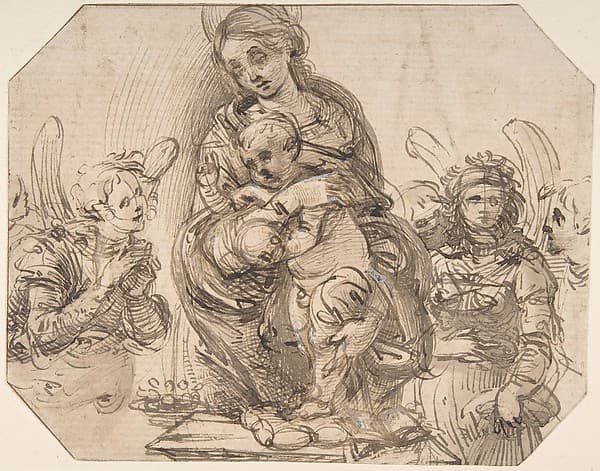
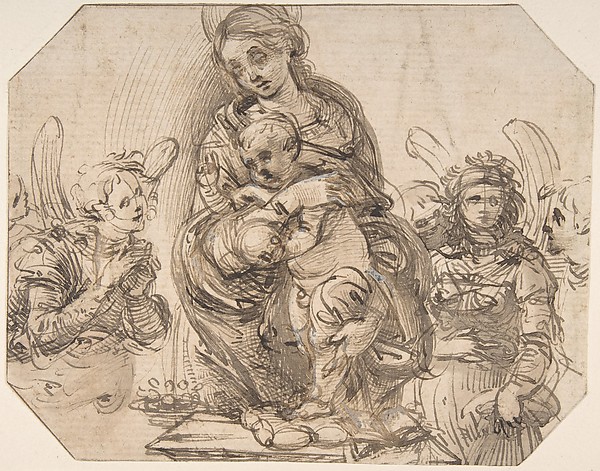
Virgin and Child Attended by Angels
Virgin and Child Attended by Angels, drawn by Filippino Lippi around 1457 (early in his career, in the workshop he had just entered after his father's death) in pen and brown ink on paper and now in the Metropolitan Museum of Art in New York, is among the earliest surviving Filippino drawings. The drawing shows the Virgin seated in three-quarter view holding the Christ Child upright on her lap, with two small attendant angels lean in at her shoulders. The figures are sketched rapidly with confident outlines characteristic of the late-Quattrocento Florentine workshop drawing tradition descending from Filippo Lippi (Filippino's father) and Botticelli (his master after his father's death). The sheet is one of the principal early Filippino drawings in any American collection.
met-436893
The Descent from the Cross, painted by Filippino Lippi (or completed by his workshop after his death) around 1477 in tempera on panel and now in the Metropolitan Museum of Art in New York, is among the surviving small Florentine altarpiece panels of his early career. The composition shows the body of Christ being lowered from the cross into the arms of the Virgin and the Magdalene at the foot of the cross; John the Evangelist supports the body from above, and Joseph of Arimathea stands on the ladder to the right detaching the nails. The chromatic palette of soft rose, blue-grey, and pale flesh against the dark sky is the unmistakable late-Quattrocento Florentine signature, and the elongated swooping figural proportions point forward to the Mannerist directions that the next Florentine generation would explore in the early sixteenth century.
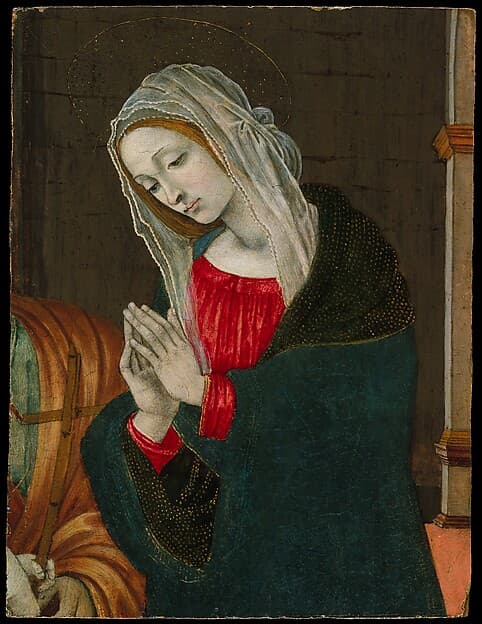
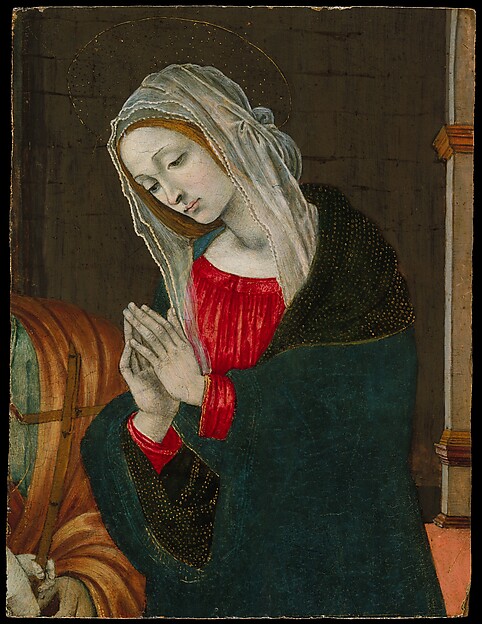
The Virgin of the Nativity, painted by Filippino Lippi around 1495 in tempera and oil on panel and now in the Metropolitan Museum of Art in New York, depicts the Virgin Mary in adoration before the newborn Christ Child laid on the ground — the iconographic compositional type known as the Adoration of the Christ Child that Florentine Quattrocento painting refined repeatedly for private devotional use. The Virgin kneels in profile on the right with her hands folded; the Christ Child lies on the ground on a small piece of straw in the lower center; a small angel and a tiny donor figure complete the composition. The chromatic palette of warm flesh, soft blue, and pale gold against a darkened landscape opening to a low Tuscan horizon is the unmistakable late-Quattrocento Florentine signature.
met-436892
Madonna and Child, painted by Filippino Lippi around 1483 in tempera on panel and now in the Metropolitan Museum of Art in New York, is one of the small Florentine devotional Madonnas from the central productive years of Filippino's career — the years of the Tornabuoni Chapel completion in Santa Maria del Carmine and the Strozzi Chapel commissions in Santa Maria Novella. The Virgin sits in three-quarter view holding the Christ Child against her chest; the chromatic palette of soft rose, pale blue, and warm flesh against a darkened ground is characteristic of his mature small-format manner. The painting belongs to the long sequence of small Madonnas that the Filippino workshop produced for private Florentine patrons throughout the 1480s and 1490s, and is one of the principal Filippino Madonnas in any American collection.