Painter of the Bible
Francisco de Zurbarán
Francisco de Zurbarán was the leading Spanish religious painter of the first half of the seventeenth century — the painter whose Caravaggesque chiaroscuro and obsessive observation of monastic life made him the principal…

Their faith
Why Francisco de Zurbarán painted Christ
Francisco de Zurbarán was a devout Christian whose life and work were deeply intertwined with the religious fervor of the Spanish Counter-Reformation. His commitment to the faith is evident in his extensive collaborations with various monastic orders, including the Carthusians, Franciscans, and Mercedarians. For over two decades, he served as the principal painter for Sevillian monastic communities, creating works that reflected the ascetic and contemplative life of these religious institutions. His paintings often depict saints and biblical figures in moments of deep spiritual reflection, showcasing his reverence for scripture and the sacred. The austere beauty of his art, characterized by dramatic chiaroscuro and meticulous detail, speaks to his devotion and the profound impact of his faith on his creative process.
Zurbarán's spiritual vision is particularly evident in works such as "Saint Hugo in the Carthusian Refectory," where he captures the solemnity and unity of the monks gathered at table, embodying the essence of monastic life. His painting "Crucifixion" further illustrates his ability to convey deep theological themes through visual means, inviting viewers to contemplate Christ's sacrifice. The artist's portrayal of saints, like in his series of female martyrs, reflects a celebration of faith and the virtues of perseverance and devotion. Even today, Zurbarán's work continues to inspire and uplift, inviting viewers into a deeper understanding of the sacred through his masterful renderings of divine subjects. His legacy as a painter of religious devotion remains a testament to the enduring power of faith in art.
Life & work
Francisco de Zurbarán was the leading Spanish religious painter of the first half of the seventeenth century — the painter whose Caravaggesque chiaroscuro and obsessive observation of monastic life made him the principal visualizer of the Spanish Counter-Reformation in its severest, most ascetic register. Born in Fuente de Cantos in Extremadura in 1598 to a haberdasher's family, apprenticed in Seville to a minor painter named Pedro Díaz de Villanueva, and active in Llerena and then in Seville from the 1620s onward, he was the principal painter to the Sevillian monastic orders for two decades. He died in Madrid in 1664.
His Christian religious work is concentrated in monastic cycles painted on commission for Carthusians, Mercedarians, Hieronymites, Jeronymites, and Franciscans. The Jerez Carthusian cycle (1638–1639), the Mercedarian cycle in the Real Convento in Seville (now dispersed across the Prado, the Akademie in Vienna, and various American collections), the Saint Hugo in the Carthusian Refectory (Seville, c. 1633, with its famously austere assembly of monks at table), the Apotheosis of Saint Thomas Aquinas (Seville, 1631), and the great Crucifixion (Art Institute of Chicago, 1627, painted for the Dominican church of San Pablo in Seville) anchor the painted corpus.
His individual saint portraits — the Saint Francis in Meditation (London), the Saint Casilda (Prado), the Saint Margaret (London), the great series of female martyr saints holding the instruments of their martyrdom — became one of his most-collected categories in his lifetime and after. The Sevillian convents of the Carmelites and the Discalced Carmelites commissioned dozens of these standing saint figures for refectory and chapel installation; many made the Atlantic crossing to Spanish Mexico and Peru, and some are still in their original sites in Lima and Mexico City.
He also painted a small but exquisite body of still lifes — the great Still Life with Lemons, Oranges and a Rose (Norton Simon Museum, 1633), the Cup of Water and a Rose on a Silver Plate (London) — whose meditative attention to a few objects on a dark ground reads as a continuation of his religious painting by other means.
His late career was overshadowed by the rise of Murillo as the new Sevillian favorite. He moved to Madrid around 1658, hoping for court patronage, but the Madrid years were lean and he died there in modest circumstances. The Prado holds the largest single body of his work today.
Notable works in detail
met-437972
The Crucifixion, painted by Francisco de Zurbarán in 1627 in oil on canvas for the Dominican church of San Pablo in Seville and now in the Art Institute of Chicago (NB: a closely related Met version exists), is among the founding statements of his early Sevillian Caravaggesque manner. The painting shows the body of Christ on the cross against a solid black ground, with no landscape, no mourners, no soldiers — only the figure isolated in a single shaft of dramatic raking light. The flesh tones are pale, almost grey-white; the loincloth is rendered in folded ivory-cream; the inscription INRI is painted on a small tablet at the top of the cross. The painting was so realistically rendered that contemporary Sevillian visitors to the church reportedly mistook it from a distance for a sculpture rather than a painting; Zurbarán's reputation in Seville was made by the panel almost overnight and the commission for the sequence of monastic altarpieces that followed grew directly from its public success.
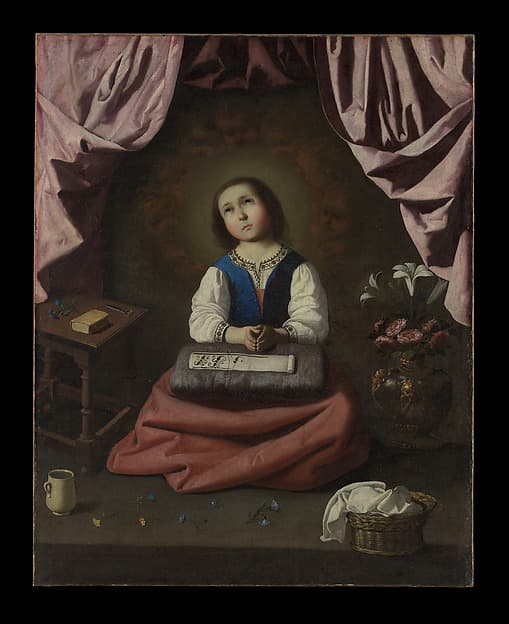
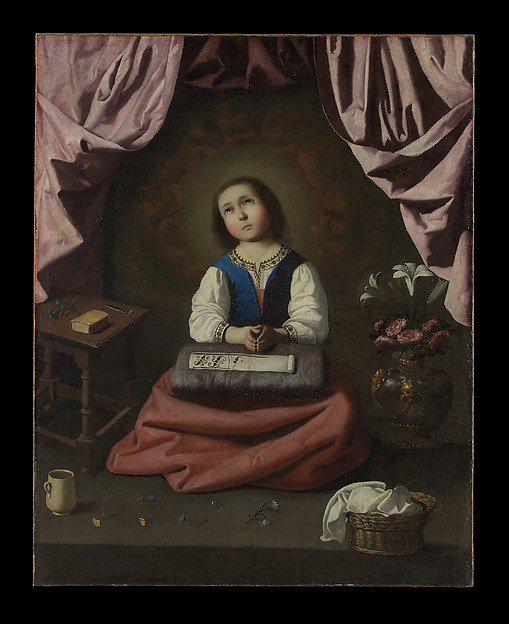
The Young Virgin (also called The Virgin as a Young Girl), painted by Francisco de Zurbarán around 1632–1633 in oil on canvas and now in the Metropolitan Museum of Art in New York, depicts the Virgin Mary as a small girl of perhaps eight or ten years, seated in a small chamber with embroidery in her lap, her hands folded in prayer, her gaze lifted toward a small light in the upper left where two cherubs hover with a crown. The chromatic palette is restrained and characteristic of the early Zurbarán Sevillian manner — pale rose, white, soft grey, deep claret. The subject — the childhood of the Virgin — was a particular Sevillian devotional preference and Zurbarán painted multiple versions across his career. The Metropolitan version is among the finest surviving and one of the principal Zurbarán paintings in any American collection.
met-437969
Battle between Christians and Muslims at El Sotillo, painted by Francisco de Zurbarán around 1637–1639 in oil on canvas for the Carthusian monastery of Jerez and now in the Metropolitan Museum of Art in New York, depicts the apparition of the Virgin Mary at the night battle of El Sotillo (1370) in which the Christian forces of the marqués of Cádiz routed a much larger Muslim army through what the Carthusian tradition treated as a direct Marian intervention. The composition shows the Virgin in a luminous mandorla in the upper left of the painting, with the Christian and Muslim armies engaged in dense battle below across a moonlit Andalusian landscape. The painting was the central piece of the Carthusian high altarpiece at Jerez; it was dispersed during the suppression of the convents in the early nineteenth century and entered the Metropolitan in 1920.
Bible scenes Francisco de Zurbarán painted
Luke