Painter of the Bible
Hieronymus Bosch
Hieronymus Bosch — born Jheronimus van Aken in the Dutch town of 's-Hertogenbosch, from which he took his painter's name — is the most singular religious imagination in European painting before the Reformation.
.jpg%3Fwidth%3D600&w=2048&q=75)
Their faith
Why Hieronymus Bosch painted Christ
Hieronymus Bosch, originally named Jheronimus van Aken, was deeply rooted in the Christian faith, as evidenced by his membership in the Confraternity of Our Lady in his hometown of 's-Hertogenbosch. This conservative religious order not only underscored his commitment to the Church but also provided a community that nurtured his artistic talents. Although little is known about his personal life, it is clear that Bosch's devotion to scripture and the teachings of the Church profoundly influenced his work. His paintings reflect a vivid imagination shaped by medieval spirituality, where he sought to convey moral lessons through his art. The fervor of his faith can be felt in the way he approached biblical themes, often illustrating the consequences of sin and the complexities of human nature with a unique and imaginative style.
Bosch's most renowned work, "The Garden of Earthly Delights," serves as a striking testament to his spiritual vision. This triptych vividly portrays the journey of humanity from the innocence of Eden to the chaotic pleasures of earthly life, ultimately leading to a harrowing depiction of Hell. Each panel invites viewers to reflect on their own moral choices and the nature of sin, employing a rich tapestry of fantastical creatures and surreal landscapes. Similarly, in "Christ Carrying the Cross," Bosch presents a tormented Christ surrounded by distorted faces, emphasizing the weight of human sin and suffering. Through these powerful images, Bosch's faith resonates with viewers, urging them to contemplate their spiritual lives and the eternal consequences of their actions. His devotion continues to inspire and challenge us, reminding us of the profound connection between faith and art.
Life & work
Hieronymus Bosch — born Jheronimus van Aken in the Dutch town of 's-Hertogenbosch, from which he took his painter's name — is the most singular religious imagination in European painting before the Reformation. Almost nothing reliable is known about his life; he never traveled, was a member of the conservative Confraternity of Our Lady in his hometown, painted for both local commissions and high-status patrons including King Philip the Fair, and died around 1516. The dating of his roughly twenty-five surviving panels is mostly approximate, and the chronology of his style is still debated.
What he left is a Bible drawn from the inside of a fevered medieval imagination. The Garden of Earthly Delights, his most famous triptych, now hangs in the Prado in Madrid; on its three panels Adam meets Eve in Eden, humanity disports itself in a dreamlike middle landscape, and the damned suffer in a black-and-fire Hell crawling with hybrid creatures, infernal architecture, and grotesque musical instruments. The Last Judgment triptychs in Vienna, Bruges, and Munich extend that infernal vocabulary across additional commissions. The Christ Carrying the Cross panels — particularly the version in Ghent — press a tormented Christ into a press of distorted faces. The Adoration of the Magi (Prado), the Crowning with Thorns (London), and the Temptation of Saint Anthony (Lisbon) round out his late style.
His monsters are catechetical. They illustrate sins, vices, demonic temptations, and the bodily consequences of sin in a vocabulary that draws on illuminated manuscripts, medieval bestiaries, popular sermons, and his own profound visual invention. Where Italian Renaissance artists gave the Bible idealized human bodies, Bosch gave it a teeming bestial chorus. The Counter-Reformation and the seventeenth century mostly looked away; the Surrealists in the twentieth century rediscovered him; the conservation work and exhibitions of the 2010s, especially the Bosch Research and Conservation Project in advance of the 2016 quincentenary, have steadied his catalogue and made his sequence of paintings clearer than at any time since his death.
He was buried in the Church of Saint John in 's-Hertogenbosch, the same building whose late-Gothic carvings — gargoyles, demons, and fantastic creatures climbing the buttresses — almost certainly fed his imagination from the start.
Notable works in detail
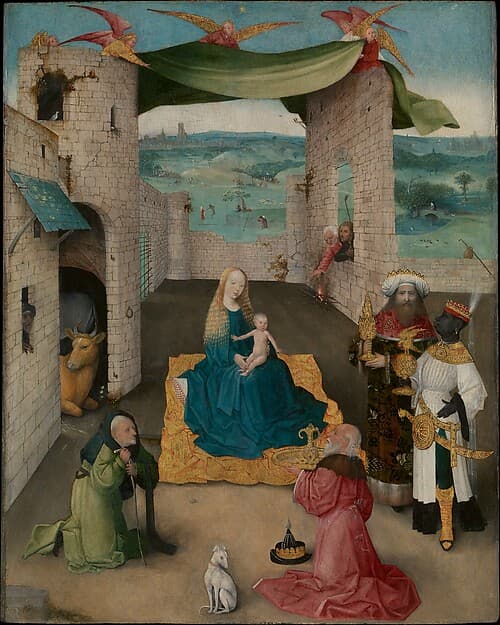
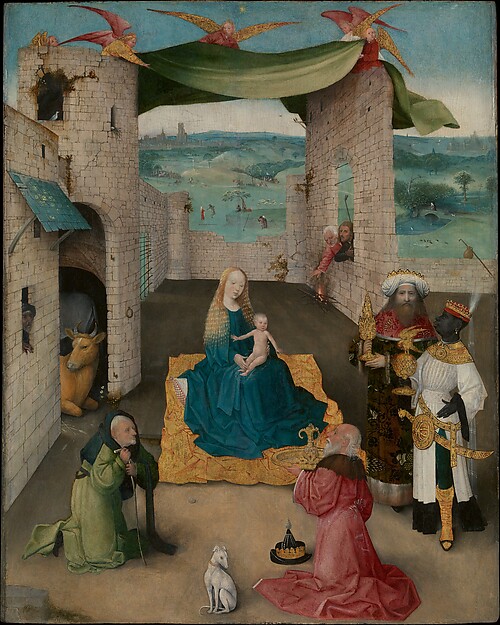
The Adoration of the Magi, painted in oil on oak panel by Hieronymus Bosch around 1470–1480 and now in the Metropolitan Museum of Art in New York, is among the small surviving group of Bosch panels that depict the Adoration as a single unified composition (rather than as part of a folding triptych). The Holy Family sits at the center of a small wooden lean-to; the three Magi stand in formal procession with their gifts; the ox and the ass occupy the back of the stable; and a small landscape with shepherds and a distant Bethlehem fades into a cool blue distance. The panel demonstrates the early Bosch combination of conventional Northern Renaissance Adoration iconography with the artist's characteristic taste for tiny intricate detail — the embroidery on the kings' cloaks, the small grotesque carvings on the corners of the stable — that would, in his later great triptychs, become the central organizing principle of his entire pictorial vocabulary.
met-435725
Christ's Descent into Hell, painted in oil on panel in the workshop of Hieronymus Bosch (or by a close follower) around the middle of the sixteenth century and now in the Metropolitan Museum of Art in New York, illustrates the apocryphal Harrowing of Hell — the tradition that Christ between his death on Friday and his Resurrection on Sunday descended into the underworld to free the souls of the just who had died before his Incarnation. The composition shows Christ stepping out of an open hellmouth at the lower right, his white winding sheet still draped across him, while Adam, Eve, and the patriarchs emerge from the mouth behind him; the rest of the panel is filled with the unmistakable Bosch hellscape — fantastic flaming architecture, monstrous hybrid creatures, demons with bird heads and metal weapons, and small tormented bodies scattered across every register. The panel is one of the principal Bosch-school works in any American collection.
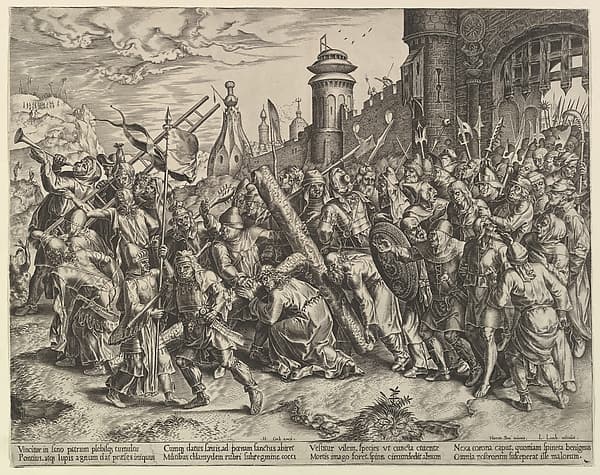
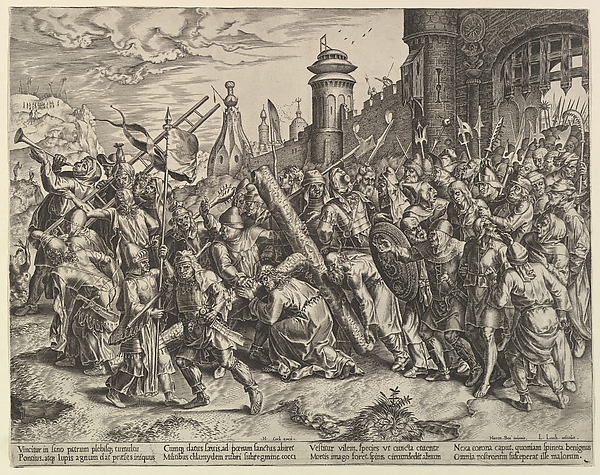
Christ on the Way to Calvary, painted in oil on panel by a follower or close imitator of Hieronymus Bosch around the middle of the sixteenth century and now in the Metropolitan Museum of Art in New York, depicts the Passion subject Bosch returned to repeatedly in his late career: the figure of Christ pressed into a tight crowd of grotesque tormentors as he carries his cross toward Golgotha. The faces around Christ are caricatures of human cruelty — long noses, twisted mouths, bared teeth, prominent warts — drawn from the late-medieval Northern tradition of physiognomic exaggeration that Bosch's signature workshop made into a particularly intense visual vocabulary. Christ at the center of the composition is the only calm and ungrimacing face in the panel; his serenity contrasts with the grotesquerie around him. The panel is among the principal Bosch-school treatments of the subject in any American collection.